
Agilex BUNKER MINI 2.0
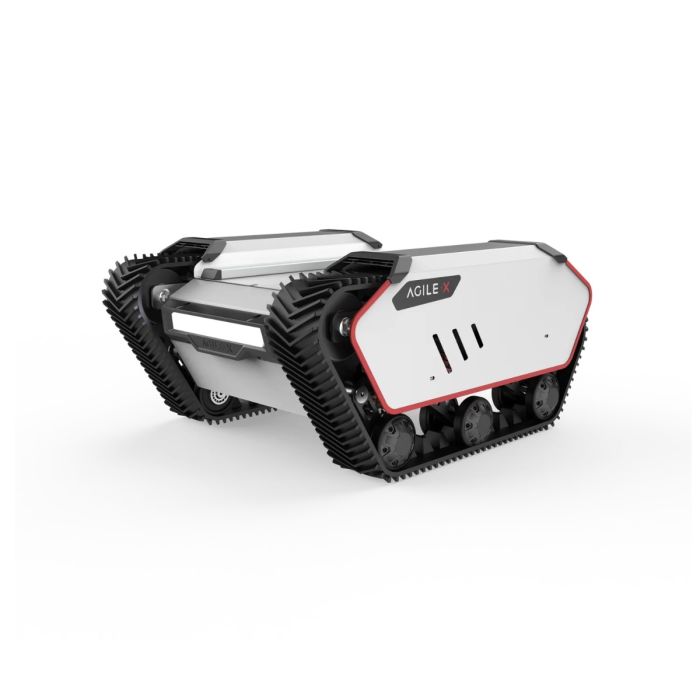
In stock
- BRAND:
- AGILEX
- PART #:
- BUNKER MINI
- ORIGIN:
- China
- AVAILABILITY:
- SUBJECT TO AVAILABILITY
- SKU:
- AgileX-BUNKER-MINI
Agilex BUNKER MINI 2.0
Picture a narrow service corridor beneath a processing plant: a raised cable tray at one end, a shallow step at the other, standing water in between, and an inspection payload that must cross all of it without a technician walking ahead. That is the gap the Agilex BUNKER MINI 2.0 is built to close. It is a compact tracked chassis that moves the payload so that the engineering team can concentrate on what the payload does: the sensing, the decision-making and the task itself.
Robots Middle East supplies the Agilex BUNKER MINI 2.0 to research institutions, integrators and industrial operators across the Middle East. Robots Middle East prepares each quotation, arranges delivery to the project site and remains the point of contact for technical support once the chassis is in service, so that a single partner accompanies the project from first enquiry to field deployment.
Background
AgileX and its family of development chassis
AgileX is known for mobile robot chassis designed as foundations for secondary development rather than as closed, finished machines. Its range spans wheeled and tracked platforms, robotic arms and complete development kits, and the wider portfolio can be explored in the AgileX category. The BUNKER name identifies the tracked branch of that family. The sources name three versions associated with this page: the original BUNKER MINI, the current BUNKER MINI 2.0, and a Bunker Mini 2.0 Pack + ROS 2 R&D Kit that bundles the chassis for development work.
Positioning: a sealed, open base for special robots
The BUNKER MINI 2.0 is an all-round tracked chassis vehicle for industrial applications. Its purpose is the development of special robots for inspection and exploration, EOD rescue, special shooting and special transport. Two characteristics define that positioning. The first is physical resilience: the chassis carries an IP67 protection level and an operating temperature range of -20 to ~60 °C. The second is openness: control runs over a CAN interface, the chassis works with sensors and peripherals that support the CAN protocol, and AgileX provides open-source SDK and ROS content. The result is a base that can be both sealed against its environment and open to the developer.
Technical Specifications
| Specification | Value |
|---|---|
| Product type | All-round tracked chassis vehicle for industrial applications |
| Dimensions | 660 x 584 x 340 mm |
| Weight | 55 kg |
| Track width | 100 mm |
| Maximum speed | 0~1 m/s |
| Climbing ability | 30° (no payload) |
| Obstacle surmounting capacity | 120 mm |
| Motor | 250 W x 2 (brushed DC motors) |
| Battery | 24 V 30 Ah lithium battery |
| Charge time | 3–4 hours |
| Operating temperature | -20 to ~60 °C |
| Protection level | IP67 |
| Communication interface | CAN |
| CAN standard | CAN2.0B standard, communication baud rate of 500K, message format of MOTOROLA |
| Remote control | FS remote control, fitted from the factory |
| Software | Open-source SDK and ROS content from AgileX |
| Maximum load capacity (BUNKER MINI user manual) | 25KG |
Specifications are as published by the manufacturer and are confirmed against the datasheet at quotation.
The manufacturer has not published the runtime or battery life on a single charge, the onboard sensors, the wireless connectivity or the suspension type; these points are confirmed at quotation.
What makes the BUNKER MINI 2.0 different from a wheeled development chassis?
A wheeled base is usually the quicker and more economical choice on smooth, level floors. Tracks earn their place where the ground stops cooperating: loose gravel, mud, sand, kerbs, cable runs and debris. A continuous track spreads the vehicle's weight over a longer contact patch, which helps it keep traction on soft or broken surfaces, and a tracked vehicle can steer by driving its two sides at different speeds, turning within its own footprint in a confined space.
The BUNKER MINI 2.0 applies that principle in a compact package. Its dimensions of 660 x 584 x 340 mm and a weight of 55 kg keep it manageable for a small team to transport and handle, while its 100 mm tracks, a climbing ability of 30° (no payload) and an obstacle surmounting capacity of 120 mm give it the reach to deal with ramps, steps and uneven ground. Two 250 W brushed DC motors drive the chassis at speeds of 0~1 m/s, a range suited to deliberate, controlled movement rather than haste, which is what most inspection and survey work requires.
Protection is the other point of difference. With an IP67 protection level and an operating temperature range of -20 to ~60 °C, the chassis is specified for outdoor and industrial settings in which dust, water and heat would test a less well-sealed laboratory base. For buyers in the Gulf and the wider region, where summer heat and fine dust are everyday conditions, that combination deserves careful attention when platforms are being compared.
How does the BUNKER MINI 2.0 integrate with sensors and software?
Integration begins with the CAN interface. The BUNKER MINI 2.0 adopts the CAN2.0B standard with a communication baud rate of 500K and the MOTOROLA message format, and it is compatible with sensors and peripherals that support the CAN protocol. For a development team, this means that the chassis can be commanded from an onboard computer using a documented, widely understood bus rather than a proprietary link.
On the software side, AgileX provides a comprehensive library of open-source content, comprising SDK and ROS resources, so that teams already working in the ROS ecosystem can bring the chassis into their existing navigation and perception stacks. For direct operation, testing and recovery, the chassis is equipped with an FS remote control from the factory. Mechanically, the BUNKER MINI offers aluminium T-slot rails for the secure mounting of external sensors or kits, giving integrators a practical way to fit cameras, LiDAR, compute units or tooling. Teams that prefer to start from a bundled development configuration may ask about the Bunker Mini 2.0 Pack + ROS 2 R&D Kit when requesting a quotation.
Who is the Agilex BUNKER MINI 2.0 for?
The first group is robotics integrators building special-purpose machines for clients in inspection, security and logistics. For them, the chassis removes the cost and delay of designing a sealed tracked drivetrain in-house, leaving engineering effort for the application layer.
The second group is universities and research laboratories. A ROS-compatible, CAN-controlled base with open-source SDK content suits field robotics courses, autonomy research and student competitions, particularly where experiments must leave the laboratory and operate outdoors.
The third group is industrial operators, including those in energy, utilities and infrastructure, who wish to develop inspection or exploration robots for sites that are confined, wet or rough underfoot. The IP67 protection level and the stated operating temperature range are directly relevant to such environments.
The fourth group is organisations working on EOD rescue, special shooting and special transport, the remaining application areas of this chassis. Projects that require other platform types, such as robotic arms or wheeled kits, will find the alternatives within the AgileX category, and Robots Middle East can advise on the most suitable combination.
What is the Agilex BUNKER MINI 2.0 used for?
- Inspection — carrying cameras and sensors along pipelines, tunnels, plant floors and other sites that are difficult to reach on foot.
- Exploration — surveying unknown or hazardous ground before people are sent in.
- EOD rescue — serving as the mobile base for explosive ordnance disposal and rescue robots.
- Special shooting — moving camera equipment across terrain on which conventional dollies and tripods cannot operate.
- Special transport — moving equipment and materials across rough or confined ground.
- Research and teaching — providing a ROS-compatible tracked platform for autonomy, navigation and field robotics studies.
Pricing and Availability
The Agilex BUNKER MINI 2.0 is supplied on quotation, so that the configuration, any accompanying kit and the project requirements can be specified correctly from the outset. Delivery, customs clearance and technical support are arranged together with the quotation from Robots Middle East. To begin, please share your intended application, operating environment and preferred configuration, and a quotation will be prepared for you; the enquiry form is available on this page.
Frequently Asked Questions
What kind of vehicle is the Agilex BUNKER MINI 2.0?
It is an all-round tracked chassis vehicle for industrial applications. It is intended as a base on which special robots are developed, not as a finished, single-purpose robot.
How is the BUNKER MINI 2.0 protected against dust and water?
The chassis carries an IP67 protection level. Its operating temperature range is -20 to ~60 °C.
Can the BUNKER MINI 2.0 be used with ROS?
Yes. AgileX provides open-source SDK and ROS content for the chassis, and control runs over a CAN interface using the CAN2.0B standard.
How is the chassis controlled before any autonomy is added?
The BUNKER MINI 2.0 is equipped with an FS remote control from the factory. This allows the chassis to be driven directly during testing and setup.
How are sensors and other equipment mounted?
The BUNKER MINI offers aluminium T-slot rails for the secure mounting of external sensors or kits. Sensors and peripherals that support the CAN protocol can be integrated with the chassis.
How long does the battery take to charge?
The 24 V 30 Ah lithium battery has a charge time of 3–4 hours. Runtime is addressed in the notes beneath the specification table above.
Where can I buy the Agilex BUNKER MINI 2.0 and what does it cost?
The Agilex BUNKER MINI 2.0 is available from Robots Middle East, which supplies it across the Middle East. The cost depends on the configuration and project requirements and is provided in a formal quotation upon request.
Summary
Every inspection, rescue or survey robot eventually faces the same corridor of standing water, steps and cable trays, and it must cross that ground before it can do anything useful. The Agilex BUNKER MINI 2.0 answers that challenge with a compact tracked chassis: sealed to IP67, specified from -20 to ~60 °C, able to surmount obstacles of 120 mm and controlled over an open CAN interface with SDK and ROS resources behind it. It leaves the application to the integrator and takes care of the ground. Robots Middle East quotes, delivers and supports it across the region, and for any team ready to build its next special robot, this page is the starting point.