
Apptronik APOLLO Humanoid Robot
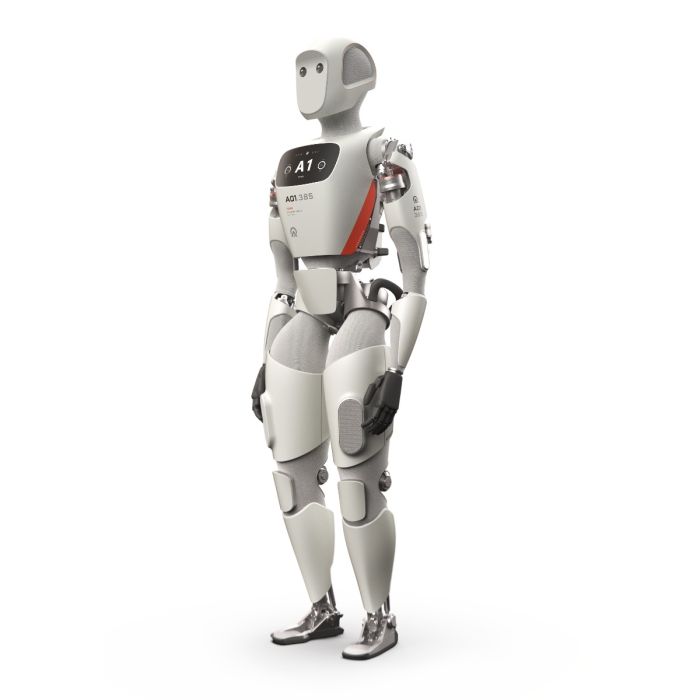
In stock
- BRAND:
- APPTRONIK
- MODEL:
- APOLLO
- AVAILABILITY:
- SUBJECT TO AVAILABILITY
- SKU:
- Apptronik-APOLLO
Apptronik APOLLO Humanoid Robot
Few machines carry as long an engineering pedigree onto a warehouse floor as the Apptronik APOLLO Humanoid Robot. Its ancestry runs through more than ten earlier robots, NASA's Valkyrie among them, yet its destination is far more ordinary: the loading bay, the production line and the shared workspace where people already do the lifting and carrying. That journey from research laboratory to working floor explains much of what sets Apollo apart. It is a robot of roughly human size, built to move safely near colleagues, to communicate with them plainly and to keep working through a quick battery exchange rather than leaving its post to recharge.
Robots Middle East supplies the Apptronik APOLLO Humanoid Robot to organisations throughout the Middle East, preparing quotations, coordinating delivery and arranging support for each project. Our team works with you from the first enquiry to establish which Apollo version and configuration suit the intended task, and to check the published specifications against the realities of your facility before any commitment is made.
Background
Apptronik and its lineage
Apollo grew out of Apptronik's experience and expertise in building over 10 previous robots, including NASA's Valkyrie humanoid. That background matters, because a humanoid is less a single invention than an accumulation of lessons in actuation, balance, control and safety, each learned on an earlier machine. Apptronik designed Apollo to transform the industrial workforce and beyond, and presents it as the first commercial humanoid robot designed for friendly interaction, mass manufacturability, performance and safety. Those four priorities run through every later decision, from how the robot behaves near people to how its components are intended to be produced in volume.
From force control to a modular second generation
The first Apollo, unveiled in 2023, was built around a unique force control architecture that maintains safe operation around people, in the manner of a collaborative robot rather than a traditional industrial robot. Apollo 2 carries that philosophy forward and broadens it. Its modular design gives teams the flexibility to choose the right mobility for the task, with bipedal and wheeled configurations. Underneath sits Apptronik's patented actuator platform, designed for 90%+ energy efficiency, simple maintainability, mass manufacturability and supply chain resiliency. On the software side, Apollo 2 works with Apptronik Artemis, which covers perception, planning, controls, safety and task execution, and with Fleet Connect, the operational layer that helps teams manage robots at scale. Apptronik's work with Google DeepMind and Gemini Robotics pairs frontier AI with this purpose-built hardware, aiming for machines that are more general, more interactive and better equipped to operate in the world around them.
Technical Specifications
| Specification | Apollo (2023 unveiling) | Apollo 2 | Alpha version (2023) |
|---|---|---|---|
| Height | 5 foot 8 inches | — | 1.7 m |
| Weight | 160 pounds | — | 73 kg |
| Lift capacity / payload | Ability to lift 55 pounds | — | Maximum payload of 25 kg |
| Batteries | Swappable, each with a four-hour runtime | Swappable; help enable 7x22 operation | — |
| Charging | — | Opportunity charging and tethering | — |
| Actuators | — | Patented actuator technology designed for 90%+ energy efficiency | — |
| Mobility | — | Modular: bipedal and wheeled configurations | — |
| Safety | Force control architecture for safe operation around people | Impact zone that pauses movement when an object is detected within its defined radius; configurable perimeter zone | — |
| Human interaction | Digital panels on the face and chest | Expressive LED mouth, coordinated lighting, speech and listening capabilities; chest display showing status, battery level, charging state and task progress | — |
| Software | — | Apptronik Artemis; Fleet Connect | — |
Specifications are given as published by the manufacturer and are confirmed against the datasheet at quotation.
The manufacturer has not published the degrees of freedom, walking speed, battery capacity, compute platform, sensor suite, connectivity, ingress protection rating or the contents of the box; all of these are confirmed at quotation.
What does Apollo 2 change compared with the original Apollo?
The 2023 Apollo established the essentials: a human-sized body, a force-controlled approach to safety, digital panels on the face and chest, and swappable batteries, each with a four-hour runtime, so that a unit could continue working after a simple battery change instead of standing idle on a plug-in charge. Apollo 2 keeps the swappable battery concept but frames it around continuity of operation: swappable packs help enable 7x22 operation, allowing teams to replace power packs quickly and keep the robot moving with minimal interruption. It then adds flexibility in how power is delivered, with opportunity charging and tethering available for different tasks, facilities and deployment needs.
The second notable change is choice of mobility. Where the original was presented as a humanoid on legs, Apollo 2 is modular, so a team can select a bipedal or a wheeled configuration according to the work. Interaction has also become richer: an expressive LED mouth, coordinated lighting, speech and listening make exchanges feel more natural, while the chest display shows status, battery level, charging state and task progress at a glance. Finally, Apollo 2 sits within a defined software environment, with Artemis handling the robot's perception, planning, controls, safety and task execution, and Fleet Connect managing robots across a site.
How does Apollo work safely alongside people?
Safety is designed into Apollo rather than added around it. The original Apollo's force control architecture allows it to operate near people much as a collaborative robot does, in contrast with a conventional industrial robot that typically requires physical separation from the workforce. Apollo 2 adds defined zones: its impact zone is designed to pause movement immediately when an object is detected within its defined radius, and its perimeter zone can be configured to suit the layout of a given site. Communication plays a part as well. A robot that shows its status, battery level and task progress on its chest, and that can speak and listen, is easier for colleagues to read and anticipate, which supports smoother cooperation on a shared floor. Every deployment still requires its own risk assessment, and Robots Middle East coordinates that discussion as part of the project.
Who is the Apptronik APOLLO Humanoid Robot for?
Apollo suits organisations whose facilities were laid out for people and who want automation that fits those spaces without wholesale redesign. Logistics and distribution operators exploring humanoid labour for repetitive handling will find the human-sized form and swappable batteries relevant. Manufacturers considering robots for work between stations, where people and machines share aisles, will look closely at the force control approach and the configurable safety zones. Innovation and research teams within larger enterprises, and system integrators building pilot programmes for clients, form a further group, particularly where interaction with staff is part of what they wish to study.
Where continuous operation is the priority, Apollo 2 is the more natural choice, since its swappable batteries help enable 7x22 operation and it supports opportunity charging and tethering. Buyers who need the robot to cross steps, uneven ground or varied terrain may prefer the bipedal configuration, and you can compare other legged machines in our Bipedal Humanoids category; sites with smooth, level floors may find a wheeled configuration better matched to the task. For a wider view of the market, the Humanoids category gathers the platforms we supply.
What is the Apptronik APOLLO Humanoid Robot used for?
- Material movement: carrying cases, totes and parts between points in warehouses and plants laid out for human workers.
- Line-side supply: bringing components to production stations so that skilled staff can remain at their tasks.
- Machine tending: loading and unloading equipment in cells where a human-shaped worker fits the existing layout.
- Shift continuity: sustaining repetitive handling across long operating periods through battery exchanges rather than charging breaks.
- Human-robot collaboration studies: evaluating how staff and a communicative humanoid share space, signals and workload.
- Pilot and fleet trials: testing humanoid automation at one site before scaling across several with fleet management software.
Pricing and Availability
The Apptronik APOLLO Humanoid Robot is supplied on quotation, because the right version, mobility configuration, charging arrangement and software scope depend on the work you intend it to do. Robots Middle East prepares each quotation after understanding your application, site conditions and timeline. Delivery, customs clearance and ongoing support are arranged together with the quotation, so that you receive a single, coherent proposal. To begin, please share your requirements through the quotation request available on this page.
Frequently Asked Questions
How tall is Apollo and how much can it lift?
The 2023 Apollo stands 5 foot 8 inches tall, weighs 160 pounds and can lift 55 pounds. The alpha version from the same year is listed at 1.7 m tall and 73 kg, with a maximum payload of 25 kg.
How long does Apollo run on a battery?
Each swappable battery on the 2023 Apollo has a four-hour runtime, and a battery change lets the robot carry on working. On Apollo 2, swappable batteries help enable 7x22 operation.
Can Apollo 2 work on wheels as well as legs?
Yes. Apollo 2 has a modular design with bipedal and wheeled configurations, so the mobility can be chosen to suit the task.
What software does Apollo 2 use?
Apollo 2 works with Apptronik Artemis for perception, planning, controls, safety and task execution, and with Fleet Connect for managing robots at scale.
How does Apollo communicate with the people around it?
The 2023 Apollo uses digital panels on its face and chest. Apollo 2 adds an expressive LED mouth, coordinated lighting, speech and listening, and a chest display showing status, battery level, charging state and task progress.
Is the ingress protection rating published?
No, the manufacturer has not published an ingress protection rating. Robots Middle East confirms it with the quotation, together with the other unpublished details.
Where can I buy the Apptronik APOLLO Humanoid Robot and what does it cost?
You can buy it from Robots Middle East, which supplies it across the Middle East. The cost depends on the version, configuration and project scope, so it is provided in a tailored quotation that you can request on this page.
Summary
The Apptronik APOLLO Humanoid Robot brings a lineage shaped by more than ten earlier robots, Valkyrie included, to the practical business of working beside people. The 2023 Apollo set out the foundations: a human-sized body, force-controlled safety, a communicative face and chest, and swappable batteries. Apollo 2 extends them with modular bipedal or wheeled mobility, highly efficient actuators, flexible charging, defined safety zones and a software stack for running robots at scale. For organisations in the region weighing whether that heritage can be put to work on their own floor, Robots Middle East is ready to help, and this page is the starting point.