
Astribot T1 Wheeled Humanoid Robot
In stock
- BRAND:
- ASTRIBOT
- MODEL:
- T1
- ORIGIN:
- China
- AVAILABILITY:
- SUBJECT TO AVAILABILITY
- SKU:
- Astribot-T1
Astribot T1 Wheeled Humanoid Robot
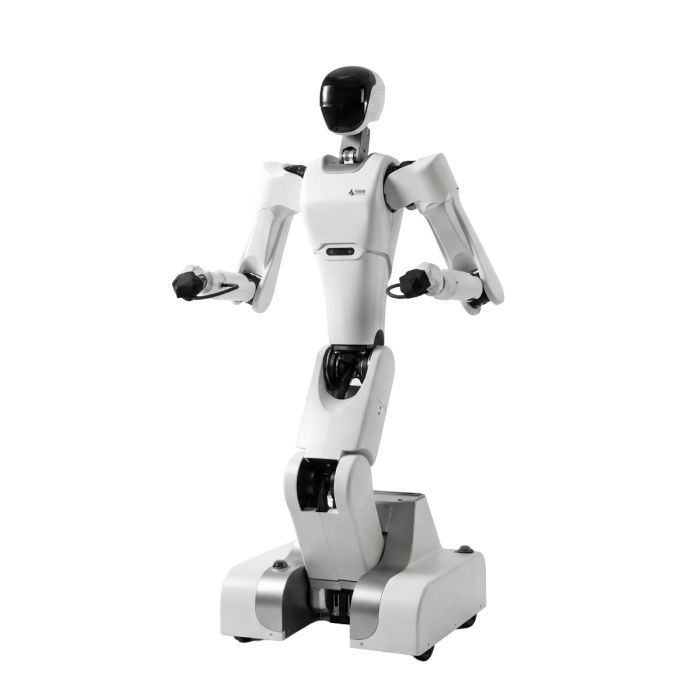
The first months with a new robot are often spent discovering what it will not let you touch: a closed controller, a fixed gripper, a motion library you can call but never open. The Astribot T1 Wheeled Humanoid Robot takes the opposite view. Its maker opens joint control, Cartesian motion, whole-body coordination and sensor data to developers through an SDK and API. The hands change from simple grippers to full five-fingered dexterous hands, and further computing modules and sensors can be added as a project grows. The result is a compact wheeled humanoid built for fine manipulation, designed to be shaped by the people who deploy it, whether at home, in a shop, in a laboratory or on an industrial site.
Robots Middle East supplies the Astribot T1 to universities, research centres, system integrators and businesses across the Middle East. Our team prepares each quotation around your intended application, advises on the choice of end effectors and add-on modules, and arranges delivery and after-sales support for installations throughout the region. Robots Middle East remains your point of contact from the first enquiry to commissioning and beyond.
Background
Stardust Intelligence and the Astribot brand
Astribot is the product brand of Stardust Intelligence, the company's formal name. Lai Jie founded the business in Shenzhen in December 2022, after stints at Tencent's Robotics X lab and Baidu. That background in large-scale research and software shapes the way the company presents its machines: as hardware and intelligence developed together rather than as a mechanical body with software added later. Shenzhen itself offers a dense supply chain for motors, electronics and precision parts, an environment in which young robotics companies can move quickly from prototype to product.
A humanoid built for the hands rather than the stage
The T1 is a wheeled humanoid built for fine manipulation. Instead of legs, it travels on a wheeled base, which places the engineering effort in the upper body, the arms and the hands. The robot is built around Astribot's cable-driven architecture, which is designed to support dexterous manipulation, compliant interaction and high-speed movement. On the intelligence side, the T1 is equipped with the Lumo-2 base model and has demonstrated autonomous tidying of miscellaneous items into a backpack, a task that combines decision-making with dexterous manipulation of deformable objects. VR-based teleoperation completes the picture, allowing an operator to guide the robot directly when a task calls for human judgement. The maker describes the T1 as compact, portable and easy to deploy, aimed at real-world use across home, commercial, research and industrial scenarios.
Technical Specifications
| Specification | Value |
|---|---|
| Product type | Wheeled humanoid robot built for fine manipulation |
| Height | 1.55 m |
| Weight | About 66 kg |
| Chassis size | 0.55 by 0.56 m |
| Degrees of freedom | 23 (excluding end effectors) |
| Degrees of freedom, hands | 16 |
| Single-arm payload | 5 kg |
| Max speed | 5 km/h |
| Runtime per charge | 4-6 hours |
| Charging time | Less than 1 hour |
| Charging and battery | Automatic charging; quick battery replacement |
| Connectivity | Ethernet, Wi‑Fi |
| Main structural material | Aluminium alloy frame with polymer covers |
| Drive architecture | Cable-driven |
| End effectors | Swap between simple grippers and full five-fingered dexterous hands |
| Modularity | Different end effectors, computing modules and sensors can be added for different tasks |
| Developer access | SDK and API: joint control, Cartesian motion, whole-body coordination, sensor data |
| AI model | Lumo-2 base model |
| Teleoperation | VR-based |
Specifications as published by the manufacturer; each figure is confirmed against the datasheet at quotation.
The manufacturer has not published the battery capacity, the IP rating, the onboard compute, the camera and sensor specifications, the package contents, the wheel base drive details, the operating system details or the operating noise level; these are confirmed at quotation.
What does the cable-driven architecture mean for the work the T1 does?
In robotics generally, a cable-driven design transmits force from the actuators to the joints through cables rather than placing a heavy motor and gearbox at every joint. Engineers pursue this approach because it can keep the moving limbs lighter and make the arm behave more gently when it meets resistance. Astribot states that its cable-driven architecture is designed to support dexterous manipulation, compliant interaction and high-speed movement, and those three goals map directly onto the jobs the T1 is intended for.
Dexterous manipulation matters because the robot carries hands with 16 degrees of freedom on top of the 23 degrees of freedom of the body. Compliant interaction matters because a robot working beside people, or handling soft and irregular objects, needs to yield rather than push. Speed matters because a manipulation platform that is precise but slow struggles to earn its place in a commercial setting. The Lumo-2 demonstration of packing miscellaneous items into a backpack illustrates the combination: soft, deformable objects, a goal that requires decisions about order and placement, and hands capable of carrying them out.
For a buyer, the practical point is that the hardware and the intelligence are presented as one system. The SDK and API give access to the same joint, Cartesian and whole-body capabilities that higher-level behaviours rely on, so a research group can work at the level of individual joints while an integrator builds task sequences on top of whole-body coordination.
How does the Astribot T1 keep working through a long day?
Endurance is often the quiet weakness of mobile manipulators. The T1 offers 4-6 hours of runtime per charge and a charging time of less than 1 hour. It supports automatic charging, so the robot can return to power without an operator plugging it in, and quick battery replacement, so a team that cannot afford downtime can exchange the battery and carry on. Together these features allow the long-duration operation and switching between scenarios that commercial and research users need.
Connectivity through Ethernet and Wi‑Fi supports both a fixed laboratory bench with a wired connection and a mobile deployment across a building. The aluminium alloy frame with polymer covers, about 66 kg of total weight and a chassis of 0.55 by 0.56 m give a footprint that fits doorways, aisles and workspaces designed for people.
Who is the Astribot T1 for?
The clearest fit is the research laboratory. Universities and institutes studying embodied AI, manipulation or human-robot interaction need a platform that exposes its internals, and the T1's SDK and API access to joint control, Cartesian motion, whole-body coordination and sensor data provides that. VR-based teleoperation also lends itself to collecting demonstration data for learning-based methods.
Developers and system integrators form the second group. The modular design, with interchangeable end effectors and the option to add computing modules and sensors, lets an integrator configure the robot for a specific client task rather than adapting the task to a fixed machine. Commercial operators exploring service roles, such as handling items in retail or hospitality environments, form a third group, attracted by a compact body that the maker describes as portable and easy to deploy. Industrial teams evaluating humanoid handling for light tasks, and innovation departments preparing pilots for home-assistance applications, complete the picture.
Buyers comparing different body formats can explore the wider Wheeled Humanoids range or the full Humanoids category, and Robots Middle East will gladly advise which platform suits a given project.
What is the Astribot T1 used for?
- Embodied AI research: a manipulation platform with open joint-level, Cartesian and whole-body control for experiments in learning and planning.
- Demonstration data collection: VR-based teleoperation allows operators to guide the robot and record task demonstrations.
- Household tidying and assistance: the Lumo-2 base model has demonstrated autonomous tidying of miscellaneous items into a backpack.
- Commercial service tasks: a compact wheeled body for handling goods in shops, hotels and other public-facing spaces.
- Light industrial handling: interchangeable grippers and dexterous hands for sorting, picking and packing in industrial scenarios.
- Application development and teaching: SDK and API access for developers, students and integrators building and testing new robot skills.
Pricing and Availability
Robots Middle East quotes the Astribot T1 on a project basis, so the offer reflects the end effectors, computing modules and sensors your application requires, together with any training or integration support you need. Delivery, customs clearance and after-sales support are arranged with your quotation. To receive a tailored offer for your organisation, please request a quotation using the enquiry options available on this page.
Frequently Asked Questions
Who manufactures the Astribot T1?
The T1 is made by Stardust Intelligence, the formal name of the company behind the Astribot product brand. The company was founded in Shenzhen in December 2022.
Does the Astribot T1 walk on legs?
No. The T1 is a wheeled humanoid, combining a humanoid upper body with a wheeled base. Its max speed is 5 km/h.
Can the hands be changed?
Yes. The hands swap between simple grippers and full five-fingered dexterous hands, and the modular design also accepts different computing modules and sensors for different tasks.
How much can each arm lift?
The T1 has a 5-kg single-arm payload. The body has 23 degrees of freedom excluding end effectors, and the hands have 16.
What software access do developers receive?
The T1 provides SDK and API access to joint control, Cartesian motion and whole-body coordination, as well as to sensor data. It is equipped with the Lumo-2 base model and supports VR-based teleoperation.
How long does the battery last?
Runtime is 4-6 hours per charge and charging takes less than 1 hour. The robot also supports automatic charging and quick battery replacement.
Where can I buy the Astribot T1 Wheeled Humanoid Robot and what does it cost?
Robots Middle East supplies the Astribot T1 across the Middle East. The cost depends on the configuration and services you require, so please request a quotation and our team will prepare an offer for your project.
Summary
Many robots arrive as finished answers to someone else's question. The Astribot T1 arrives as a platform to be shaped: a compact wheeled humanoid for fine manipulation, built on a cable-driven architecture, with hands that change from grippers to dexterous five-fingered hands, room for extra modules and sensors, and developer access that reaches down to individual joints. The Lumo-2 base model, VR-based teleoperation, 4-6 hours of runtime and charging in less than 1 hour turn that openness into a machine that can work as well as be studied. For laboratories, integrators and businesses across the region that want a humanoid they can adapt to their own tasks, with Robots Middle East handling quotation, delivery and support, this page is the starting point.