
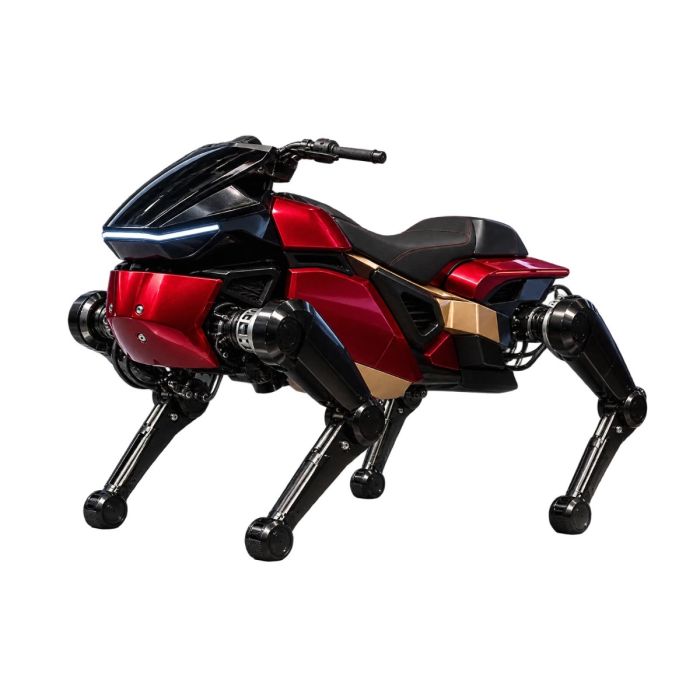
DaxAI Qiji X1 Cyber Horse Quadruped Robot
In stock
- BRAND:
- DAXAI
- MODEL:
- QIJI X1
- ORIGIN:
- China
- Warranty:
- 12 MONTHS
- AVAILABILITY:
- ALLOW 4-6 WEEKS FOR DELIVERY
- SKU:
- DaxAI-Qiji-X1
DaxAI Qiji X1 Cyber Horse Quadruped Robot
On a gravel track or across a muddy hollow, a wheel has only one way of dealing with the ground: it rolls or it stalls. A leg can choose where to land and how far to press, so the ground becomes a negotiation rather than an obstacle. That principle sits at the centre of the DaxAI Qiji X1 Cyber Horse Quadruped Robot, a rideable mount that has dispensed with wheels entirely in favour of four bionic legs. A rider takes the saddle, holds the handlebars at the front and lets an on-device world model decide how each limb meets slopes, loose stone and soft earth.
Robots Middle East supplies the Qiji X1 to customers across the Middle East, handling the quotation, the arrangements for delivery into the region and the support that follows. We work with leisure operators, venues, research groups and private buyers who want a legged machine that can be ridden rather than merely watched, and we prepare each quotation around the intended use and site.
Background
DaxAI Robotics and its founder
DaxAI Robotics emerged in Beijing around 2025 and was founded by Wang Kun, who had previously worked on robotics and autonomous driving technology. That lineage is visible in the Qiji X1: the machine carries its intelligence on board, interprets the terrain in front of it and adjusts its movement without a remote operator, much as an autonomous vehicle reads a road. The Qiji X1 All-Terrain Intelligent Mount drew crowds of visitors at the 2026 WAIC in Shanghai, where it was presented alongside its wheel-foot sibling, the Qiji XS.
A world model that walks
The key technology is DaxBrain-WM (Dualis), a world model that runs as local inference on the device itself. Combined with adaptive bionic gait and all-terrain dynamic self-balancing algorithms, it lets the Qiji X1 adjust the landing angle and depth of its limbs for steep slopes, gravel roads and muddy depressions. DaxAI positions the machine for premium off-road leisure, with the aim of turning artificial intelligence from lines of code on a screen into a real-world device that a person can actually ride. Beyond the gait itself, the Qiji X1 supports obstacle avoidance on multiple surfaces, body-form switching and voice interaction.
Technical Specifications
| Specification | Qiji X1 (point-foot) | Qiji XS (wheel-foot) |
|---|---|---|
| Structure | Pure quadruped bionic structure, without wheels | Integrated wheel-foot composite structure |
| Total weight | 300 kg | 320 kg |
| Top speed | 7 to 10 km/h | 40 km/h |
| Range | 40 km | 60 km |
| Maximum joint torque | 1,400 Nm | — |
| Dynamic load capacity | 300 kg | — |
| Battery | 165V high-voltage power battery pack | — |
| Continuous operating time | 8 to 10 hours | — |
| On-device AI | DaxBrain-WM (Dualis) world model, local inference | — |
| Charging and data | High-voltage fast charging and riding data monitoring as standard; OTA upgrades | High-voltage fast charging and riding data monitoring as standard; OTA upgrades |
Specifications are as published by the manufacturer and are confirmed against the datasheet at quotation.
The manufacturer has not published the dimensions, IP rating, charging time, battery capacity in Wh, maximum slope angle, sensors, contents of the box, rider weight limit or operating temperature range of the Qiji X1; these are confirmed at quotation.
What makes the Qiji X1 different from the wheel-foot Qiji XS?
DaxAI built two answers to the same question. The Qiji XS combines wheels and feet in an integrated composite structure, weighs 320 kg, reaches a top speed of 40 km/h and covers a range of 60 km. It is the machine for distance and pace where the ground allows wheels to do their work.
The Qiji X1 makes the opposite choice. It is a point-foot, pure quadruped with no wheels at all, weighing 300 kg and moving at 7 to 10 km/h over a range of 40 km. What it gives up in speed it returns in the way it meets the ground: every step is placed by the gait algorithms, with the landing angle and depth of each limb adjusted to the surface. A maximum joint torque of 1,400 Nm and a dynamic load capacity of 300 kg describe a machine built to carry weight through each stride rather than to cover ground quickly.
Both models share high-voltage fast charging and riding data monitoring as standard, and both receive OTA upgrades that update the gait library from the cloud and refine riding plans. The decision between them is therefore less about features than about terrain and tempo: walking pace over difficult ground, or road-going speed over easier ground.
How does the Qiji X1 handle rough ground?
The Qiji X1 is designed to navigate steep slopes, gravel and mud autonomously. Rather than following a fixed stepping pattern, the DaxBrain-WM world model works with the self-balancing algorithms to read the terrain and alter how each leg lands. On loose stone the limb can be set at a different angle; in a soft depression it can press to a different depth. Because inference runs locally on the machine, these decisions do not depend on a network connection.
Manoeuvrability matters as much as traction on uneven ground. The Qiji X1 coordinates its steps to walk straight, sidestep, back up and turn in place, which allows a rider to reposition the machine in confined spaces where a wheeled vehicle would need room to manoeuvre. Obstacle avoidance on multiple surfaces and body-form switching add to that flexibility, while voice interaction offers a further channel between rider and machine alongside the handlebars.
Who is the Qiji X1 for?
The first audience is premium off-road leisure: resorts, estates, adventure parks and experience operators who want to offer guests something that cannot be reproduced with a quad bike or a buggy. A legged mount that walks at a measured pace over rough ground suits guided rides where the experience itself is the point.
The second audience is venues and organisers of exhibitions, launches and public events. The attention the Qiji X1 attracted at WAIC in Shanghai shows how strongly a rideable quadruped draws visitors, and a machine that turns in place and sidesteps can be shown within a defined arena.
Universities, research laboratories and innovation centres form a third group, interested in on-device world models, bionic gait and human–robot interaction in a full-sized, rideable form. Collectors and private enthusiasts of advanced robotics complete the picture.
Buyers whose priority is speed and distance on firmer surfaces should look at the Qiji XS, whose wheel-foot structure offers a higher top speed and a longer range. Those who want a legged platform for carrying equipment or sensors rather than a rider may find a better fit among our Standard Quadrupeds.
What is the Qiji X1 used for?
- Premium off-road leisure — guided rides across slopes, gravel and muddy ground, the purpose for which DaxAI built the machine.
- Guest experiences at resorts and estates — a distinctive attraction for properties that want to offer something beyond conventional vehicles.
- Exhibitions and public events — a crowd-drawing centrepiece for technology shows, launches and visitor centres.
- Robotics research and teaching — a full-sized platform for studying on-device world models, adaptive gait and dynamic balance.
- Human–robot interaction studies — exploring how riders steer by handlebars and voice a machine that makes its own footing decisions.
- Brand and innovation showcases — a tangible demonstration of artificial intelligence for organisations presenting their technology ambitions.
Pricing and Availability
Robots Middle East supplies the Qiji X1 on a quotation basis, so that each offer reflects the configuration, the intended use and the destination. Delivery, customs clearance and after-sales support are arranged with the quotation. Our team will also discuss with you how the machine suits your site and the conditions in which it will operate before you commit. To begin, please submit your requirements through the quotation request available on this page.
Frequently Asked Questions
Does the Qiji X1 have wheels?
No. The Qiji X1 is a point-foot model with a pure quadruped bionic structure and no wheels. DaxAI's wheel-foot design is the separate Qiji XS.
How fast does the Qiji X1 travel?
The Qiji X1 has a top speed of 7 to 10 km/h, a walking-pace mount intended for difficult ground rather than for speed.
How long does it run before recharging?
The 165V high-voltage power battery pack gives a range of 40 km and a continuous operating time of 8 to 10 hours. High-voltage fast charging comes as standard.
How does the rider control it?
The rider sits on a saddle and steers with handlebars mounted at the front. The machine also supports voice interaction, while the DaxBrain-WM world model manages footing and balance.
Can the software be updated after delivery?
Yes. The Qiji X1 supports OTA continuous upgrades, which update the gait library from the cloud and optimise riding plans, and riding data monitoring comes as standard.
Can the Qiji X1 manoeuvre in tight spaces?
Yes. Coordinated by the DaxBrain-WM world model, it can walk straight, sidestep, back up and turn in place, which makes repositioning in confined areas straightforward.
Where can I buy the DaxAI Qiji X1 Cyber Horse Quadruped Robot and what does it cost?
You can buy it from Robots Middle East, which supplies it across the Middle East. The cost is provided in a quotation prepared for your requirements, which you can request on this page.
Summary
The DaxAI Qiji X1 Cyber Horse Quadruped Robot is built on the idea that a leg can negotiate ground that a wheel can only roll over. It trades the pace of its wheel-foot sibling for a pure quadruped structure, an on-device world model and gait algorithms that place each step to suit slopes, gravel and mud, all beneath a saddle and handlebars. With 1,400 Nm of maximum joint torque, a dynamic load capacity of 300 kg and 8 to 10 hours of continuous operation, it is a serious machine for premium off-road leisure, events and research. For buyers in the Middle East who want to ride that idea rather than read about it, this page is the starting point.