
Engineered Arts RoboThespian Humanoid Robot
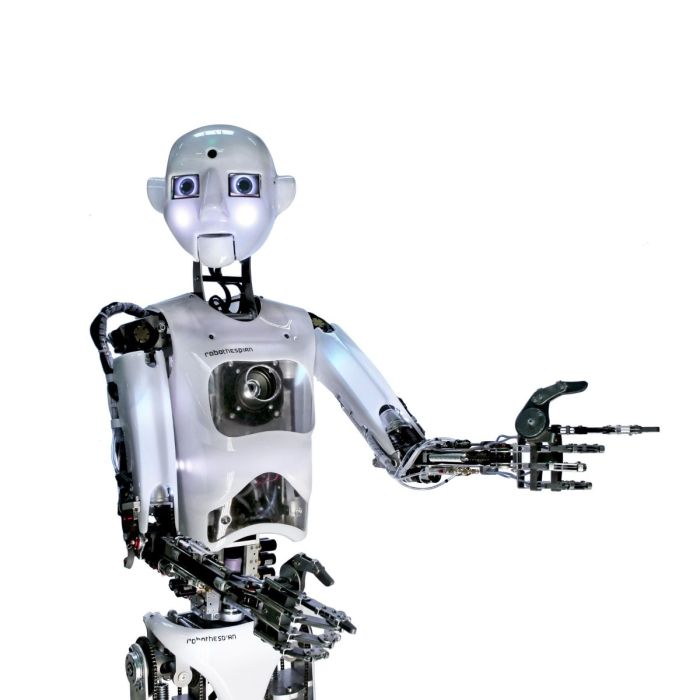
In stock
- BRAND:
- ENGINEERED ARTS
- MODEL:
- RoboThespian
- ORIGIN:
- United Kingdom
- AVAILABILITY:
- SUBJECT TO AVAILABILITY
- SKU:
- Engineered-Arts-RoboThespian
Engineered Arts RoboThespian Humanoid Robot
An actor needs a voice, a face and a sense of timing. A robot actor needs all three, and also a compressed-air line, a mains socket and a network cable running quietly behind the set. The Engineered Arts RoboThespian Humanoid Robot sits where theatre and engineering meet. Its gestures, its glance across a room and the movement of its jaw as it speaks are meant to read as performance. Each of them depends on a site that has been prepared for it. Buying one is therefore a question of two things: what you want the audience to feel, and what your building can supply.
Robots Middle East sells the Engineered Arts RoboThespian Humanoid Robot and supplies it to museums, universities, visitor attractions and corporate venues across the Middle East. Robots Middle East prepares each quotation for the configuration you need. It arranges delivery to your site and remains your point of contact for support once the robot is installed and performing.
Background
Engineered Arts and the idea of a robot performer
Engineered Arts was founded by Will Jackson in 2004. From the outset, RoboThespian has been the company's answer to a question most robotics firms do not ask: how should a machine behave in front of people who have come to be informed, entertained or persuaded? The result is an exhibit and research platform rather than an industrial tool. It is designed to hold attention in a public space and to give researchers a humanoid they can programme in full. The RT4 model carries that idea forward as a life-size, interactive, fully programmable humanoid robot exhibit suitable for public display, demonstration and academic research.
Expression first, and an operating system of its own
Expression is where RoboThespian concentrates its engineering. The RT4 has an actuated upper body, arms, fingers, head and jaw designed to mimic human expression and gestures. This is the vocabulary a presenter uses, not the vocabulary of a warehouse robot. Behind that movement, Engineered Arts runs its own operating system, called Tritium, instead of an off-the-shelf alternative. For a buyer, that choice means the software, the content tools and the robot's behaviour come from a single developer. Updates and new content features are delivered over the robot's network connection.
Technical Specifications
| Specification | Value |
|---|---|
| Product type (RT4) | Life size, interactive, fully programmable humanoid robot exhibit |
| Actuated parts (RT4) | Upper body, arms, fingers, head and jaw |
| Height | 1.75 metres (5 ft 9 in) |
| Weight | 33 kilograms (73 lb) |
| Head option: RoboThespian Hard Face | 2 LCD screens for the eyes; RGB LEDs in the cheeks; high speed servo synchronising mouth movements with speech |
| Fingers (RoboThespian Hard Face) | Independently opened and closed |
| Head option: RoboThespian Projected Face | Pico projector in the head projects the entire face |
| Option: RoboThespian Gripping Hands | Hands with adaptive grip for grasping objects |
| Option: RoboThespian Active Legs | Customer specific variant with a further axis of movement to bend at the knees |
| Mains power | Standard domestic mains power, 100v - 250v AC |
| Compressed air supply | Un-oiled, compressed air at 6bar (87psi), filtered to 10µm |
| Peak air consumption | 30L/min (7.9 US gpm) at 6bar (87psi) maximum |
| Airline connection | 8mm (5/16in) outside diameter Push-In-Fitting |
| Operating environment | Indoor use only; recommended room temperature 10°C - 30°C; relative humidity 45% - 60% |
| Network | Wired internet network connection with good bandwidth |
| Operating system | Tritium (Engineered Arts) |
Specifications are as published by the manufacturer and are confirmed against the datasheet at quotation.
The manufacturer has not published the dimensions of the base and console, the payload, the battery life or runtime, the power consumption, the contents of the box or the IP rating; Robots Middle East confirms each of these at quotation.
What is the difference between the Hard Face and the Projected Face?
The head is the first decision most buyers make, because it shapes how visitors read the robot's character. The RoboThespian Hard Face is a physical, sculpted face. Two LCD screens bring the eyes to life, and RGB LEDs, capable of any colour, light the cheeks. A high speed servo synchronises the mouth with speech, so the jaw moves as the robot talks. The effect is mechanical and deliberate: the audience sees a machine performing, and the craft of the movement is part of the appeal. The Hard Face configuration also has fingers that can be opened and closed independently, which suits pointing, counting and most everyday gestures.
The RoboThespian Projected Face takes a different route. A pico projector inside a different head design projects the entire face of the robot. Because the face is an image rather than a fixed shell, the expression is rendered rather than sculpted. That is a consideration for venues that want the face itself to change with the content. The choice is therefore about tone rather than a ranking. A science centre that wants visitors to see how the robot works may prefer the Hard Face. A brand experience that wants the face to carry the story may lean towards the Projected Face. Robots Middle East can set out both configurations side by side in the quotation.
What does a venue need to install RoboThespian?
Site preparation is the practical side of the purchase, and it deserves as much attention as the choice of face. RoboThespian runs on standard domestic mains power in the range 100v - 250v AC, which covers the supplies found across the region. It also requires un-oiled compressed air at 6bar (87psi), filtered to 10µm. The airline connects to the robot through an 8mm (5/16in) outside diameter Push-In-Fitting. Peak air consumption is 30L/min (7.9 US gpm) at 6bar (87psi) maximum, and average consumption is much lower. The air supply is something the venue's facilities team should plan alongside the electrical work, not as an afterthought.
The robot is suitable for indoor use only. The recommended room temperature is 10°C - 30°C and the recommended relative humidity is 45% - 60%. In a region where summer heat is a fact of life, a climate-controlled gallery or hall is part of the installation. A wired internet connection with good bandwidth is also needed. It carries TinMan Telepresence, remote administration and support, and the application of updates and new software and content features. Robots Middle East reviews these requirements with you before the quotation is finalised, so that power, air, climate and network are ready when the robot arrives.
Who is the Engineered Arts RoboThespian Humanoid Robot for?
The clearest fit is the public venue that wants a humanoid to meet visitors: museums, science centres, planetariums, cultural attractions and exhibition stands. For these buyers, the actuated upper body, expressive head and programmable content matter more than strength or mobility. Universities and research groups form a second segment. The RT4 is described as suitable for academic research, and its full programmability makes it a platform for work in human-robot interaction, communication and social robotics. Corporate visitor centres, innovation showrooms and hospitality venues make up a third group, using the robot as a presenter that welcomes guests and explains a story.
Within those segments, the options steer the choice. A venue that wants the robot to hand over or hold objects should look at the RoboThespian Gripping Hands, which offer adaptive grip. A project that needs a fuller body language, with the robot bending at the knees, can discuss the RoboThespian Active Legs, a customer specific variant. Buyers whose requirement is a robot that walks, or that carries loads, are better served elsewhere in our Humanoids range or in the Bipedal Humanoids category.
What is the Engineered Arts RoboThespian Humanoid Robot used for?
- Museum guide: presents galleries and collections to visitors in a voice and manner the curators script.
- Science centre exhibit: demonstrates how robots move and communicate, with the machine itself as the lesson.
- Academic research: serves as a fully programmable humanoid for studies of interaction, gesture and expression.
- Live performance: acts, recites or performs set pieces on a stage or in an auditorium.
- Corporate reception and showrooms: greets guests and delivers a brand or product story at a visitor centre.
- Telepresence: lets a remote operator speak through the robot using TinMan Telepresence over the network connection.
Pricing and Availability
Each RoboThespian is configured to the project, with a choice of face and optional hands or legs, so Robots Middle East prices it by quotation rather than from a fixed list. Tell us about your venue, your audience and the configuration you have in mind, and we will prepare a quotation that reflects it. Delivery, customs and support are arranged with the quotation. To begin, a quotation request for the Engineered Arts RoboThespian Humanoid Robot is available on this page.
Frequently Asked Questions
Can RoboThespian bend its legs?
The RT4 is built around an actuated upper body, arms, fingers, head and jaw. The RoboThespian Active Legs is a customer specific variant that adds a further axis of movement, enabling the robot to bend at the knees.
Can RoboThespian be installed outdoors?
No. It is suitable for indoor use only, with a recommended room temperature of 10°C - 30°C and relative humidity of 45% - 60%.
What operating system does RoboThespian use?
Engineered Arts uses its own operating system, called Tritium, rather than an off-the-shelf operating system.
Does RoboThespian need an internet connection?
Yes. A wired internet connection with good bandwidth is required for TinMan Telepresence, remote administration and support, and the application of updates and new software and content features.
Can RoboThespian pick up objects?
Grasping objects requires the RoboThespian Gripping Hands option, which offers hands with adaptive grip. In the Hard Face configuration, the fingers can be opened and closed independently for gestures such as pointing and counting.
What power and air supply does it need?
It runs on standard domestic mains power in the range 100v - 250v AC. It also needs un-oiled compressed air at 6bar (87psi), filtered to 10µm, delivered through an 8mm (5/16in) outside diameter Push-In-Fitting.
Where can I buy the Engineered Arts RoboThespian Humanoid Robot and what does it cost?
Robots Middle East supplies the Engineered Arts RoboThespian Humanoid Robot across the Middle East. The price depends on the configuration you choose, so we provide it in a tailored quotation that you can request on this page.
Summary
RoboThespian asks a buyer to think like a theatre producer. On the stage there is a life-size humanoid whose arms, fingers, head and jaw are built for expression, with a Hard Face or a Projected Face to set its character, and options for gripping hands or bending knees. In the wings there is the support it relies on: mains power, a filtered compressed-air line, a climate-controlled room and a wired network that carries telepresence, support and new content. Plan both together, and the robot does what Engineered Arts designed it to do, which is to hold an audience. For venues and research teams across the Middle East ready to plan that installation with Robots Middle East, this page is the starting point.