
Fourier MetaMotus Galileo Biomechanics Analysis and Rehabilitation Platform
In stock
- BRAND:
- FOURIER
- PART #:
- MetaMotus Galileo
- ORIGIN:
- China
- Warranty:
- 12 MONTHS
- AVAILABILITY:
- SUBJECT TO AVAILABILITY
- SKU:
- Fourier-MetaMotus-Galileo
Fourier MetaMotus Galileo Biomechanics Analysis and Rehabilitation Platform
Most therapy departments grow by accumulation. A treadmill arrives one year, a force plate the next, a motion capture suite when the research budget allows, and the patient spends the session moving between machines that rarely share what they record. The Fourier MetaMotus Galileo Biomechanics Analysis and Rehabilitation Platform starts from the opposite premise: measurement, training and immersion belong in one place, beneath and around one person, at the same moment. It joins virtual reality and robotics in a single biomechanics analysis and rehabilitation platform, so that what a therapist observes and what a patient practises are no longer separated by a corridor and a change of equipment.
Robots Middle East supplies the MetaMotus Galileo to hospitals, rehabilitation centres, universities and research institutes across the Middle East. Our team prepares each quotation around the intended clinical or research setting, coordinates delivery and installation planning, and remains your point of contact for support once the platform is in service. A system of this scope is configured rather than simply shipped, so we invite organisations to discuss their space, patient groups and research objectives with us at an early stage.
Background
Fourier and its rehabilitation lineage
Fourier is a Chinese robotics company headquartered in Shanghai. Its rehabilitation work covers devices for individual joints and limbs, lower-limb exoskeletons and connected rehabilitation software, which you can explore across the wider Fourier range. The MetaMotus Galileo was unveiled at RehabWeek 2023 and launched in November 2023, and it represents the most integrated point of that portfolio: rather than addressing one joint or one stage of recovery, it brings together technologies that rehabilitation providers have traditionally purchased, installed and operated as separate systems.
Virtual reality and robotics on one platform
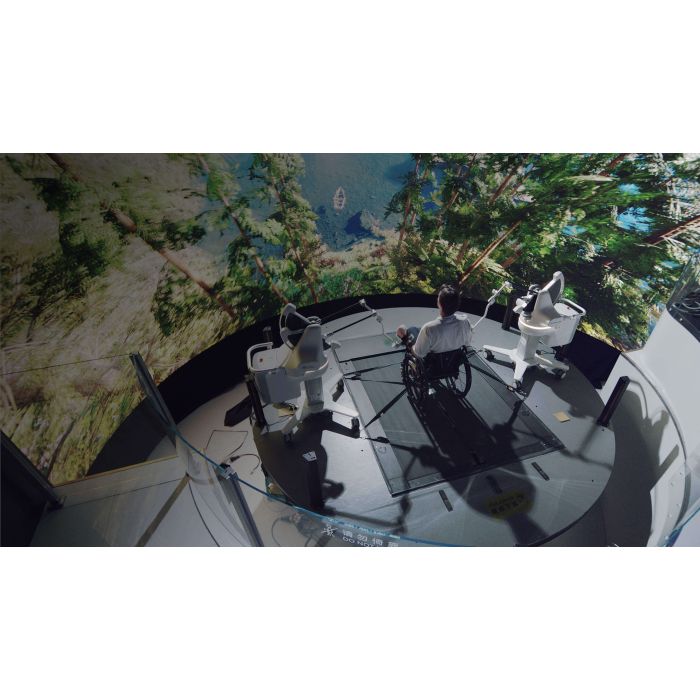
At the core of the Galileo sits a 6-DoF Stewart platform paired with a 6-component force plate, surrounded by an 8K UHD LED curved screen that places the patient inside immersive virtual landscapes. Around that core, the system integrates a dual-belt treadmill, dynamic weight support, a motion capture system, rehabilitation robotics, exercise therapy equipment and human-computer interaction software. The Galileo X processor ties these elements together, enabling real-time multimodal data analysis for research and protocol development, and extending the platform's use into areas such as exposure therapy for post-traumatic stress disorder (PTSD).
Technical Specifications
| Specification | Value |
|---|---|
| Product type | Biomechanics analysis and rehabilitation platform integrating virtual reality (VR) and robotics |
| Motion platform | 6-DoF Stewart platform |
| Force measurement | 6-component force plate |
| Display | 8K UHD LED curved screen |
| Treadmill | Dual-belt treadmill |
| Body weight support | Dynamic weight support |
| Movement tracking | Motion capture system |
| Further integrated elements | Rehabilitation robotics, exercise therapy equipment, human-computer interaction software |
| Processor | Galileo X processor with real-time multimodal data analysis |
| Training modes | Wheelchair, balance and walking training; multi-tasking and anti-interference training for advanced users |
| Supported users | Adults and children, including wheelchair users and people using prosthetic limbs |
| Launch | November 2023 (unveiled at RehabWeek 2023) |
| Manufacturer | Fourier, Shanghai |
Specifications are as published by the manufacturer and are confirmed against the datasheet at quotation.
Fourier has not published the dimensions, weight, power requirements, treadmill speed range, weight support capacity, force plate range and accuracy, motion capture system model, motion platform travel, software compatibility, delivery contents or certifications; each of these is confirmed at quotation.
What makes the MetaMotus Galileo different from a conventional gait laboratory?
A conventional gait laboratory is usually an assessment space. Patients walk a measured path, cameras and plates record what happens, and the findings are carried to a separate therapy area where training takes place on different equipment. The difficulty is not the quality of either activity but the gap between them: the conditions under which a movement is measured are seldom the conditions under which it is retrained.
The MetaMotus Galileo closes that gap by placing assessment and therapy on the same surface. The force plate and motion capture system observe the body while the dual-belt treadmill, the Stewart platform and the curved screen create the task. Dynamic weight support allows a patient who is not yet ready to carry full load to take part, and the motion platform can introduce the perturbations that everyday walking presents, from uneven ground to sudden shifts in balance. Because everything happens within one system, the therapist can adjust the challenge and see its effect in the same session.
The immersive display adds a dimension that a laboratory corridor cannot. Virtual environments allow the patient to practise in settings that resemble daily life, and multi-tasking and anti-interference training introduce the distractions and divided attention that real streets and workplaces demand. For more advanced users, this is where rehabilitation moves from controlled movement towards functional confidence.
What does the Galileo X processor add to clinical and research work?
Integrating many instruments is only useful if their signals can be read together. The Galileo X processor enables real-time multimodal data analysis, so that force, movement and task information can be interpreted as one picture rather than as separate files reconciled after the session. For therapists, this supports the comprehensive motor assessment for which the platform is designed: measuring and analysing the nuances of motor function in order to tailor treatment plans more effectively.
For research teams, the same capability supports protocol development, allowing new training or assessment approaches to be designed, run and examined within a controlled environment. The processor also extends the platform beyond physical rehabilitation into applications such as exposure therapy for PTSD, where the combination of an immersive scene and a responsive physical platform can be used in a structured way. A further, less conventional application is the training, testing and assessment of humanoid robots, for which the Galileo creates a diverse yet controlled environment serving both rehabilitation and research purposes.
Who is the Fourier MetaMotus Galileo for?
The platform is aimed first at rehabilitation hospitals and specialist centres that treat a broad range of functional impairments. Fourier positions it for evaluating and treating adults and children with neurological and musculoskeletal injuries, amputations, limb disabilities, cardiorespiratory dysfunction and degenerative diseases. Its inclusive design supports users who rely on wheelchairs as well as individuals using prosthetic limbs, and its training scope runs from the early stages of recovery to later, more demanding phases, which suits institutions that wish to follow a patient through the whole pathway on one system.
University departments and clinical research groups form a second audience. The real-time multimodal analysis of the Galileo X processor and the controlled, repeatable environment make the platform a candidate for biomechanics studies and for the development of new rehabilitation protocols. Mental health services exploring exposure therapy for PTSD, and robotics laboratories that need a controlled setting for humanoid robot testing, make up a smaller but distinct group.
Organisations whose needs centre on a single joint, a single limb or a specific stage of therapy may find a more focused device better suited to their space and caseload; our wider selection of Medical Robots is the place to compare those options, and Robots Middle East is glad to advise on which combination fits your service.
What is the Fourier MetaMotus Galileo used for?
- Gait rehabilitation — walking training on the dual-belt treadmill, with dynamic weight support for patients who cannot yet bear full load.
- Balance training — controlled challenges delivered through the 6-DoF Stewart platform and measured by the force plate.
- Wheelchair training — structured practice for wheelchair users within immersive virtual surroundings.
- Motor assessment — measuring and analysing motor function to inform and refine individual treatment plans.
- Exposure therapy — use of the immersive environment and the Galileo X processor in therapy for PTSD.
- Research and robotics testing — protocol development, multimodal data analysis and humanoid robot training and assessment.
Pricing and Availability
The MetaMotus Galileo is supplied on a quotation basis, because its configuration, installation requirements and supporting services depend on the facility it is destined for. Robots Middle East prepares each quotation after reviewing your intended use, available space and patient or research population. Delivery, customs clearance and after-sales support are arranged as part of the quotation. To begin the process, please use the quotation request available on this page.
Frequently Asked Questions
What does the MetaMotus Galileo combine in one system?
It integrates a 6-DoF Stewart platform, a 6-component force plate, an 8K UHD LED curved screen, a dual-belt treadmill, dynamic weight support, a motion capture system, rehabilitation robotics, exercise therapy equipment and human-computer interaction software.
Can wheelchair users and prosthesis users train on the platform?
Yes. The platform is designed to support users who rely on wheelchairs as well as individuals using prosthetic limbs, and wheelchair training is one of its training modes.
Is the platform suitable for children?
Fourier positions the system for evaluating and treating functional impairments in both adults and children.
What role does the Galileo X processor play?
The Galileo X processor enables real-time multimodal data analysis for research and protocol development. It also extends the platform's use into areas such as exposure therapy for PTSD.
Can the Galileo be used outside patient rehabilitation?
Yes. It supports humanoid robot training, testing and assessment by providing a diverse yet controlled environment for both rehabilitation and research.
What are the dimensions, weight and power requirements?
Fourier has not published these figures. Robots Middle East confirms them, together with site requirements, during the quotation process.
Where can I buy the Fourier MetaMotus Galileo and what does it cost?
You can obtain the MetaMotus Galileo through Robots Middle East, which supplies it across the Middle East. The cost depends on configuration and project scope, so it is provided in a tailored quotation on request.
Summary
Where many rehabilitation services have assembled their capabilities piece by piece, the Fourier MetaMotus Galileo gathers them into one platform: a moving floor, a measuring surface, an immersive screen and a processor that reads it all together. That consolidation lets assessment and therapy take place under the same conditions, supports patients from the early stages of recovery to advanced multi-tasking work, and opens the system to research, exposure therapy and humanoid robot testing. For hospitals, centres and laboratories in the region considering an integrated approach to rehabilitation with Robots Middle East, this page is the starting point.