
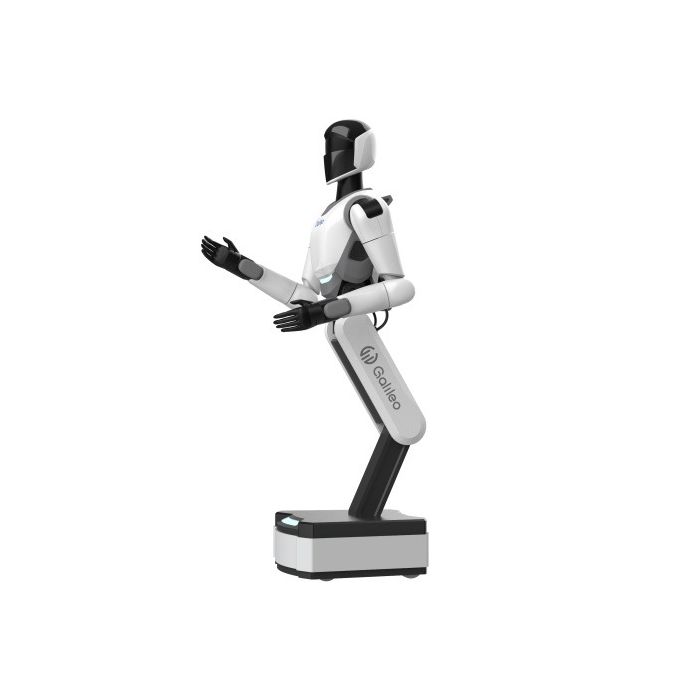
Galileo SH1 Dual Arm Wheeled Humanoid Robot
In stock
- BRAND:
- GALILEO
- MODEL:
- SH1
- ORIGIN:
- China
- Warranty:
- 12 MONTHS
- AVAILABILITY:
- SUBJECT TO AVAILABILITY
- SKU:
- GALILEO-SH1
Galileo SH1 Dual Arm Wheeled Humanoid Robot
Factories, substations, hospital corridors and restaurant floors were all designed around the same worker: someone of roughly human height, moving across a level floor and using both hands. The Galileo SH1 Dual Arm Wheeled Humanoid Robot works with that design rather than against it. It stands 1720mm tall in its standard pose, rolls on an omnidirectional chassis and has two arms that can each carry 5kg, so it fits the workspaces people already use without the site being rebuilt around it. The question it answers is not whether a robot can walk, but whether it can be useful as soon as it rolls through the door.
Robots Middle East supplies the Galileo SH1 to organisations across the Middle East, including utilities, manufacturers, logistics operators, healthcare providers, hospitality groups and research institutions. Robots Middle East prepares each quotation around the end-effector and configuration a project requires, and arranges delivery, commissioning guidance and after-sales support across the region.
Background
Galileo and its mobile robot range
Galileo builds mobile robots in several form factors, and the SH1 sits within a wider family offered through this store. That family includes legged and wheeled quadruped robot dogs, a full humanoid and dedicated sensing hardware. The SH1 is Galileo's answer to a specific brief: a machine that has the upper body of a humanoid but the stable, efficient base of a wheeled platform. Buyers comparing these form factors can browse the full Wheeled Humanoids category alongside it.
Sensing everywhere, thinking on board
Rather than relying on one sensor head, the SH1 spreads its perception across the whole body. A binocular camera in the head gives a stereo view of the scene. Each wrist carries a depth camera and a 6-axis force sensor, so the robot sees an object from close range and feels the forces when it grips or pushes. The torso adds four RGB cameras and two IMUs, and the chassis carries a 3D LiDAR, eight ultrasonic sensors and a further IMU for navigation and obstacle awareness. All of this is processed on board by an AGX Orin 64GB computing platform rated at 275TOPS, which leaves headroom for perception and planning workloads without depending on a remote server.
The robot can be driven by an operator through remote manual control or run fully autonomously, and the two modes can be switched freely according to conditions on site. A handheld remote controller is included in the specification, OTA upgrades are supported, and the platform is open to secondary development, which matters to integrators and research teams who intend to build their own applications on it.
Technical Specifications
| Specification | Value |
|---|---|
| Standard pose height | 1720mm |
| Body weight | 80kg |
| Endurance | Approx. 4h |
| Charging voltage | 100~240V |
| Total DOF | 24 total |
| Max single-arm payload | 5kg |
| End-effector options | 2-finger gripper / 3-finger dexterous hand (non-tactile) / 3-finger dexterous hand (tactile) / 5-finger dexterous hand |
| Chassis | Speed: 1.5m/s, rotation in place, omnidirectional movement |
| Head sensor | Binocular camera × 1 |
| Wrist sensors | Depth camera × 2, wrist 6-axis force sensor × 2 |
| Torso sensors | RGB camera × 4, IMU × 2 |
| Chassis sensors | 3D LiDAR, ultrasonic sensor × 8, IMU × 1 |
| Speaker | 8W |
| Microphone | Linear 4-microphone array |
| Communication | Ethernet, WiFi 6, Bluetooth 5.3 |
| Computing platform | AGX Orin 64GB 275TOPS |
| Protection rating | IP66 dustproof and waterproof |
| Operation modes | Remote manual control and fully autonomous intelligent operation |
| Handheld remote controller | Yes |
| OTA upgrade | Supported |
| Secondary development | Supported |
Specifications are as published by the manufacturer and are confirmed against the datasheet at quotation.
The manufacturer has not published the battery capacity, the overall dimensions, the arm reach, the package contents, the operating temperature range or the maximum repeat positioning accuracy of the arms; Robots Middle East confirms these at quotation.
What does a wheeled base change compared with a walking humanoid?
Legged humanoids attract attention because they move like people, but much of the work in a plant, a warehouse or a ward takes place on flat, finished floors where legs bring complexity without adding much benefit. The SH1 trades legs for an omnidirectional chassis that travels at 1.5m/s, rotates in place and moves in any direction. In practice this means it can line up beside a workbench, a shelf or an equipment cabinet, turn on the spot in a narrow aisle and hold a steady stance while its arms work.
That steadiness is what the upper body needs. With 24 degrees of freedom in total and a 5kg payload per arm, the SH1 is aimed at handling, inspection and service tasks rather than heavy lifting, and a stable base lets the wrist cameras and force sensors do precise work. The chassis also carries its own LiDAR, ultrasonic array and IMU, so navigation is handled at floor level while the torso and wrist sensors concentrate on the task. For sites with stairs or rough terrain, a legged platform may still be the better fit, and that is a conversation worth having before a configuration is fixed.
How does the Galileo SH1 cope with demanding sites?
The complete machine has passed industrial-grade protection testing and reaches an IP66 dustproof and waterproof rating. For the Middle East this is a practical point rather than a marketing one: dust, sand and wash-down cleaning are part of daily life at many industrial, utility and food-service sites. An IP66 enclosure allows the robot to be considered for environments where unprotected service robots would be kept away.
Endurance is approximately four hours, and the charger accepts 100~240V, so the robot can be charged from standard supplies across different markets. Connectivity through Ethernet, WiFi 6 and Bluetooth 5.3 lets it join site networks for supervision and data exchange, while the dual operating modes give site teams a fallback: if an autonomous routine meets an unexpected condition, an operator can take over with the handheld remote controller and then return the robot to autonomous work.
Who is the Galileo SH1 Dual Arm Wheeled Humanoid Robot for?
The first group is industrial operators: utilities, manufacturers and inspection contractors who want a robot that can patrol, observe and handle light objects at human working height, with a protection rating suited to harsh sites. The second is logistics and sorting teams looking at tasks where items must be picked, moved and placed rather than simply transported. The third is service organisations in healthcare, catering, entertainment and everyday life services, where a robot that can talk through its 8W speaker, listen through its linear 4-microphone array and use two hands has a role in front of people as well as behind the scenes.
The fourth group is universities, laboratories and system integrators. Support for secondary development, onboard AGX Orin computing and a rich sensor set make the SH1 a capable platform for embodied AI, manipulation and human–robot interaction research. Institutions building out a research fleet can also explore the wider Research Robots category. Where a project needs legged mobility rather than a wheeled base, Robots Middle East can advise on the other form factors in the Galileo range.
What is the Galileo SH1 Dual Arm Wheeled Humanoid Robot used for?
- State Grid and power utilities — patrols and inspection at substations and power facilities, where dust and weather resistance matter.
- Industrial inspection and manufacturing — checking equipment, reading instruments and handling light parts along production lines.
- Logistics sorting — picking, sorting and placing items in warehouses and distribution centres.
- Healthcare — carrying supplies and supporting routine tasks in clinical and care environments.
- Catering and entertainment — serving, greeting and interacting with guests in restaurants, venues and exhibitions.
- Life services — assisting with everyday service tasks in buildings, residences and public spaces.
Pricing and Availability
The Galileo SH1 is supplied on quotation, because the right end-effector, software scope and support package differ from one project to the next. Tell Robots Middle East about the task, the site and the number of units, and the team will return a quotation built around that configuration. Delivery, customs clearance and support are arranged together with the quotation. The quotation request form is available on this page.
Frequently Asked Questions
Which end-effectors can be fitted to the Galileo SH1?
The SH1 can be fitted with a 2-finger gripper, a 3-finger dexterous hand without tactile sensing, a 3-finger dexterous hand with tactile sensing or a 5-finger dexterous hand. The choice depends on the objects and tasks involved.
How much can each arm carry?
The maximum payload is 5kg per arm. This suits handling, inspection and service work rather than heavy lifting.
Can the robot work without an operator?
Yes. It supports fully autonomous intelligent operation as well as remote manual control, and the two modes can be switched freely to suit conditions on site.
Is the Galileo SH1 suitable for dusty or wet environments?
The complete machine reaches an IP66 dustproof and waterproof rating after industrial-grade protection testing. Conditions at your own site are reviewed with Robots Middle East before a configuration is fixed.
How long does it run on a charge?
Endurance is approximately four hours, and the charger accepts 100~240V, so the robot can be charged from standard supplies.
Can we develop our own applications for it?
Secondary development is supported, and the AGX Orin 64GB computing platform rated at 275TOPS runs workloads on board. OTA upgrades are also supported for keeping the system up to date.
Where can I buy the Galileo SH1 Dual Arm Wheeled Humanoid Robot and what does it cost?
Robots Middle East supplies the Galileo SH1 across the Middle East on quotation. The cost depends on the configuration, end-effector and support required, so please request a quotation from this page.
Summary
The Galileo SH1 Dual Arm Wheeled Humanoid Robot starts from a simple observation: most workplaces are already shaped for a human-sized worker with two hands on a level floor. By pairing a humanoid upper body with 24 degrees of freedom and two 5kg-payload arms with an omnidirectional wheeled chassis, sensing spread from head to wheels, onboard AGX Orin computing and an IP66 rating, it is built to fit into those spaces rather than demand new ones. For utilities, manufacturers, logistics operators, service providers and researchers in the Middle East who want to put such a robot to work, this page is the starting point.