
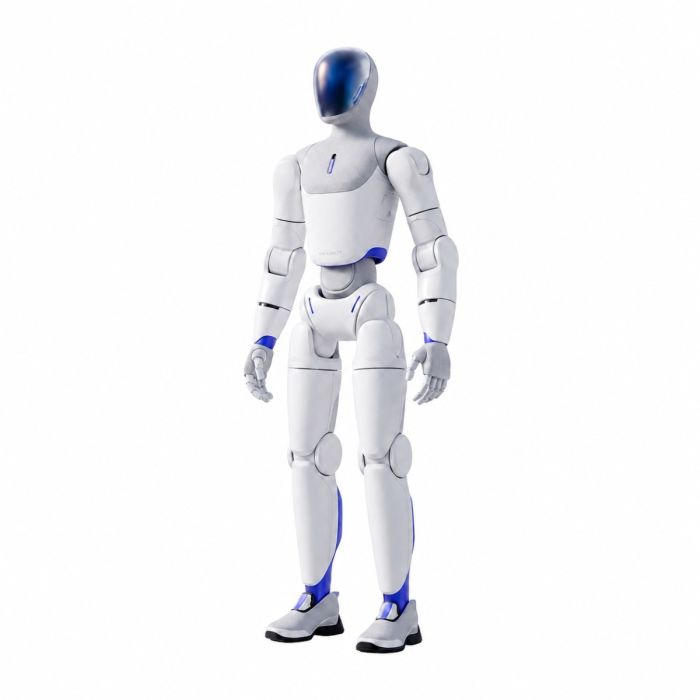
Galbot ET1 Galaxy Star Bipedal Humanoid Robot
In stock
- BRAND:
- GALBOT
- MODEL:
- ET1
- ORIGIN:
- China
- AVAILABILITY:
- SUBJECT TO AVAILABILITY
- SKU:
- Galbot-ET1
Galbot ET1 Galaxy Star Bipedal Humanoid Robot
Teaching a machine to walk is one of the hardest problems in robotics, and few companies attempt it within a couple of years of their founding. The Galbot ET1 Galaxy Star Bipedal Humanoid Robot is exactly that attempt: Galbot's first humanoid that moves fully on two legs rather than rolling on a wheeled base. Compact at 1,230 mm and 30 kg, finished in flexible exterior materials for safety and trained on 100,000 hours of human motion data, it marks the moment a young Beijing company stepped off the stable ground of wheeled platforms and into the far less forgiving discipline of legged balance.
Robots Middle East supplies the Galbot ET1 to universities, research institutes, technology integrators and corporate innovation teams across the Middle East. Robots Middle East prepares each quotation, coordinates delivery into the destination country and remains the point of contact for after-sales support, so that organisations in the region deal with a single accountable partner from the first enquiry through to commissioning and beyond.
Background
Galbot: a Beijing company with academic roots
Galbot is a Beijing company founded in 2023 by He Wang, a professor at Peking University. That academic origin shapes how the company approaches robotics: as a problem of embodied intelligence, in which a machine must perceive, decide and act in the physical world rather than simply repeat programmed motions. Galbot first became known for wheeled platforms such as the Galbot G1 Wheeled Humanoid Robot, which pair a humanoid upper body with a mobile base. Wheels offer stability and efficiency on prepared floors, and they allowed the company to concentrate on manipulation and intelligence before taking on the separate challenge of walking.
From wheels to legs, and a learned sense of movement
The ET1 is the step that follows. As Galbot's first fully walking, bipedal humanoid robot, it represents a deliberate shift away from the wheeled architecture of its earlier products. Two elements of its design stand out. First, its movement is grounded in learning: the robot was trained on 100,000 hours of human motion data, an approach that reflects the wider move in humanoid robotics towards data-driven control rather than hand-tuned gait routines. Second, Galbot did not build every component alone: the ET1 incorporates motor solutions from Unitree, a well-established name in legged robotics, combining Galbot's work on intelligence with proven actuation expertise. The exterior uses flexible materials for safety, a sensible choice for a machine intended to operate near people.
Technical Specifications
| Specification | Value |
|---|---|
| Manufacturer | GALBOT, Beijing (founded 2023) |
| Platform type | Bipedal humanoid robot, fully walking |
| Height | 1,230 mm |
| Weight | 30 kg |
| Training data | 100,000 hours of human motion data |
| Motors | Motor solutions from Unitree |
| Exterior | Flexible materials for safety |
| Versions named | Standard, Pro, Flagship |
Specifications are as published by the manufacturer and are confirmed against the datasheet at quotation. The manufacturer has not published the battery capacity, the runtime per charge, the walking speed, the payload, the IP rating, the connectivity, the power input, the contents of the box or the sensor details of the Pro and Flagship versions; Robots Middle East confirms these at quotation.
What changes when Galbot moves from wheels to legs?
A wheeled humanoid and a bipedal humanoid answer different questions. A wheeled base is inherently stable: the robot can stop, stand still and work with its arms without expending effort on balance. That is why wheeled designs suit structured settings such as shops, laboratories and warehouses with smooth, level floors. A bipedal robot must balance continuously, which makes control considerably harder, but in return it gains the ability to move through spaces designed around the human gait, where steps, thresholds and uneven surfaces are normal rather than exceptional.
For Galbot, the ET1 is therefore less a replacement for its wheeled machines than an extension of the company's reach. The intelligence developed on earlier platforms now meets a body that walks, and the decision to train on a large volume of human motion data indicates how Galbot intends to tackle the balance problem: by learning from how people move. The compact build of 1,230 mm and 30 kg also matters. A lighter, smaller humanoid is generally easier to handle, transport and test in a laboratory or demonstration space, and the flexible exterior adds a further consideration of safety when people share the space with the robot.
Buyers planning a deployment should therefore match the ET1 to settings where these qualities count most: spaces shaped around people, where a compact walking robot can be studied, tested and shown safely.
What do the Standard, Pro and Flagship versions mean for buyers?
The sources name three versions of the ET1: Standard, Pro and Flagship. They give no version-by-version breakdown, and the height and weight are not assigned to a specific version, so this page attributes no difference in capability to one version over another.
In practice, the right version depends on the work planned. A team focused on locomotion research may have different priorities from one building perception-heavy applications, and the sensor package is likely to be a deciding factor. Robots Middle East sets out the configuration of each version in the quotation, so that the choice can be made against the full details rather than assumptions.
Who is the Galbot ET1 for?
The ET1 is suited first to research groups working on bipedal locomotion and embodied artificial intelligence. Universities and institutes studying how learned motion translates into stable walking will find in it a platform built around exactly that idea. Its compact size makes it practical for laboratories where space is limited and where a full-scale humanoid would be cumbersome to operate safely.
Technology integrators and developers form a second group. Organisations building software for humanoid robots, or evaluating legged platforms for future service roles, can use the ET1 to explore what a walking robot can and cannot yet do in their environment. Corporate innovation teams, science centres and exhibition organisers make up a third group, for whom a walking humanoid with a flexible, safety-minded exterior is a compelling way to demonstrate the direction of robotics to visitors and stakeholders.
Buyers whose priority is stable manipulation on flat, prepared floors, for example in retail or laboratory automation, may find that a wheeled platform such as the Galbot G1 Wheeled Humanoid Robot or the Galbot S1 Heavy Duty Wheeled Humanoid Robot fits that brief more directly. Those comparing legged machines from several manufacturers can browse the wider range of Bipedal Humanoids or the full selection of Humanoids.
What is the Galbot ET1 used for?
- Bipedal locomotion research — studying balance, gait and recovery on a compact, fully walking humanoid platform.
- Embodied AI development — building and testing control approaches that learn from human motion rather than fixed routines.
- Human–robot interaction studies — observing how people respond to a walking humanoid with a flexible exterior in shared spaces.
- University teaching — giving students hands-on experience with a modern legged robot in robotics and AI programmes.
- Exhibitions and visitor engagement — presenting a walking humanoid at science centres, trade events and corporate showcases.
- Evaluation of legged service roles — assessing whether bipedal robots can work in human-designed environments before larger investment.
Pricing and Availability
Robots Middle East provides the Galbot ET1 on a quotation basis, tailored to the version and configuration your organisation requires. Delivery, customs clearance and support are arranged with the quotation. To begin, please submit an enquiry through the quotation request for the Galbot ET1 Galaxy Star Bipedal Humanoid Robot, available on this page.
Frequently Asked Questions
Who manufactures the Galbot ET1?
The ET1 is made by Galbot, a Beijing company founded in 2023 by Peking University professor He Wang. It is the company's first fully walking, bipedal humanoid robot.
How tall is the Galbot ET1 and how much does it weigh?
The ET1 is 1,230 mm tall and weighs 30 kg. Its compact build makes it practical for laboratories and demonstration spaces.
How does the ET1 learn to move?
The ET1 was trained on 100,000 hours of human motion data. This data-driven approach underpins how it develops its walking and movement.
Whose motors does the ET1 use?
The ET1 incorporates motor solutions from Unitree. Galbot combines this actuation with its own work on robot intelligence.
Is the ET1 designed with safety in mind?
Yes, its exterior uses flexible materials for safety. Requirements for your specific environment can be discussed with Robots Middle East before purchase.
Which versions of the ET1 are available?
The sources name three versions: Standard, Pro and Flagship. Robots Middle East sets out the configuration of each in the quotation.
Where can I buy the Galbot ET1 and what does it cost?
You can buy the Galbot ET1 from Robots Middle East, which supplies it across the Middle East. The cost depends on the version and configuration, and is set out in a quotation that you can request on this page.
Summary
The Galbot ET1 Galaxy Star Bipedal Humanoid Robot is the point at which a young company takes on robotics' most demanding physical problem. Built by a Beijing firm founded in 2023, it leaves the wheeled bases of Galbot's earlier machines behind and walks on two legs, combining a compact 1,230 mm, 30 kg frame, Unitree motor solutions, a flexible exterior for safety and movement trained on 100,000 hours of human motion data. For research groups, developers and innovation teams, it offers a practical way into legged embodied AI. Robots Middle East quotes, delivers and supports the ET1 across the region; for any organisation ready to explore what a walking humanoid can bring to its work, this page is the starting point.