
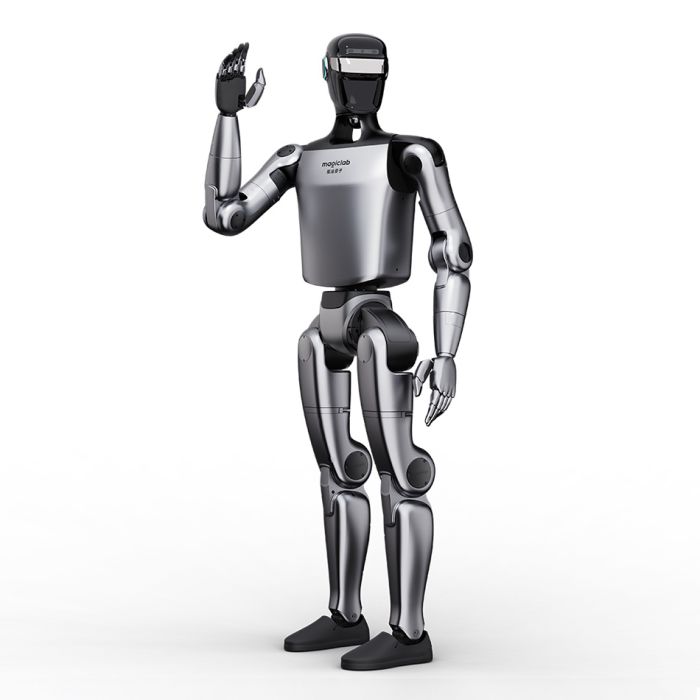
MagicLab MagicBot Z1 Development Edition Humanoid Robot
In stock
- BRAND:
- MAGICLAB
- MODEL:
- MAGICBOT Z1 DEVELOPMENT EDITION
- ORIGIN:
- China
- Warranty:
- 12 MONTHS
- AVAILABILITY:
- SUBJECT TO AVAILABILITY
- SKU:
- MagicLab-MagicBot-Z1-Dev
MagicLab MagicBot Z1 Development Edition Humanoid Robot
Algorithms that look flawless in simulation tend to meet their first honest critic on the day they are loaded onto a real body, with real joints, real friction and a floor that does not forgive rounding errors. The MagicLab MagicBot Z1 Development Edition Humanoid Robot is built to be that critic. It is a highly dynamic humanoid that supports walking, running and getting up after a fall, and it is configured to be expanded and reprogrammed by the people who study it. For research groups, universities and integrators, it offers a physical test bed on which work in locomotion, perception and interaction can be checked against reality rather than assumed.
Robots Middle East supplies the MagicBot Z1 Development Edition to universities, research institutes, technology centres and commercial organisations across the Middle East. Robots Middle East prepares each quotation to the configuration the customer requires, arranges delivery to the customer's site and remains the point of contact for technical support once the robot is in service.
Background
Magiclab Robotics Technology and its home in Wuxi
The Z1 is designed and manufactured by Magiclab Robotics Technology (Wuxi) Co., Ltd., a company based in Wuxi, in Jiangsu Province, China. Its catalogue covers several forms of mobile robot, from humanoids to quadruped robot dogs, which places the Z1 within a broader engineering programme focused on legged machines that move dynamically and interact with people. That breadth matters to a buyer: a manufacturer that works across several legged platforms tends to treat actuation, balance control and perception as shared disciplines rather than one-off efforts.
A development configuration within the Z1 family
The Z1 family comprises two versions: the MagicBot Z1 Standard Edition and the MagicBot Z1 Development Edition. MagicLab positions the Z1 as a highly dynamic humanoid for scientific research and education, exhibitions and exchanges, commercial performances and entertainment, and home companionship. The Development Edition is the configuration this page describes, and its defining character lies in what can be added and changed: a basic set of degrees of freedom that can be expanded, optional wrist joints, an optional dexterous hand, an optional high-computing-power module, and support for OTA updates and secondary development. Together these make the robot a platform to be built upon rather than a finished appliance.
Technical Specifications
| Specification | Value |
|---|---|
| Standing dimensions (H × W × T) | 1369 × 422 × 200 mm (136.9 × 42.2 × 20 cm) |
| Total weight | Approx. 40 kg+ (with battery) |
| Degrees of freedom | 24 basic DoF, expandable up to 50 DoF |
| Single-arm DoF | 5+ (optional addition of 2 wrist DoF) |
| Dexterous hand | Optional 11-DoF WeiKuan dexterous hand |
| Maximum joint torque | 130 N·m |
| Joint range of motion | Up to 320° (some joints); knee joint –152°, head Z-axis ±40° |
| Joint structure | Industrial-grade high-rigidity roller bearings |
| Battery | 10000 mAh (quick-release smart battery) |
| Sensor configuration | 3D LiDAR, depth camera, binocular fisheye camera |
| Computing module | 8-core high-performance CPU (basic), optional high-computing-power module |
| Audio | Voice commands, chatbot voice interaction |
| Motion capabilities | Humanoid walking, humanoid running, getting up after falling |
| Software / development | Supports OTA / secondary development |
| Manufacturer | Magiclab Robotics Technology (Wuxi) Co., Ltd., Wuxi, Jiangsu, China |
Specifications are as published by the manufacturer and are confirmed against the datasheet at quotation.
The manufacturer has not published the charging time, the IP rating, the maximum walking speed, or the charger rating and box contents of the Development Edition; Robots Middle East confirms these details at quotation.
How far can the MagicBot Z1 Development Edition be expanded?
Expansion is the central argument for this version. The robot starts from 24 basic degrees of freedom and can be expanded up to 50 DoF, which turns the question of configuration into a research decision rather than a fixed constraint. Each arm offers 5+ degrees of freedom, with the option of adding 2 wrist DoF, and the end of the arm can carry the optional 11-DoF WeiKuan dexterous hand. For a laboratory, this means the same body can serve a locomotion study one term and a manipulation study the next, with the upper limbs specified to match the experiment.
Computing follows the same logic. The basic configuration runs on an 8-core high-performance CPU, and an optional high-computing-power module is available for teams whose perception, planning or learning workloads demand more on board. Because the platform supports OTA updates and secondary development, software can evolve alongside the hardware, so a research programme is not tied to the behaviour the robot shipped with.
What does the Z1 Development Edition offer a research laboratory?
Three qualities stand out for experimental work. The first is a robust body. Joint torque reaches 130 N·m, enough to power dynamic walking and motion testing, and the joints use industrial-grade high-rigidity roller bearings that help them withstand the impacts that come with robot experiments. Some joints reach a range of motion of up to 320°, the knee travels to –152° and the head turns ±40° about its Z-axis, which gives controllers room to explore postures beyond a narrow walking gait.
The second is perception. A 3D LiDAR, a depth camera and a binocular fisheye camera give the robot complementary views of its surroundings, a combination well suited to mapping, obstacle awareness and research into visual navigation. The third is interaction: voice commands and chatbot voice interaction allow studies of how people speak with, instruct and respond to a humanoid. Add the quick-release 10000 mAh smart battery, which lets a team swap packs rather than pause a session, and the robot fits the rhythm of a working laboratory.
Who is the MagicBot Z1 Development Edition for?
Universities and research institutes are the most natural owners. Departments working on legged locomotion, whole-body control, reinforcement learning or embodied AI need hardware that can be modified, and the expandable degrees of freedom and secondary development support suit that need directly. Teaching programmes benefit as well: students can move from studying a humanoid to writing behaviour for one, on a body of a size that can be handled in a classroom or teaching laboratory.
System integrators and corporate innovation teams form a second group. They can prototype applications in reception, guidance or customer engagement, using the voice interaction and sensor suite as foundations for their own software. Organisers of exhibitions, science centres and commercial performances form a third, since MagicLab names exhibitions, entertainment and performances among the Z1's intended uses. Researchers exploring home companionship complete the picture.
Buyers who do not plan to undertake secondary development or hardware expansion may also wish to consider the MagicLab MagicBot Z1 Standard Edition Humanoid Robot, the other version in the family; Robots Middle East can advise on which of the two suits your project. Further platforms are listed in our Bipedal Humanoids and Research Robots categories.
What is the MagicBot Z1 Development Edition used for?
- Locomotion research — developing and testing controllers for humanoid walking, running and recovery after falls.
- Manipulation studies — exploring grasping and dexterity with the optional wrist joints and WeiKuan dexterous hand.
- Embodied AI development — running perception and learning workloads on board, with the optional high-computing-power module.
- Education and training — teaching robotics, control and programming on a humanoid that students can modify.
- Exhibitions and performances — presenting dynamic humanoid motion at events, showrooms and commercial shows.
- Human–robot interaction — studying spoken exchanges through voice commands and chatbot voice interaction.
Pricing and Availability
Robots Middle East supplies the MagicBot Z1 Development Edition on a quotation basis, so that the offer reflects the configuration you actually need: the number of degrees of freedom, wrist expansion, the dexterous hand and the computing module. Delivery, customs clearance and technical support are arranged together with your quotation. To begin, please share your intended application and preferred configuration through the quotation request available on this page.
Frequently Asked Questions
Can the number of degrees of freedom be increased?
Yes. The robot has 24 basic degrees of freedom and can be expanded up to 50 DoF, including optional wrist joints and the optional 11-DoF WeiKuan dexterous hand.
Does the robot support custom software?
Yes. The MagicBot Z1 Development Edition supports OTA updates and secondary development, allowing your team to build and deploy its own applications.
Which sensors does it carry?
The sensor configuration comprises a 3D LiDAR, a depth camera and a binocular fisheye camera.
What kind of battery does it use?
It uses a 10000 mAh quick-release smart battery, so a depleted pack can be exchanged quickly between sessions.
Can the robot recover after a fall?
Yes. Its motion capabilities include getting up after falling, alongside humanoid walking and running, and its joints use industrial-grade high-rigidity roller bearings to help withstand impacts during experiments.
Can it respond to spoken instructions?
Yes. The robot supports voice commands and chatbot voice interaction.
Where can I buy the MagicLab MagicBot Z1 Development Edition Humanoid Robot and what does it cost?
You can buy it from Robots Middle East, which supplies it across the Middle East. The cost depends on the configuration you choose, so please request a quotation and we will prepare an offer that includes delivery and support.
Summary
Every robotics team eventually has to leave simulation behind and face a body that answers back. The MagicBot Z1 Development Edition is designed for that moment: a highly dynamic humanoid with joints built to withstand experimental impacts, a perception suite combining LiDAR with depth and fisheye cameras, voice interaction, and a configuration that can grow from 24 basic degrees of freedom up to 50. Its support for secondary development keeps the software as open as the hardware. For laboratories, universities, integrators and exhibitors in the Middle East who want a humanoid they can question, change and learn from, this page is the starting point.