
MirrorMe Black Panther X Open Industrial-Grade Quadruped Robot
In stock
- BRAND:
- MIRRORME
- MODEL:
- BLACK PANTHER X
- ORIGIN:
- China
- Warranty:
- 12 MONTHS
- AVAILABILITY:
- SUBJECT TO AVAILABILITY
- SKU:
- MirrorMe-Black-Panther-X
MirrorMe Black Panther X Open Industrial-Grade Quadruped Robot
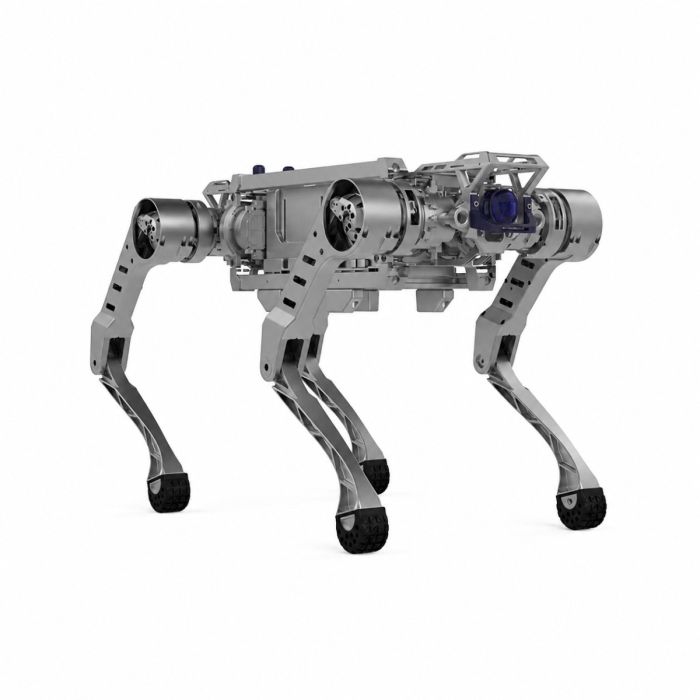
Here is a machine that weighs 7 kg and is rated to carry 8 kg, more than its own mass, at up to 4 m/s. Yet its most unusual quality does not appear on any load sheet. The MirrorMe Black Panther X Open Industrial-Grade Quadruped Robot gives its owner the interfaces, the shells and the code. The platform that carries your equipment is also one you are free to rebuild. For laboratories, developers and engineering teams, that pairing of working capability and openness changes what a legged robot can reasonably be asked to do.
Robots Middle East supplies the Black Panther X to universities, research centres, integrators and businesses across the Middle East. Our team prepares each quotation, arranges delivery to your site and provides support after the robot arrives. We can also discuss accessories and plug-in modules for your project.
Background
Mirror Me Technology and its approach to legged robots
Mirror Me Technology builds industrial-grade legged robots that prioritise precision, modularity and real-world capability. The company summarises its range under three ideas: precision, modularity and field-proven performance. Its catalogue spans several quadruped designs, a wheeled quadruped and a humanoid. Within that family, the Black Panther X carries the company's engineering into a format meant to be opened up rather than kept sealed. It does not set out to be a closed appliance with a fixed set of behaviours. It is a working machine that its owner is expected to modify, extend and program.
Openness as the defining technology
The manufacturer describes the Black Panther X as an open, industrial-grade quadruped that you can build, code and own. That openness has three layers. First, there is full access to the interfaces, so external hardware and software can communicate with the robot. Second, the shells are 3D-printable, so the body can be reshaped, repaired or adapted to carry particular equipment. Third, the code is accessible, which supports motion-control development: custom gaits, dance routines and experimental control. Alongside these sits OpenClaw, an AI assistant that the manufacturer presents as a teammate. OpenClaw helps the operator control, command and inspect both the robot and any external module devices connected to it.
Technical Specifications
| Specification | Value |
|---|---|
| Top speed | 4 m/s |
| Payload capacity | 8 kg |
| Stair height | 18 cm |
| Slope climb ability | 30° |
| Dimensions | 646 × 368 × 475 mm |
| Weight | 7 kg |
| Battery life | Up to 1.5 hours of operation |
| Operating voltage | 26 ~ 33.6 V |
| Charging method | Standard Charger (33.6V / 6A) |
| Operating temperature | 0 ~ 40°C |
| Number of joints | 12 |
| Peak joint torque | 33 N·m |
| Peak joint speed | 22 rad/s |
| Durability rating | IP43 (spray water + small particle protection) |
| Maneuvers | 720° side flip |
| Accessories | Supports FPV cameras, lights and plug-in modules |
| Shells | 3D-printable |
Specifications are as published by the manufacturer and are confirmed against the datasheet at quotation.
The manufacturer has not published the processor or onboard computer, the sensors included, the wireless connectivity, the battery capacity, the box contents, the assembly time or the languages supported by the software SDK; these are confirmed at quotation.
What does an open quadruped allow that a closed one does not?
A closed robot lets you use the behaviours its maker has chosen. An open one lets you decide those behaviours yourself. The Black Panther X gives access to its interfaces, shells and code, so the question moves from whether the robot can do a task to how your team will make it do that task. Gait research is the clearest example. The manufacturer names custom gaits and experimental control as intended uses. Researchers can therefore work directly on locomotion rather than treating it as a black box.
The 3D-printable shells matter in a different way. A mount for a camera, a housing for a sensor or a replacement panel after a hard fall can be designed and printed in-house. There is no need to wait for a bespoke part. Because the robot supports FPV cameras, lights and plug-in modules, the body and the payload can be developed together. OpenClaw extends the same idea to supervision: it helps operators command and inspect both the robot and the external modules attached to it. Hardware experiments can therefore be observed as they happen. Each of these layers works without the others, but together they make the robot a development environment as much as a machine.
How does the Black Panther X cope with real terrain?
Openness would be of limited value if the platform could not leave the bench. Here the published figures describe a capable field machine. The Black Panther X climbs stairs of 18 cm and slopes of 30°, reaches a top speed of 4 m/s and carries up to 8 kg. Its 12 joints deliver a peak torque of 33 N·m and a peak joint speed of 22 rad/s. That reserve of power also allows dynamic manoeuvres such as the 720° side flip.
The IP43 rating covers spray water and small particles. That suits dusty yards, light spray and the general grime of outdoor test sites. The published operating range of 0 ~ 40°C should be noted for projects in the region, where outdoor temperatures in summer can exceed that ceiling. Field trials are best planned for cooler hours or shaded and conditioned spaces. With up to 1.5 hours of operation per charge and a standard charger rated at 33.6V / 6A, the robot suits sessions of focused testing rather than continuous all-day patrols.
Who is the Black Panther X for?
University laboratories and research institutes form the most natural audience. Locomotion, control theory and embodied AI all benefit from a quadruped whose code can be changed and whose behaviour can be studied in depth. Such groups may also wish to browse our wider range of Research Robots.
Robotics developers and start-ups building their own applications will value the open interfaces and the support for plug-in modules. These let them prototype payloads and software on a legged base without designing one from scratch. Systems integrators exploring inspection or monitoring concepts can use the FPV camera and lighting support, with OpenClaw assisting in command and inspection. Universities and technical colleges that teach robotics will find the printable shells and accessible code useful for hands-on projects. Exhibition, entertainment and outreach teams can put the custom dance routines and dynamic manoeuvres to good use.
Buyers weighing the Black Panther X against other legged platforms can compare the MirrorMe line, including the MirrorMe BPX Pro Quadruped Robot, and our selection of Standard Quadrupeds. Robots Middle East will set out the differences in writing at quotation.
What is the Black Panther X used for?
- Locomotion research: developing and testing custom gaits and experimental control strategies on a real legged platform.
- Robotics education: teaching mechanics, control and programming with a robot whose shells and code students can change.
- Payload prototyping: mounting FPV cameras, lights and plug-in modules to trial new sensing or tooling concepts.
- Inspection trials: evaluating legged inspection workflows with OpenClaw helping to command and inspect the robot and its modules.
- Demonstrations and entertainment: choreographing dance routines and dynamic manoeuvres for exhibitions, events and outreach.
- Custom hardware development: designing and printing bespoke shells, mounts and housings for specific projects.
Pricing and Availability
Robots Middle East supplies the Black Panther X on a quotation basis. The final configuration, including accessories, plug-in modules and the unpublished details listed above, is agreed with each customer. Delivery, customs and support are arranged with the quotation. To begin, tell us about your application, your site and the modules you have in mind through the quotation request available on this page.
Frequently Asked Questions
How much can the Black Panther X carry?
The payload capacity is 8 kg, against a robot weight of 7 kg. Mounted cameras, lights and modules count towards that payload.
Can I modify the robot's body?
Yes. The shells are 3D-printable, so you can design and print your own panels, mounts and housings.
Can I program my own movements?
Yes. The code is open, and the manufacturer names custom gaits, dance routines and experimental control as intended uses.
How long does the battery last?
The robot offers up to 1.5 hours of operation. It charges with a standard charger rated at 33.6V / 6A.
Is the Black Panther X suitable for outdoor use?
It carries an IP43 rating for spray water and small particle protection, and it operates between 0 and 40°C. It climbs 18 cm stairs and 30° slopes.
What is OpenClaw?
OpenClaw is an AI assistant that acts as a teammate. It helps you control, command and inspect the robot and any external module devices connected to it.
Where can I buy the MirrorMe Black Panther X and what does it cost?
You can buy it from Robots Middle East, which supplies customers across the Middle East. The cost depends on the configuration and modules you choose and is set out in a written quotation.
Summary
The Black Panther X carries more than its own weight, moves at up to 4 m/s and climbs stairs and slopes like a field machine. Its real distinction is that none of this is locked away. Open interfaces, 3D-printable shells and accessible code let research groups, developers, educators and integrators turn a capable quadruped into their own platform, with OpenClaw at hand to command and inspect it. For teams across the Middle East that want a legged robot to build on rather than simply operate, this page is the starting point.