
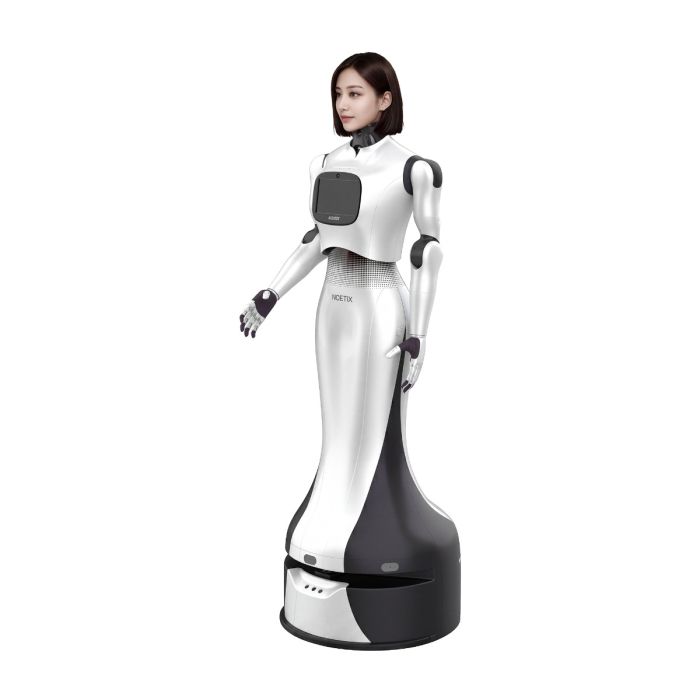
Noetix HOBBS W1 Wheeled Humanoid Bionic Robot
In stock
- BRAND:
- NOETIX
- MODEL:
- HOBBS W1
- PART #:
- HOBBS
- ORIGIN:
- China
- AVAILABILITY:
- SUBJECT TO AVAILABILITY
- SKU:
- Noetix-HOBBS
Noetix HOBBS W1 Wheeled Humanoid Bionic Robot
Wax figures have drawn crowds for centuries because they look alive yet cannot answer back. The Noetix HOBBS W1 Wheeled Humanoid Bionic Robot closes that gap from the other side. It has a face cast in platinum silicone and moved by motors beneath the skin. That face sits on a body that rolls through a building, listens, replies and reaches out with working hands. A kiosk asks visitors to read and tap. The Hobbs W1 meets their gaze, changes expression as the conversation turns and then leads them to the room they were looking for. It is a reception and guidance robot built on a simple premise: people respond to faces before they respond to menus.
Robots Middle East supplies the Noetix HOBBS W1 Wheeled Humanoid Bionic Robot to organisations across the Middle East, including corporate headquarters, exhibition venues, universities and healthcare facilities. Our team prepares your quotation, coordinates delivery to your site and remains your point of contact for support once the robot is in service. Before you commit, we help you clarify the specifications that matter for your deployment, so that the robot you receive suits the halls it will work in and the visitors it will serve.
Background
Noetix Robotics and its university roots
Noetix Robotics is a Beijing company founded by researchers from Tsinghua University and Zhejiang University. That academic lineage shows in how the company approaches humanoid robotics. It does not treat appearance and intelligence as separate problems. Instead, it brings mechanical design, perception and language models together in a single machine. The Hobbs W1 belongs to the company's wider humanoid portfolio, and you may compare it with similar machines in our Bionic Humanoids category.
A face engineered for conversation
The face is the defining technology of the Hobbs W1. Thirty-two motors move it to show smiles, anger, sadness and agreement. Lip sync keeps those movements in step with speech, so the mouth follows the words rather than moving on its own. The skin is made of platinum silicone that resists oil and ageing, and the hair feels like real human hair. Behind the face, a large AI model keeps track of context across a conversation. Speech recognition reaches about 98% accuracy, and the voice sounds smooth and natural. Businesses can also customise the face and swap it quickly, so a single robot can take on a branded persona or change character between events.
Technical Specifications
| Specification | Value |
|---|---|
| Product type | Lifelike wheeled humanoid with a hyper-realistic silicone face |
| Active degrees of freedom | 54, including 32 in the face |
| Facial expression | 32 motors; smiles, anger, sadness and agreement |
| Robotic arms | Five degrees of freedom |
| Dexterous hands | Six degrees of freedom |
| Skin | Platinum silicone, resistant to oil and ageing |
| Hair | Feels like real human hair |
| Conversation | Large AI model for context, with lip sync |
| Speech recognition | About 98% accuracy |
| Navigation sensors | LiDAR, ultrasonic sensors and depth cameras |
| Navigation accuracy | Centimetre-level, with obstacle avoidance |
| Autonomous navigation | Maps and moves through complex indoor environments |
| Runtime | About six hours under full load |
| Developer software | Android SDK, demos and documentation |
| Face customisation | Customisable and quickly swappable |
| Manufacturer | Noetix Robotics, Beijing |
Specifications are as published by the manufacturer and are confirmed against the datasheet at quotation. The manufacturer has not published the payload, IP rating, charging time, battery capacity, maximum speed or package contents; they are confirmed at quotation.
What makes the HOBBS W1 different from a screen-based reception robot?
A tablet on wheels can answer questions, but it seldom holds anyone's attention. Visitors glance at it, read what they need and walk on. The Hobbs W1 is designed for a different kind of encounter. Of its 54 active degrees of freedom, 32 are in the face. A large share of its engineering therefore goes into the signals people read without thinking: a smile when a guest arrives, a nod of agreement, a change of expression when a request cannot be met. Lip sync ties those signals to speech, so the robot looks like it is speaking rather than playing a recording.
The face is only half of the argument. Many machines with lifelike heads stay fixed to a counter or a plinth. The Hobbs W1 combines its expressive face with a wheeled base and LiDAR navigation, so the robot that greets a visitor can also escort them. Its five-degree-of-freedom arms and six-degree-of-freedom dexterous hands make possible a range of manipulation tasks that are uncommon among reception-focused robots. The swappable face adds a practical point: the robot's identity is not fixed at purchase. An organisation can present a persona that suits its brand and change it when the context changes.
Can the HOBBS W1 operate with minimal supervision?
The Hobbs W1 is built to support daily operations with minimal human supervision. It maps complex indoor environments and moves through them on its own. LiDAR, ultrasonic sensors and depth cameras guide it with centimetre-level accuracy and help it avoid obstacles, which matters in lobbies and corridors where people do not move in predictable lines. It runs for about six hours under full load, enough to cover a substantial part of a working day at a reception desk or an exhibition stand.
Every venue has its own routines, so Noetix offers an Android SDK, demos and documentation for developers. An in-house team or an integration partner can build applications around your visitor flow, your information sources and your languages of service. This makes the Hobbs W1 a platform you can adapt over time rather than a closed appliance.
Who is the Noetix HOBBS W1 for?
The Hobbs W1 is aimed first at organisations whose front door matters. Corporate headquarters and business centres can use it to receive guests and direct them, adding a memorable presence to the lobby. Hospitals and clinics can deploy it as a guide for visitors who need directions in large, busy buildings. Schools and universities can place it in halls and reception areas, and it also gives students in robotics and human–robot interaction a real platform to study.
Exhibition organisers, museums and brand experience teams form a second group. For them, the realistic face and customisable persona are the main attraction, because a robot that changes character between events fits a changing calendar. Developers and research groups form a third group: the Android SDK, demos and documentation give them a starting point for building their own applications on a highly expressive humanoid. If you are weighing the Hobbs W1 against other mobile platforms, our Wheeled Humanoids category shows the alternatives side by side.
What is the Noetix HOBBS W1 used for?
- Front-desk reception: greeting arriving guests with natural conversation and facial expressions that put them at ease.
- Wayfinding and escort: mapping the building and guiding visitors to their destination while avoiding obstacles along the way.
- Hospital visitor guidance: helping patients and families find departments and wards in complex healthcare buildings.
- Campus information point: answering questions from students and visitors in school and university halls.
- Exhibitions and brand ambassadors: presenting a customised face and persona that draws visitors to a stand or gallery.
- Interaction research and development: building and testing applications with the Android SDK, demos and documentation.
Pricing and Availability
The Noetix HOBBS W1 Wheeled Humanoid Bionic Robot is supplied by Robots Middle East on quotation. Each quotation reflects your venue, your intended use and any software or customisation you require. Delivery, customs clearance and after-sales support are arranged together with your quotation. Our team will also advise you on planning the deployment for your building and your visitors. To begin, a request for quotation for the Noetix HOBBS W1 Wheeled Humanoid Bionic Robot is available on this page.
Frequently Asked Questions
How many degrees of freedom does the HOBBS W1 have?
The Hobbs W1 has 54 active degrees of freedom, 32 of them in the face. Its robotic arms have five degrees of freedom and its dexterous hands have six.
How long does the HOBBS W1 run on a single charge?
It runs for about six hours under full load. That covers a substantial part of a working day at a reception desk or an exhibition stand.
How does the robot navigate indoors?
It uses LiDAR, ultrasonic sensors and depth cameras to map complex indoor environments and move through them. Its centimetre-level accuracy and obstacle avoidance allow it to operate with minimal supervision.
Can the face be customised?
Yes. Businesses can customise the face and swap it quickly, so the robot can present a branded persona or change character between events.
Can developers build applications for the HOBBS W1?
Noetix offers an Android SDK, demos and documentation for developers. These allow you to tailor the robot's behaviour to your own visitor flows and services.
How natural is the conversation?
A large AI model keeps track of context, and speech recognition reaches about 98% accuracy. The voice sounds smooth and natural, and lip sync keeps the mouth in step with what the robot says.
Where can I buy the Noetix HOBBS W1 Wheeled Humanoid Bionic Robot and what does it cost?
You can obtain the Noetix HOBBS W1 Wheeled Humanoid Bionic Robot from Robots Middle East, which supplies it across the Middle East. The cost depends on your configuration and deployment, so please request a quotation on this page.
Summary
The wax figure stays silent; the Hobbs W1 does not. Its silicone face is driven by thirty-two motors and paired with context-aware conversation and lip sync. LiDAR navigation lets it leave the counter, and its dexterous hands give it work to do beyond talking. Noetix Robotics, founded by Tsinghua and Zhejiang university researchers, has combined these elements into a reception and guidance robot for halls, offices, schools and hospitals. A swappable face and an Android SDK let each organisation make it its own. For organisations across the Middle East that want their first point of contact to feel personal, with Robots Middle East handling quotation, delivery and support, this page is the starting point.