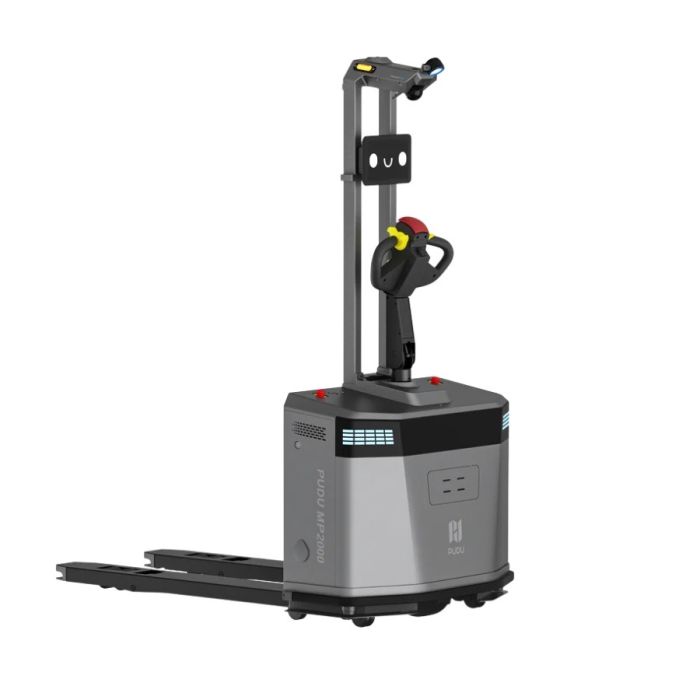
PUDU MP2000 AI-Native Pallet Handling Robot
In stock
- BRAND:
- PUDU ROBOTICS
- MODEL:
- MP2000
- ORIGIN:
- China
- Warranty:
- 12 MONTHS
- AVAILABILITY:
- SUBJECT TO AVAILABILITY
- SKU:
- PUDU-MP2000
PUDU MP2000 AI-Native Pallet Handling Robot
Ask a warehouse supervisor where the working hours disappear and the answer is rarely the long haul. It is the short shuttle: a pallet lifted at the dock, carried across the building, set down in a staging lane, and then the same again, trip after trip through the shift. Each run ties up a trained driver and a forklift that could be doing more demanding work elsewhere. The PUDU MP2000 AI-Native Pallet Handling Robot is aimed squarely at that repetitive middle distance. It collects pallets that people have put down by hand, carries loads of up to 2000 kg through aisles as narrow as 2 m, and accepts its next job from a voice command or a task button as readily as from a software interface, without the site having to be altered to suit it.
Robots Middle East supplies the PUDU MP2000 to warehouses, manufacturing plants and logistics operators across the Middle East, in both the Standard version (MPID01-M) and the Narrow Fork version (MPID01-N). Our team prepares each quotation around the client's pallets, floor layout and daily workflow, and Robots Middle East remains the single point of contact for delivery and for support once the robot is working on site.
Background
PUDU Robotics and its path into pallet logistics
PUDU Robotics built its reputation on service robots that share space with people, from delivery robots in restaurants and hotels to autonomous carriers for factory floors. That background matters for a pallet robot. A machine designed to move among diners and staff has to treat people as a normal part of its environment rather than as an interruption, and the MP2000 carries that thinking into the heavier world of pallet handling. Instead of a fenced cell or a dedicated lane, the expectation is a shared floor where operators, forklifts and the robot work alongside one another.
Multi-sensor navigation and edge intelligence
The MP2000 navigates using 3D LiDAR-SLAM and VSLAM, building its understanding of the facility from the structure it sees rather than from magnetic tape, reflectors or floor markers. Depth cameras, 3D LiDAR and other sensors form a multi-layer safety system that detects people, equipment and obstacles in real time. Decision-making sits on the robot itself: each unit plans its own routes, and a fleet continues operating in sync even when it is offline. Because of this combination of multi-sensor navigation and edge intelligence, the robot requires no site modifications, platform integration or complex deployment.
Technical Specifications
| Specification | Standard version (MPID01-M) | Narrow Fork (MPID01-N) |
|---|---|---|
| Model number | MPID01-M | MPID01-N |
| Overall dimensions | 1585 x 910 x 1870 mm (62.40 x 35.83 x 73.62 inches) | 1585 x 910 x 1870 mm (62.40 x 35.83 x 73.62 inches) |
| Max. load | 2000 kg (4409.25 lbs) | 2000 kg (4409.25 lbs) |
| Max. lift height | 200±5 mm (7.87±0.20 inches) | 200±5 mm (7.87±0.20 inches) |
| Lowered fork height | 80±5 mm (3.15±0.20 inches) | 80±5 mm (3.15±0.20 inches) |
| Fork outer width | 620 mm (24.41 inches) | 550 mm (21.65 inches) |
| Navigation method | 3D LiDAR-SLAM, VSLAM | 3D LiDAR-SLAM, VSLAM |
| Speed (unloaded / loaded) | Up to 1.6 m/s / 1.2 m/s | Up to 1.6 m/s / 1.2 m/s |
| Fork insertion time | 20 seconds | 20 seconds |
| Gradeability (full load / unloaded) | 3° / 8° | 3° / 8° |
| Thresholds and gaps | Thresholds up to 10 mm, gaps up to 35 mm | Thresholds up to 10 mm, gaps up to 35 mm |
| Narrow-aisle pickup | 90° pickup in aisles as narrow as 2 m, pallet spacing down to 15 cm | 90° pickup in aisles as narrow as 2 m, pallet spacing down to 15 cm |
| Pallet misalignment tolerance | Offset up to 15 cm, angle up to 15° | Offset up to 15 cm, angle up to 15° |
| Supported pallets | Standard three-runner and perimeter-base pallets; learns non-standard load carriers | Standard three-runner and perimeter-base pallets; learns non-standard load carriers |
| Charging time | About 2 h at 200V~240Vac; about 3.2 h at 100V~120Vac | About 2 h at 200V~240Vac; about 3.2 h at 100V~120Vac |
| Battery life | — | 12 h (no load); 6 h (max. load) |
Specifications are as published by the manufacturer and are confirmed against the datasheet at quotation.
The manufacturer has not published the robot's weight, battery capacity, IP rating, turning radius, safety certifications, wireless connectivity, noise level or the contents of the box, nor a battery life figure for the Standard version; all of these are confirmed at quotation.
How does the PUDU MP2000 cope with pallets that are not placed perfectly?
This is the question that separates a useful pallet robot from a demonstration piece. In a working facility, pallets are set down by people under time pressure, and they rarely land square to a line. The MP2000 adapts automatically to manually placed pallets offset by up to 15 cm and angled by up to 15°, so the operator who drops a load at the end of a lane does not have to come back and straighten it before the robot can collect it.
Pallet type is handled in the same spirit. The robot supports standard three-runner pallets and perimeter-base pallets, and it learns to recognise non-standard load carriers automatically for precise fork engagement and stable transport. Once a load is on the forks, the robot detects its dimensions and contours and calculates in real time the space it needs for safe passage, which matters when an overhanging load meets a doorway or a parked trolley. Thresholds up to 10 mm and gaps up to 35 mm are within its capability, covering the small steps and joints that appear at dock plates and between floor sections.
Where a task falls outside the routine, the MP2000 switches between autonomous and manual modes. It handles the repetitive work independently, while an operator can step in when a situation calls for human judgement, so the operation continues rather than stopping for a fault call.
What is the difference between the Standard and Narrow Fork versions?
The two versions share the same body, the same 2000 kg maximum load, the same lift and lowered fork heights, and the same navigation and safety systems. Where they differ is the forks: the Standard version (MPID01-M) has a fork outer width of 620 mm, while the Narrow Fork version (MPID01-N) has a fork outer width of 550 mm. The narrower spread is the one to consider where the pallets in circulation have tighter fork entries, and the choice should follow the pallets a facility actually uses rather than general preference. The Narrow Fork version is listed with a battery life of 12 h with no load and 6 h at maximum load.
Who is the PUDU MP2000 for?
The clearest fit is the operation where pallets travel short, repeated routes inside one building: distribution centres moving goods from inbound docks to staging, manufacturers feeding raw material to production and taking finished goods away, and third-party logistics providers whose layouts change with each client. For these buyers, the absence of site modifications is often the deciding factor, because tape, reflectors or fixed infrastructure would have to be revised every time the floor plan shifts.
Facilities with tight storage are a second group. Ninety-degree pickup in aisles as narrow as 2 m, with pallets spaced as closely as 15 cm, allows the robot to work in layouts that were planned around dense storage rather than around machinery. Multi-storey sites form a third group, since optional integration with elevator controls, automatic doors and other IoT devices allows pallet movements to extend beyond a single floor or zone.
Within these segments, the Narrow Fork version suits operations whose pallets need the 550 mm fork width, while the Standard version covers pallets matched to the 620 mm spread. Buyers comparing pallet automation with other forms of material transport can review the wider Factory Robots category, and those whose goods move in carts or containers rather than on pallets may find a closer match within our Industrial Robots range.
What is the PUDU MP2000 used for?
- Dock-to-staging transfer: collecting inbound pallets from receiving areas and carrying them to staging or storage lanes.
- Line-side supply: delivering palletised raw material and components to production lines on a repeating schedule.
- Finished-goods removal: clearing completed pallets from the end of a line to dispatch or warehousing.
- Dense-storage handling: picking up pallets at right angles in narrow aisles where space is at a premium.
- Multi-floor movement: moving pallets between levels through optional integration with elevator controls and automatic doors.
- Mixed-carrier transport: handling standard three-runner, perimeter-base and learned non-standard load carriers within one fleet.
Pricing and Availability
The PUDU MP2000 is supplied on a quotation basis, as the right configuration depends on your pallet types, the version required and the way tasks will be dispatched, whether through PUDU Link, APIs, voice commands or task buttons. Delivery, customs clearance and support are arranged together with the quotation, so the proposal you receive covers the full path from order to operation. To begin, share your floor layout, pallet types and expected volumes with Robots Middle East, and request a tailored quotation using the enquiry options available on this page.
Frequently Asked Questions
Does the PUDU MP2000 require changes to my facility?
No. The robot navigates with 3D LiDAR-SLAM and VSLAM and requires no site modifications, platform integration or complex deployment.
How much weight can the PUDU MP2000 carry?
Both versions carry a maximum load of 2000 kg (4409.25 lbs). Speeds reach up to 1.6 m/s unloaded and 1.2 m/s loaded.
Can it collect pallets that are slightly out of position?
Yes. It adapts automatically to manually placed pallets offset by up to 15 cm and angled by up to 15°, which reduces the need for operators to reposition loads.
Which pallet types does it support?
It supports standard three-runner pallets and perimeter-base pallets, and it learns to recognise non-standard load carriers automatically.
How does it keep people safe on a shared floor?
Depth cameras, 3D LiDAR and other sensors form a multi-layer safety system that detects people, equipment and obstacles in real time.
How long does charging take?
Charging takes about 2 h at an input voltage of 200V~240Vac, or about 3.2 h at 100V~120Vac.
Where can I buy the PUDU MP2000 and what does it cost?
Robots Middle East supplies the PUDU MP2000 across the Middle East on a quotation basis. The cost depends on the version, quantity and integration required, and we prepare a tailored quotation once we understand your operation.
Summary
The PUDU MP2000 AI-Native Pallet Handling Robot addresses the short, repetitive pallet trips that quietly consume driver time in warehouses and factories. It does so by fitting into the facility as it stands: it accepts imperfectly placed pallets, learns unfamiliar load carriers, manages small thresholds and gaps, works in narrow aisles and keeps operating as a synchronised fleet even offline. The Standard and Narrow Fork versions share one platform and differ in fork width, so the choice comes down to the pallets you handle each day. For any operation in the region ready to hand that middle distance to an autonomous machine, with Robots Middle East quoting, delivering and supporting it, this page is the starting point.