
Paxini GMH18 Robot Hand
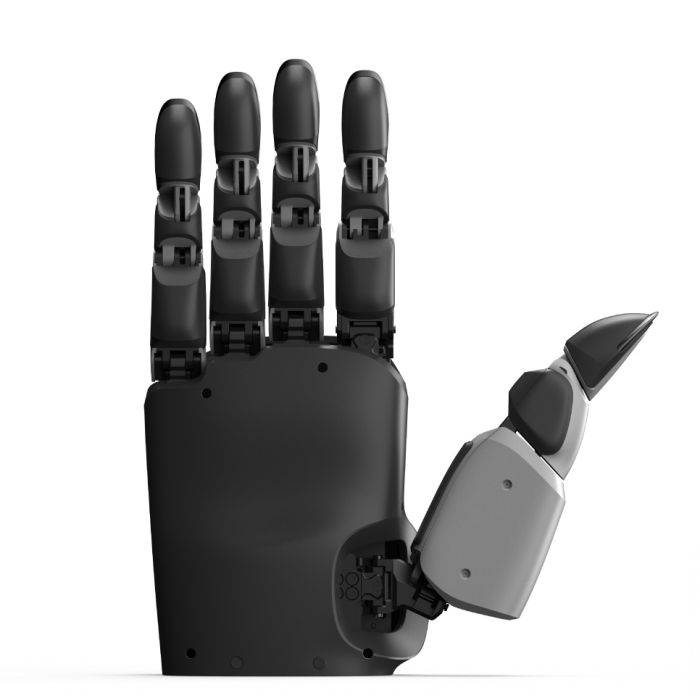
In stock
- BRAND:
- PAXINI
- PART #:
- GMH18
- ORIGIN:
- China
- AVAILABILITY:
- SUBJECT TO AVAILABILITY
- SKU:
- Paxini-GMH18
Paxini GMH18 Robot Hand
Many robot cells carry two end effectors: a sturdy gripper for heavy items and a gentler one for anything fragile, with a tool change and lost cycle time between them. The Paxini GMH18 Robot Hand makes the case for a single hand instead. It pairs an 18-DOF, human-like hand form with multi-dimensional tactile sensing and a 20 kg payload capacity, so the fingers that carry a substantial load also register pressure, force and slip as they work. For teams building humanoid, industrial, service or research robots, the question shifts from which gripper to fit to what this one hand should be taught to do.
Robots Middle East supplies the GMH18 to system integrators, manufacturers, universities and research laboratories across the Middle East. Our team prepares each quotation for the project in hand, confirms the configuration with you, including whether the optional palm or back-of-hand cameras are needed, and arranges delivery and after-sales support directly. Buyers in the region therefore deal with one accountable supplier, Robots Middle East, from the first enquiry to the moment the hand is running on their robot.
Background
PaXini and its tactile-first approach
The GMH18 is made by PaXini, also known as PaXini Tech, a robotics manufacturer based in China. Sensing sits at the centre of the company's work: its hands are defined first by what they can feel, and only then by how they move. That order of priorities shapes the GMH18, which is presented as a hand with adaptive, sensor-rich fingertips rather than as a mechanical gripper with a few sensors added later. The wider manufacturer range, including dexterous hands and tactile humanoid platforms, can be explored in the Paxini category.
For buyers, this lineage matters. A hand designed by a company that focuses on touch is likely to treat feedback as a primary function of the product, which is exactly what applications involving unfamiliar, irregular or delicate objects require. It also places the GMH18 within a family of products that share the same design thinking, which helps when a project grows from a single test cell into a larger programme.
Hollow-cup motor and multi-link drive
Inside the fingers, the GMH18 uses a hollow-cup motor combined with a multi-link drive. Hollow-cup, or coreless, motors are generally chosen in compact mechanisms because they suit small housings and respond quickly to control commands, while multi-link transmissions let a single actuator move a finger through a natural, curling motion. Together, this kind of arrangement is a common route to a hand that looks and moves like a human one without requiring a separate motor at every joint.
Paired with the tactile layer across the palm, fingertips and fingernails, the drive gives the hand both halves of a good grasp: the mechanism to close around an object and the sensing to judge how firmly it is held. The result is what PaXini describes as adaptive grasping, where the hand conforms to the item rather than the item having to suit the hand.
Technical Specifications
| Specification | Value |
|---|---|
| Product type | 18-DOF robotic hand with multi-dimensional tactile sensing |
| Degrees of freedom | 18-DOF |
| Payload capacity | 20 kg |
| Tactile sensing | Pressure, force and slip |
| Sensing coverage | Palm, fingertips and fingernails |
| Drive | Hollow-cup motor + multi-link drive |
| Design | Human-like hand form with adaptive, sensor-rich fingertips |
| Connectivity | Common industrial protocols |
| Expansion options | Modular; optional palm or back-of-hand cameras |
| Manufacturer | PaXini (PaXini Tech), China |
Specifications are as published by the manufacturer and are confirmed against the datasheet at quotation.
The manufacturer has not published the dimensions, exact weight, power supply voltage, communication interface model, fingertip force, operating temperature, IP rating, package contents, software or SDK support, or the number of tactile sensing units; these details are confirmed with the quotation.
Why does tactile sensing matter in a robot hand?
A robot that relies on vision alone knows where an object is, but not how it behaves once it is gripped. A carton may flex, a polished part may begin to slide, and a soft pouch may deform under pressure. Without touch, the controller must either squeeze hard enough for the worst case, risking damage, or grip lightly and risk a drop. Both choices limit what the robot can handle reliably.
The GMH18 addresses that gap by reading pressure, force and slip across the palm, the fingertips and even the fingernails. Slip detection is particularly valuable: it tells the control system that an object is starting to move, so grip can be corrected before the item falls. Coverage on the fingernails is less common in robot hands and helps with tasks where the edge of a finger does the work, such as lifting a thin item from a flat surface or separating stacked objects.
This richer feedback is what allows the GMH18 to pick up, hold and manipulate items that vary in shape, size or material. In practical terms, a single hand can move between objects that would otherwise need different tooling, and a research team gains data on contact and grip that a simple gripper cannot provide.
What sets the GMH18 apart from a conventional gripper?
Conventional parallel or vacuum grippers are excellent at one well-defined job. They are typically matched to a part, and when the part changes, the gripper changes with it. The GMH18 takes a different approach, offering a human-like form with 18 degrees of freedom so that it can adapt its grasp instead of being redesigned for each new item.
Its 20 kg payload capacity is the second distinguishing point. Dexterous hands are often associated with light, delicate work, while heavy handling is left to rigid tooling. The GMH18 is positioned to cover both: the same hand that adjusts its grip on a fragile object can also carry heavier items, which suits mixed workloads in logistics and assembly.
Integration is the third consideration. The hand connects through common industrial protocols, which helps it fit into existing control architectures, and its modular expansion options include palm or back-of-hand cameras. A camera mounted on the hand itself gives a close view of the object during the final approach, complementing the tactile data once contact is made.
Who is the Paxini GMH18 Robot Hand for?
The GMH18 is aimed at organisations whose robots must combine stability with human-level sensitivity. Humanoid robot developers form a natural audience, since a human-like hand is central to robots expected to work in spaces designed for people. Industrial integrators are another, particularly where a cell handles a changing mix of items and the cost of swapping tooling is high.
Service robotics teams will find value in a hand that can manage everyday objects of different materials without damaging them, and university and corporate research laboratories can use the tactile feedback to study grasping, manipulation and learning from touch. For projects where the combination of payload capacity and full tactile coverage is the priority, the GMH18 is the PaXini hand to evaluate first.
Buyers comparing options within the same range may also wish to review the Paxini DexH13 Dexterous Robot Hand and the Paxini Dexh5. Robots Middle East can set out the published specifications of each side by side with the quotation, so that the choice rests on your application rather than on assumptions.
What is the Paxini GMH18 Robot Hand used for?
- Logistics picking: handling parcels and goods that vary in shape, size and material within a single workflow.
- Assembly: holding and positioning parts where grip stability and controlled force both matter.
- Humanoid robots: giving humanoid platforms a human-like hand able to work with everyday objects.
- Service robotics: managing household or commercial items gently, with slip detection to prevent drops.
- Tactile research: collecting pressure, force and slip data for studies in grasping and manipulation.
- Mixed-load handling: combining delicate tasks and heavier object handling on one end effector.
Pricing and Availability
The GMH18 is supplied on quotation, prepared for your configuration and project requirements, including any optional cameras and integration needs. Delivery, customs clearance and technical support are arranged together with the quotation. To begin, please send us details of your robot platform and intended application, and our team will respond with a tailored offer; the quotation request is available on this page.
Frequently Asked Questions
How many degrees of freedom does the GMH18 have?
The GMH18 is an 18-DOF robotic hand. This gives it a human-like range of movement for adaptive grasping.
What payload can the GMH18 handle?
The hand has a payload capacity of 20 kg, which supports heavier object handling alongside delicate tasks.
What does the hand sense?
It senses pressure, force and slip across the palm, the fingertips and the fingernails. This feedback helps robots adjust their grip and interact more naturally with objects.
Can cameras be added to the hand?
Yes. The GMH18 offers modular expansion options, including optional palm or back-of-hand cameras, which can be specified in your quotation.
How does the GMH18 connect to a robot controller?
The hand connects via common industrial protocols. The specific interface model has not been published and is confirmed at quotation.
What drive system does the GMH18 use?
It uses a hollow-cup motor combined with a multi-link drive, which moves the fingers in a natural, human-like way.
Where can I buy the Paxini GMH18 Robot Hand and what does it cost?
You can buy the GMH18 from Robots Middle East, which supplies it across the Middle East. Pricing depends on configuration and project scope, so please request a quotation and our team will prepare an offer for you.
Summary
The case for the GMH18 is the case for fewer compromises at the end of the robot arm. Instead of one gripper for weight and another for care, it brings an 18-DOF human-like hand, a 20 kg payload capacity and tactile sensing for pressure, force and slip across the palm, fingertips and fingernails into one end effector. A hollow-cup motor with multi-link drive, connection through common industrial protocols and optional palm or back-of-hand cameras complete a hand designed for industrial, service, humanoid and research robots alike. For organisations in the Middle East ready to give their robots a sense of touch, with Robots Middle East handling quotation, delivery and support, this page is the starting point.