
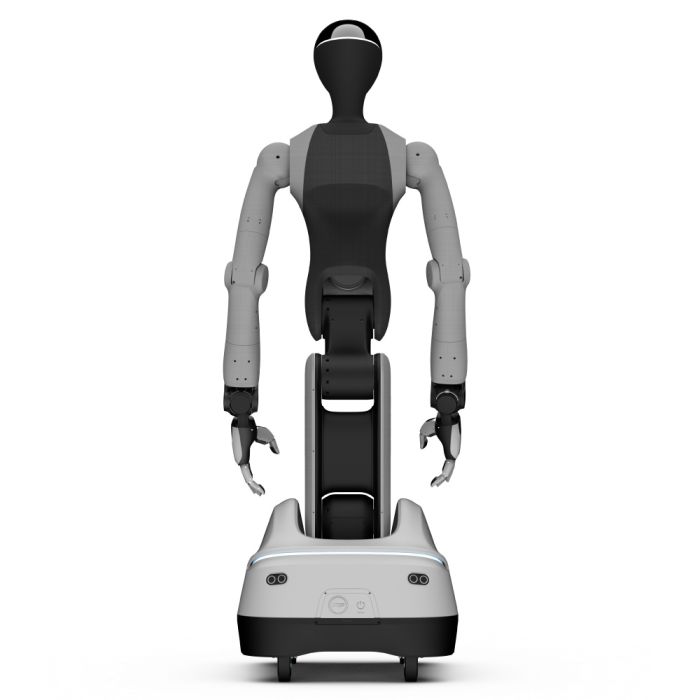
PaXini TORA DOUBLE ONE Lightweight Humanoid Robot
In stock
- BRAND:
- PAXINI
- MODEL:
- TORA DOUBLE ONE
- ORIGIN:
- China
- AVAILABILITY:
- SUBJECT TO AVAILABILITY
- SKU:
- Paxini-TORA-DOUBLE-ONE
PaXini TORA DOUBLE ONE Lightweight Humanoid Robot
Deploying robots into a factory aisle, a hospital corridor and a café counter has traditionally meant buying three different machines, each with its own software, its own training and its own maintenance routine. The PaXini TORA DOUBLE ONE Lightweight Humanoid Robot approaches the problem from the other end. It offers one humanoid upper body with up to 52 joint degrees of freedom, one on-board AGX Orin computing platform and one embodied AI model, mounted on whichever chassis the site demands. For the buyer, the decision shifts from which robot to purchase to which ground it will stand on.
Robots Middle East supplies the TORA DOUBLE ONE to organisations across the Middle East, including research laboratories, universities, manufacturers, logistics operators and service businesses. Each quotation is prepared around the chassis and dexterous hand you select. Robots Middle East then arranges delivery, import formalities and after-sales support throughout the region.
Background
PaXini and its focus on touch
PaXini has built its robotics range around tactile sensing. Its catalogue includes a full line of multi-dimensional tactile dexterous hands, and the TORA DOUBLE ONE is designed to carry any of them. The hand is therefore treated as a core part of the humanoid rather than as an afterthought. This matters because much of the work people ask robots to do happens at the moment of contact: gripping a component without crushing it, sensing that a container has slipped, or judging whether a drawer has closed fully. Cameras alone describe how an object looks. Touch tells the robot how the object is behaving in its grasp.
The TORA DOUBLE ONE sits within PaXini's wider humanoid family, which buyers can explore through our Humanoids and Wheeled Humanoids categories. Its particular contribution is a modular lower body. The same upper body and intelligence can work on a level industrial floor or on more demanding ground, depending on the chassis chosen at the time of order.
OmniVTLA, PX-Core and on-board computing
Three elements form the robot's intelligence. The first is OmniVTLA, PaXini's self-developed embodied intelligence model, which connects what the robot perceives with what it does. The second is PX-Core, a visual-tactile dual-modal control system that combines sight and touch in the control loop. The third is an AGX Orin computing platform, which supplies high-performance processing on board the robot. Together they allow perception, decision-making and manipulation to take place within the machine itself.
Perception is supported by 3D LiDAR, a fisheye camera, a depth camera and circular microphone arrays. LiDAR and depth sensing map the space around the robot, the fisheye camera provides a wide field of view and the microphone arrays capture sound from around the platform. This sensor set is the foundation for navigation and for interaction with people and objects.
Technical Specifications
| Specification | Value |
|---|---|
| Maximum joint degrees of freedom | Up to 52 |
| Embodied AI model | OmniVTLA (self-developed by PaXini) |
| Computing platform | AGX Orin |
| Control system | PX-Core visual-tactile dual-modal control |
| Sensors | 3D LiDAR, fisheye camera, depth camera, circular microphone arrays |
| Chassis options | Omnidirectional chassis (Model P) or obstacle-crossing chassis (Model X) |
| Omnidirectional chassis (Model P) | Dual-steer AGV design with two steering wheels; flexible steering and lateral translation; intended for stability on industrial floors |
| Obstacle-crossing chassis (Model X) | Four-wheel-drive folding, transformable design; lifts its legs to adapt to complex terrain; intended for tight spaces and varied ground conditions |
| Minimum folded height | Less than 60cm (both chassis models) |
| Maximum slope | 8.5 degrees |
| Maximum obstacle height | 21.5cm |
| Dexterous hand compatibility | PaXini's full line of multi-dimensional tactile dexterous hands |
Specifications are as published by the manufacturer and are confirmed against the datasheet at quotation.
The manufacturer has not published the weight, payload, battery capacity, ingress protection rating, full dimensions, contents of the box, connectivity or operating system; these details are confirmed at quotation.
What is the difference between the Model P and Model X chassis?
The two chassis answer different questions about the workplace. The omnidirectional Model P uses a dual-steer AGV design, with two steering wheels that let the robot turn and also move sideways. On a smooth, level industrial floor, this allows the humanoid to line up beside a workstation, slide along a conveyor or position itself at a shelf without repeated forward-and-back manoeuvres. Stability on that kind of floor is its stated purpose.
The obstacle-crossing Model X takes a different approach. It is a four-wheel-drive folding chassis whose transformable design lets it lift its legs to adapt to complex terrain. It is intended for tight spaces and varied ground conditions: thresholds, uneven surfaces and areas where a flat-floor AGV would struggle.
Both chassis share the same upper body, the same OmniVTLA model and the same compatibility with PaXini's tactile hands, and both fold to a minimum height of less than 60cm. Choosing between them is therefore a decision about the site rather than about the robot's capabilities. We recommend that buyers describe their floors, doorways and transitions to our team so the right chassis can be specified in the quotation.
How does visual-tactile control change what the robot can do?
Most mobile robots rely on vision to decide where an object is and then perform a pre-planned motion to take hold of it. With PX-Core, the TORA DOUBLE ONE combines visual and tactile information in its control. The robot can therefore draw on what it feels as well as what it sees while handling an object. When fitted with one of PaXini's multi-dimensional tactile dexterous hands, the platform brings contact data into the same system that plans its movements.
For buyers, the practical significance lies in the type of task that becomes realistic. Soft packaging, irregular items, objects that are partly hidden from the cameras and delicate components are all cases where touch adds information that vision cannot. Combined with up to 52 joint degrees of freedom, this gives the robot the means to approach manipulation in a way closer to how a person works with their hands.
Who is the TORA DOUBLE ONE for?
The first group is manufacturers and logistics operators evaluating humanoids for work at benches, shelves and lines. Where floors are level and well maintained, the Model P omnidirectional chassis matches PaXini's own description of stability on industrial floors. Facilities with ramps, thresholds, cramped storerooms or mixed surfaces should look at the Model X obstacle-crossing chassis instead.
The second group is research institutions and university laboratories working on embodied intelligence, dexterous manipulation and tactile perception. A platform that combines an embodied AI model, visual-tactile control, a full sensor set and on-board AGX Orin computing offers a coherent base for experiments that link perception to physical action.
The third group is service businesses in commercial, healthcare, catering and hospitality settings, where a robot must move among people and handle everyday objects. For these buyers, the folding design is a practical consideration, since both chassis reduce to a minimum height of less than 60cm for transport or storage. Organisations comparing several wheeled platforms can review alternatives in our Wheeled Humanoids category.
What is the TORA DOUBLE ONE used for?
- Workstation tasks: positioning beside benches and lines to pick, place and handle parts with tactile hands.
- Material handling in tight spaces: moving between storage areas and work cells where layout or ground is demanding.
- Embodied AI research: studying how vision, touch and action combine in a humanoid platform.
- Commercial service: receiving visitors, guiding them and handling objects in public-facing spaces.
- Healthcare support: carrying out fetch-and-deliver tasks in clinical and care environments under supervision.
- Catering and hospitality: handling items and supporting staff in kitchens, cafés and hotels.
Pricing and Availability
The TORA DOUBLE ONE is supplied on quotation, because the final configuration depends on the chassis model, the dexterous hand and the support your project requires. Robots Middle East arranges delivery, customs clearance and support together with your quotation. Our team will also confirm the details the manufacturer has not yet published before you commit. To begin, use the quotation request available on this page.
Frequently Asked Questions
How many degrees of freedom does the TORA DOUBLE ONE have?
It offers up to 52 joint degrees of freedom. The exact figure for your order depends on the configuration, including the dexterous hand selected.
Which chassis should I choose?
The Model P omnidirectional chassis, with its dual-steer design, is intended for stability on industrial floors. The Model X four-wheel-drive folding chassis is intended for tight spaces and varied ground. Our team can advise once you have described your site.
Can the robot be folded for transport?
Yes. Both chassis models fold to a minimum height of less than 60cm.
What computing platform does it use?
The robot carries an AGX Orin computing platform and runs PaXini's self-developed OmniVTLA embodied intelligence model.
Which hands can be fitted?
The TORA DOUBLE ONE can carry PaXini's full line of multi-dimensional tactile dexterous hands. The hand is specified as part of your quotation.
What sensors does it have?
It is equipped with 3D LiDAR, a fisheye camera, a depth camera and circular microphone arrays to perceive its surroundings.
Where can I buy the PaXini TORA DOUBLE ONE and what does it cost?
You can buy it from Robots Middle East, which supplies, delivers and supports the robot across the Middle East. Pricing depends on the configuration and is provided in a tailored quotation.
Summary
The TORA DOUBLE ONE replaces the idea of one machine per environment with one humanoid that adapts to the ground beneath it. Its upper body offers up to 52 joint degrees of freedom, works with PaXini's tactile hands and is controlled through PX-Core visual-tactile control, the OmniVTLA model and AGX Orin computing. Beneath it, the Model P chassis serves level industrial floors and the Model X chassis handles tight and uneven spaces, and both fold below 60cm. For organisations in the Middle East considering a single platform for factory, laboratory or service work, a quotation from Robots Middle East confirms the configuration and the open specifications, and this page is the starting point.