
Rotunbot RT-G Spherical Amphibious Patrol Robot
In stock
- BRAND:
- ROTUNBOT
- MODEL:
- RT-G
- ORIGIN:
- China
- Warranty:
- 12 MONTHS
- AVAILABILITY:
- SUBJECT TO AVAILABILITY
- SKU:
- Rotunbot-RT-G
Rotunbot RT-G Spherical Amphibious Patrol Robot
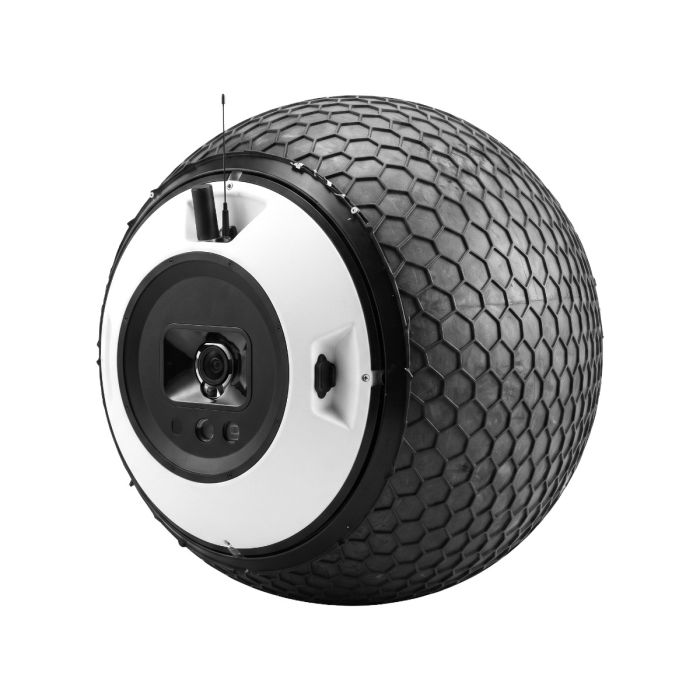
In December 2024, people walking through a commercial area of Wenzhou, in China's Zhejiang province, found the local police patrols accompanied by something that looked less like a vehicle than a large rolling ball. That machine was the Rotunbot RT-G Spherical Amphibious Patrol Robot. Its appearance poses a practical question for any security planner. What does a patrol robot gain when it gives up wheels, tracks and legs, and lets its whole body do the travelling? The answer lies in a shell that rolls, an internal mass that steers it, and a design that carries on from mud and slush into water.
Robots Middle East supplies the Rotunbot RT-G to police forces, security operators and public-safety organisations across the Middle East. Robots Middle East prepares each quotation, arranges delivery to your site and provides support once the robot is in service. Configuration questions, documentation and after-sales matters are therefore handled by a single point of contact in the region.
Background
Logon Technology and the ROTUNBOT platform
The RT-G is developed by Logon Technology and sold under the ROTUNBOT brand. Its most visible milestone to date is the Wenzhou deployment alongside police patrols in a commercial district. That setting placed the robot among pedestrians, shopfronts and open public spaces rather than on a closed industrial site. The choice of environment says a good deal about the intended role. The RT-G is meant to work in plain view beside officers, as a mobile extension of a patrol rather than a machine hidden behind a perimeter fence.
For organisations in the Middle East, that public-facing role is relevant. Commercial districts, waterfront promenades and large event venues all demand a security presence that is visible, reassuring to the public and able to respond quickly. A robot that has already worked in such a setting gives buyers a reference point for how the platform behaves among people, and not only in a test area.
A shell that rolls: internal mass and gyroscopic stabilisation
Instead of driving wheels mounted beneath a chassis, the RT-G uses motors to shift an internal mass. Moving that mass controls the robot's direction and keeps it balanced, while the outer shell itself rolls across the ground. Gyroscopic self-stabilisation works alongside this mechanism to maintain balance and traction as the robot travels.
Spherical robots as a class have attracted interest from engineers for years. An enclosed rolling body has no exposed wheels, axles or tracks to snag on debris, and its drive components sit inside the shell rather than beneath it. The RT-G applies that principle to a full-size patrol machine designed to handle mud, slush and light off-road terrain, and to operate in water. In environments where a conventional ground robot would be restricted, this gives the platform a clear advantage.
Technical Specifications
| Specification | Value |
|---|---|
| Brand | ROTUNBOT |
| Model | RT-G |
| Developer | Logon Technology |
| Weight | 125 kg |
| Top speed | 35 km/h |
| Locomotion | Motors shift an internal mass to control movement and balance; the outer shell rolls across the ground |
| Stabilisation | Gyroscopic self-stabilisation for balance and traction |
| Terrain | Mud, slush and light off-road terrain |
| Amphibious operation | Can operate in water |
| Sensors | GPS, cameras, ultrasonic sensors (positioning, environmental awareness, obstacle avoidance, target tracking) |
| Non-lethal equipment | Tear gas, smoke bombs, horns, acoustic dispersers, net shooters |
| Field deployment | Police patrols, commercial area of Wenzhou, Zhejiang province, December 2024 |
Specifications are as published by the manufacturer and are confirmed against the datasheet at quotation.
The manufacturer has not published the dimensions, the battery capacity, the battery runtime, the ingress protection rating, the communication range, the payload, the operating temperature range or the contents of the box; Robots Middle East confirms each of these at quotation.
What makes the Rotunbot RT-G different from a wheeled patrol robot?
Most ground patrol robots depend on wheels or tracks that meet the ground at a few fixed points. On a dry pavement this works well. On wet sand, mud or slush, those contact points are exactly where traction is lost. The RT-G removes the distinction between body and wheel. Because the entire shell rolls, the surface it presents to the ground is the robot itself, and its balance is managed from inside by the moving internal mass and the gyroscopic stabilisation.
The second difference is water. A conventional ground robot treats a shoreline, a flooded underpass or a canal edge as the end of its route. The RT-G is designed to operate in water, so a patrol does not have to stop where the land does. For sites that combine paved areas, open ground and water, such as ports, marinas, coastal parks and waterfront developments, that continuity is the central argument for the platform.
The third difference is presence. A 125 kg sphere capable of 35 km/h is an unusual sight on patrol, and its visibility is part of its function. Combined with horns and acoustic dispersers, the RT-G can make its presence known in a crowded area. Its non-lethal equipment, which includes tear gas, smoke bombs and net shooters, places it closer to a law-enforcement tool than to a simple observation robot.
Is the Rotunbot RT-G autonomous or remotely operated?
The RT-G has been presented as an autonomous platform capable of identifying and tracking targets. Its sensing package of GPS, cameras and ultrasonic sensors serves positioning, environmental awareness, obstacle avoidance and target tracking. In the initial police deployment in Wenzhou, however, the units were operated remotely.
For buyers, this distinction matters when planning operations. An organisation evaluating the RT-G should plan for a trained operator and a remote-control workflow, and should ask to see any autonomous functions demonstrated before relying on them. Robots Middle East discusses the control arrangement, the operator requirements and the intended concept of operations with each customer before a configuration is agreed.
Who is the Rotunbot RT-G for?
The RT-G is offered as a single version, so the question is less which model to choose and more whether the platform fits the mission. Police and public-safety agencies are the most obvious users. The robot's only documented field deployment was with police patrols, and its non-lethal equipment is aimed at crowd management and incident response.
Security operators responsible for large commercial precincts, shopping districts and mixed-use developments are a second group. For them, a visible, mobile unit that moves with patrol teams can extend coverage across open spaces. Port authorities, marina operators and the managers of coastal and waterfront estates form a third group, because the RT-G's ability to operate in water addresses terrain that wheeled robots cannot cover.
Finally, government research bodies, innovation units and integrators evaluating new security technologies will find in the RT-G a distinctive locomotion concept worth assessing. Because the robot carries non-lethal equipment, the configuration supplied to each country is agreed with Robots Middle East in line with the regulations that apply to the buyer.
What is the Rotunbot RT-G used for?
- Urban patrol support – accompanying officers through commercial districts and pedestrian areas as a visible mobile unit.
- Waterfront and shoreline patrol – continuing a route from the promenade or beach into the water where ground robots must stop.
- Crowd management – using horns and acoustic dispersers to warn and direct people during incidents.
- Non-lethal incident response – deploying tear gas, smoke bombs or net shooters under operator control where the mission requires it.
- Remote observation and tracking – using cameras, GPS and ultrasonic sensors for situational awareness and following a subject.
- Patrol over difficult ground – crossing mud, slush and light off-road terrain around parks, perimeters and open sites.
Pricing and Availability
Robots Middle East quotes the Rotunbot RT-G individually, because the configuration, the non-lethal equipment and the control arrangement depend on each customer's mission and regulatory context. Each quotation sets out the agreed configuration and the technical documentation that accompanies it. Delivery, customs clearance and after-sales support are arranged with the quotation. To begin the process, please use the quotation request available on this page.
Frequently Asked Questions
Who develops the Rotunbot RT-G?
The RT-G is developed by Logon Technology and marketed under the ROTUNBOT brand. It was deployed with police patrols in a commercial area of Wenzhou, Zhejiang province, in December 2024.
How does the RT-G move without wheels?
Motors inside the robot shift an internal mass, which controls its movement and balance while the outer shell rolls across the ground. Gyroscopic self-stabilisation helps it maintain balance and traction.
Can the RT-G operate in water?
Yes. The design allows the platform to operate in water as well as on mud, slush and light off-road terrain, giving it an advantage where a conventional ground robot would be restricted.
How heavy and how fast is the RT-G?
The RT-G weighs 125 kg and has a top speed of 35 km/h.
Which sensors does the RT-G carry?
It carries GPS, cameras and ultrasonic sensors, used for positioning, environmental awareness, obstacle avoidance and target tracking.
What non-lethal equipment does the RT-G carry?
The RT-G is equipped with tear gas, smoke bombs, horns, acoustic dispersers and net shooters. The equipment supplied is agreed with Robots Middle East in line with the buyer's local regulations.
Where can I buy the Rotunbot RT-G and what does it cost?
The RT-G is available from Robots Middle East, which supplies it across the Middle East. The cost depends on the agreed configuration and is provided in a formal quotation, which you can request on this page.
Summary
The rolling ball that joined police patrols in Wenzhou is more than a curiosity. The Rotunbot RT-G replaces wheels and tracks with a shell that is itself the wheel, steered by a moving internal mass and held steady by gyroscopic stabilisation. It handles mud, slush and light off-road terrain, operates in water, and carries GPS, cameras, ultrasonic sensors and a set of non-lethal tools for incident response. Its documented use has been remotely operated, which buyers should reflect in their planning. For police, security and waterfront operators in the region who need a patrol that does not end at the water's edge, and who want Robots Middle East to handle configuration, delivery and support, this page is the starting point.