
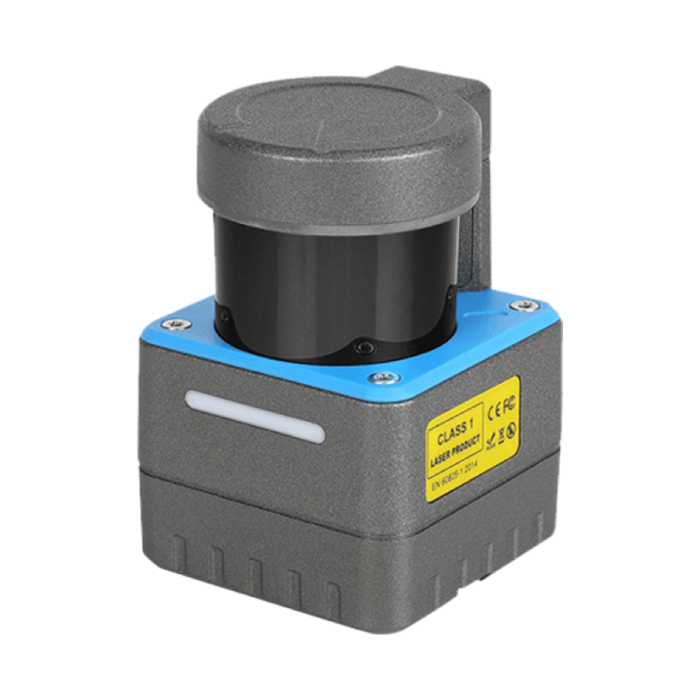
OLEI Laser / Camera (LR-1BS2)
In stock
- BRAND:
- OLEI
- MODEL:
- LR-1BS2
- PART #:
- LR-1BS2
- ORIGIN:
- China
- Warranty:
- 12 MONTHS
- AVAILABILITY:
- SUBJECT TO AVAILABILITY
- SKU:
- SEER-Robotics-OLEI-LR-1BS2
OLEI Laser / Camera (LR-1BS2)
A yellow line painted on a factory floor tells people where the danger begins, but it cannot move when the layout changes, and it cannot tell a robot to slow down. The OLEI Laser / Camera (LR-1BS2) takes that boundary off the floor and places it in software: a 2D 270° obstacle avoidance LiDAR sensor that measures the space around a machine and reacts when something crosses a zone the integrator has drawn. Because the safe area can be set freely, the line follows the work rather than the work following the line.
Robots Middle East supplies the OLEI Laser / Camera (LR-1BS2) to robot builders, system integrators and operators of automated sites across the Middle East. Robots Middle East prepares each quotation against the project, arranges delivery to the site and provides support once the sensor is part of a working machine.
Background
OLEI and the sensing layer of automation
OLEI is a LiDAR brand, and on this store the LR-1BS2 sits within the SEER Robotics range of components for building and integrating mobile robots. In that kind of ecosystem, the controller plans routes and the navigation sensors build the map, while a dedicated obstacle sensor has a narrower and more urgent task: to notice what is close to the machine and to signal it immediately. The manufacturer frames the LR-1BS2 for robotics, security, industrial and intelligent logistics applications, providing mobile obstacle avoidance, safe area protection and related functions.
Time of flight, zones and outputs
The LR-1BS2 measures distance using the time-of-flight principle: it emits light, times its return and converts that time into range across a 270° field of view. What makes it practical for a protective role is the way it reports what it sees. It offers switching output together with point cloud data, so a machine can be driven through a PLC from simple switched signals, or a controller can work directly with the point cloud. Protection is organised as 16-bank, 3-level protection, with the safe area set freely, which lets an integrator define several zone sets and graduate the response as an object approaches. The manufacturer positions it as an obstacle avoidance LiDAR with excellent cost performance.
Technical Specifications
| Specification | Value |
|---|---|
| Product type | 2D 270° Obstacle Avoidance LiDAR Sensor |
| Operating principle | Time of flight |
| Field of view (LR-1BS2 Series) | 270° |
| Detection capability (manufacturer page) | Up to 20m |
| Range (distributor listing, LR-1BS2 Series) | 10 m |
| Angular resolution (LR-1BS2 Series) | 0.225° |
| Horizontal angle accuracy | ±1° |
| Outputs | Switching output with point cloud data (through PLC or point cloud data) |
| Output current | Not to exceed 20mA per output port |
| Safety zones | Safe area can be set freely; 16-bank, 3-level protection |
| Connectivity | 2-meter "Power/IO" cable and "Ethernet" connection |
| Ethernet interface | RJ-45 |
| Protection class | IP65 or optional |
| Certifications | FCC, EMC, CE, RoHS, REACH, FDA |
Specifications are as published by the manufacturer and are confirmed against the datasheet at quotation.
The manufacturer has not published the weight, the dimensions, the power consumption, the scanning frequency, the measurement range by target reflectivity, the operating temperature or the contents of the box; each of these is confirmed at quotation.
What makes the LR-1BS2 different from a navigation LiDAR?
A navigation LiDAR is judged by how well it helps a robot know where it is. An obstacle avoidance LiDAR such as the LR-1BS2 is judged by something else: how reliably it tells the machine that something has entered a space where it should not be. That difference shapes the whole design. The LR-1BS2 is built around configurable zones rather than map building, with the safe area set freely and organised into 16 banks across three protection levels. In practice, this lets one sensor hold different zone shapes for different situations, such as a robot travelling empty, carrying a load or approaching a docking point, and respond in stages rather than with a single stop.
The output arrangement reinforces that role. Switching outputs allow the sensor to work with a PLC without any point cloud processing at all, which suits machines with simple control architectures, while the point cloud remains available for controllers that want the raw geometry. Each output port is rated not to exceed 20mA, a figure the integrator needs when wiring to the input stage of a controller. The 270° field of view covers the front and both sides of a vehicle or machine from a single mounting point, and the 0.225° angular resolution with ±1° horizontal angle accuracy defines how finely that arc is sampled.
Which range figure applies to the LR-1BS2?
Two figures appear in the sources, and a careful buyer will notice them. The manufacturer's page describes detection capability up to 20m, while a distributor listing for the LR-1BS2 Series gives a range of 10 m. The sources also name two versions, LR-1BS2 and LR-1BS2H, without assigning separate figures to each. Because a protective zone is only as useful as the distance at which it can be set, this is a point to settle before a design is finalised: Robots Middle East confirms the range that applies to the exact version ordered against the manufacturer's datasheet, together with the protection class, which the manufacturer lists as IP65 or optional.
Who is the OLEI Laser / Camera (LR-1BS2) for?
The first group is builders of autonomous mobile robots and automated guided vehicles who need a dedicated obstacle and safe area sensor alongside their navigation system. For them, the combination of a wide field of view, configurable zones and switching outputs means the protective function can be handled close to the hardware, independent of the main navigation stack.
The second group is system integrators working on fixed industrial equipment, where a configurable zone can guard the approach to a machine, a conveyor transfer or a work cell. Here the PLC-friendly outputs matter more than the point cloud, and the ability to redraw the safe area makes re-layouts less disruptive. Buyers planning such projects may find related equipment in the Factory Robots category.
The third group is operators of warehouses and distribution centres, where vehicles share space with people, racking and pallets. Those comparing complete platforms can browse the Logistics Robots category, and those comparing sensors within the same family can also review the OLEI Laser / Camera (LR-1BS5H) before requesting a quotation. Security applications, which the manufacturer names among its target fields, form a fourth group, where a sensor watches a perimeter or restricted area rather than a moving path.
What is the OLEI Laser / Camera (LR-1BS2) used for?
- Mobile obstacle avoidance: detecting objects around an autonomous mobile robot so it can slow down or stop before contact.
- Safe area protection: holding a freely configured zone around a machine and signalling when it is entered.
- Staged speed reduction: using the three protection levels to graduate a vehicle's response as an obstacle draws closer.
- Intelligent logistics: guarding the travel paths of transport robots in warehouses and distribution centres.
- Industrial machine guarding: feeding switched outputs to a PLC to protect the approach to fixed equipment.
- Security monitoring: watching a defined area for intrusion, one of the fields the manufacturer names for the sensor.
Pricing and Availability
The OLEI Laser / Camera (LR-1BS2) is supplied by quotation, so that the version, protection class and range can be matched to the project before an order is placed. Please send Robots Middle East a description of the machine, the zones you intend to protect and the control system the sensor will connect to. Delivery, customs and after-sales support are arranged with the quotation. The request form for a quotation is available on this page.
Frequently Asked Questions
What kind of sensor is the LR-1BS2?
It is a 2D 270° obstacle avoidance LiDAR sensor that measures distance using the time-of-flight principle. Its role is obstacle avoidance and safe area protection rather than mapping.
Can the LR-1BS2 work with a PLC?
Yes. It provides switching output with point cloud data, so it can be used through a PLC or through the point cloud data, and each output port should not exceed 20mA.
How are the protection zones configured?
The safe area can be set freely, and protection is organised as 16-bank, 3-level protection. This allows several zone sets with graduated responses.
How does the sensor connect?
It comes with a 2-meter "Power/IO" cable and an "Ethernet" connection, and it connects to a computer through an RJ-45 Ethernet interface.
Which certifications does it carry?
The manufacturer lists FCC, EMC, CE, RoHS, REACH and FDA certification.
Is the LR-1BS2 suitable for dusty or wet environments?
The manufacturer gives the protection class as IP65 or optional. The class for your exact version is confirmed with the quotation.
Where can I buy the OLEI Laser / Camera (LR-1BS2) and what does it cost?
You can buy it from Robots Middle East, which supplies it across the Middle East. The cost depends on the version and project requirements and is provided in a quotation requested on this page.
Summary
The painted line on the floor has served factories for decades, but it cannot adapt, and it cannot speak to a machine. The OLEI Laser / Camera (LR-1BS2) replaces that fixed boundary with zones drawn in software: a 270° field of view measured by time of flight, a safe area set freely across 16 banks and three protection levels, and outputs that reach either a PLC or a controller hungry for point cloud data. With its stated certifications and an RJ-45 Ethernet interface, it is designed to slot into robots, machines and logistics systems where protection must keep pace with change. For buyers who want that boundary to move with the work, this page is the starting point.