
SICK Laser / Camera (nanoScan3 Core I/O)
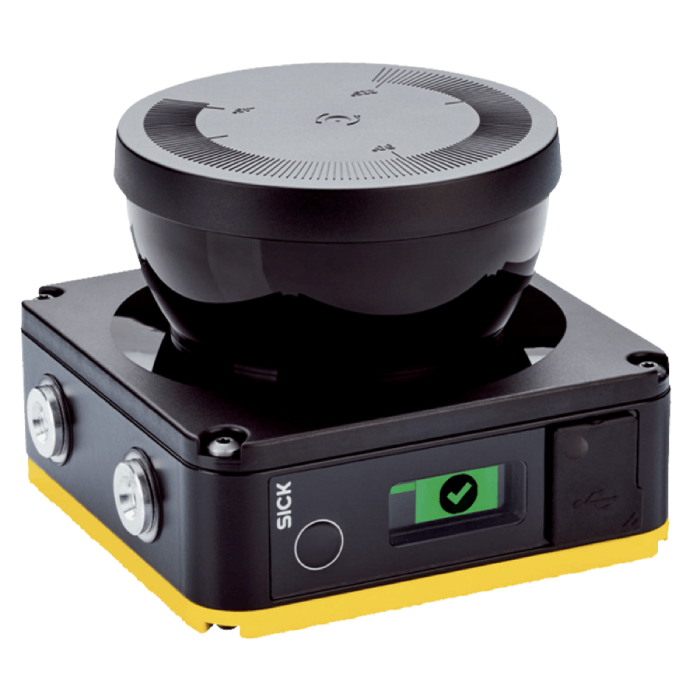
In stock
- BRAND:
- SICK
- MODEL:
- nanoScan3 Core I/O
- PART #:
- nanoScan3 Core I/O
- ORIGIN:
- China
- Warranty:
- 12 MONTHS
- AVAILABILITY:
- SUBJECT TO AVAILABILITY
- SKU:
- SEER-Robotics-SICK-nanoScan3-Core-I-O
SICK Laser / Camera (nanoScan3 Core I/O)
Picture an automated vehicle reaching the end of a busy warehouse aisle just as a picker steps out from behind a rack. Whether that moment ends in a calm slowdown or an abrupt halt depends on a sensor few people ever look at. The SICK Laser / Camera (nanoScan3 Core I/O) is one of those sensors: a 2D safety laser scanner that draws invisible boundaries on the floor and tells the machine which ones it may not cross. It sweeps a 275° arc, holds a protective field out to 3 m and a warning field out to 10 m, and does so from an aluminium housing that weighs 0.67 kg.
Robots Middle East supplies the SICK Laser / Camera (nanoScan3 Core I/O) to integrators, machine builders and operators of automated sites across the Middle East. Our team prepares the quotation, coordinates delivery to your facility and remains your point of contact for technical questions once the scanner is installed on your vehicle or machine.
Background
SICK and its place in machine safety
SICK is a long-established German manufacturer of industrial sensors, and safety laser scanning is one of the fields with which the company is most closely associated. Its scanners are used to guard machines, robot cells and automated vehicles in factories and distribution centres, where they replace or complement physical guarding with fields that can be configured in software. The nanoScan3 family sits within that tradition as a compact line intended for applications where space on the machine is limited.
Where the Core I/O version sits in the family
The sources name several versions of the nanoScan3: the nanoScan3 Core I/O, the nanoScan3 Pro I/O, the nanoScan3 Pro I/O – EFI-pro, the nanoScan3 Pro – EFI-pro and the nanoScan3 Pro – EtherNet/IP. The Core I/O is the version described on this page. It is supplied as a sensor without system plug, intended for indoor use, and it signals its safety state through one OSSD pair. Configuration and diagnostics run over a micro USB connection using SICK's Safety Designer software on a PC. This makes the Core I/O a straightforward choice where a single protective function is to be wired directly into a machine's safety circuit.
Technical Specifications
| Specification | Value |
|---|---|
| Product version | nanoScan3 Core I/O |
| Model | Sensor without system plug |
| Application | Indoor |
| Protective field range | 3 m |
| Warning field range | 10 m |
| Distance measuring range | 40 m |
| Scanning angle | 275° |
| Angular resolution | 0.17° |
| Number of fields | 8 |
| Response time | 70 ms |
| Safety integrity level | SIL 2 (IEC 61508) |
| Performance level | PL d (EN ISO 13849) |
| OSSD pairs | 1 |
| Configuration and diagnostics interface | USB 2.0, micro USB |
| Configuration method | PC with Safety Designer (Configuration and Diagnostic Software) |
| Power consumption typical | 3.9 W (without output load) |
| Dimensions (W x H x D) | 106.6 mm x 80 mm x 117.5 mm (including system plug) |
| Weight | 0.67 kg |
| Enclosure rating | IP65 (IEC 60529) |
| Ambient operating temperature | –10 °C ... +50 °C |
| Wavelength | 905 nm |
| Laser class | 1 (21 CFR 1040.10 and 1040.11, IEC 60825-1) |
| Housing material | Aluminium |
Specifications are as published by the manufacturer and are confirmed against the datasheet at quotation.
The manufacturer has not published the package contents, the Ethernet data rate, the scan frequency or the humidity range; these are confirmed at quotation.
How do the protective field, warning field and measuring range work together?
A safety scanner of this kind does three different things with the same rotating beam, and it helps to keep them apart when planning an installation. The protective field, which reaches up to 3 m on the Core I/O, is the safety-relevant zone: when an object enters it, the scanner switches its OSSD pair and the machine is brought to a safe state. This is the function certified to SIL 2 (IEC 61508) and PL d (EN ISO 13849).
The warning field extends further, up to 10 m. It is typically used to announce an approach before it becomes critical, so that a vehicle can reduce speed or a machine can give a visual or audible signal while there is still room to react. Used well, the warning field is what turns abrupt emergency stops into gentle slowdowns, which matters for throughput as much as for comfort on the shop floor.
The distance measuring range of 40 m describes how far the scanner can measure contours at all. In mobile robotics, measurement data of this kind is commonly put to use for orientation and navigation tasks, separate from the safety function. With eight fields available and a 0.17° angular resolution across the 275° scanning angle, the scanner can be configured to suit different situations on the same machine, all of which is set up in Safety Designer over the micro USB interface.
Why does the compact housing matter for mobile robots?
On an automated guided vehicle or autonomous mobile robot, every millimetre of the chassis is contested. Batteries, drive units, load-handling equipment and controllers all compete for space, and a safety scanner must sit low, often at a corner, with a clear view in its direction of travel. The Core I/O measures 106.6 mm x 80 mm x 117.5 mm including the system plug and weighs 0.67 kg, which allows it to be fitted where larger sensors would force a redesign.
Its wide 275° scanning angle means that a single unit mounted at a corner can watch both the front and one side of a vehicle. Typical power consumption of 3.9 W (without output load) is modest for a battery-powered platform. The aluminium housing carries an IP65 (IEC 60529) enclosure rating and the unit is specified for ambient temperatures from –10 °C to +50 °C, a sensible fit for indoor warehouses, production halls and conditioned logistics buildings. Laser class 1 at 905 nm means the scanner is classed as eye-safe under the cited standards.
Who is the SICK Laser / Camera (nanoScan3 Core I/O) for?
The Core I/O is suited to engineers who need a certified protective function wired directly into a safety circuit, without a network-based safety interface. Builders of automated guided vehicles and autonomous mobile robots are the most obvious buyers, particularly those designing compact platforms for intralogistics; you will find related platforms in our Logistics Robots category. Machine builders and integrators guarding stationary equipment, such as robot cells, transfer stations or work areas at production machines, form a second group; see our Factory Robots category for the kind of systems these scanners protect.
A third group consists of operators retrofitting existing vehicles or machines, where the small footprint and USB-based configuration simplify the work. Projects that require more than one OSSD pair or that need to integrate the scanner into a networked safety architecture should look at the Pro versions named by the sources, including the EFI-pro and EtherNet/IP variants. Their specifications are not covered on this page, so Robots Middle East will confirm which version fits your safety concept when preparing the quotation.
What is the SICK Laser / Camera (nanoScan3 Core I/O) used for?
- AGV collision protection — guarding the direction of travel of automated guided vehicles so that they stop before reaching a person or obstacle.
- AMR speed reduction — using the warning field to slow autonomous mobile robots as people approach in shared spaces.
- Robot cell access monitoring — detecting entry into the working area of a stationary robot without relying solely on fences.
- Machine hazard zone guarding — monitoring the floor area in front of production machines and halting motion when it is entered.
- Warehouse vehicle retrofits — adding a certified protective function to existing material-handling vehicles with limited mounting space.
- Contour measurement support — providing distance data across a wide arc that can assist orientation tasks on mobile platforms.
Pricing and Availability
The SICK Laser / Camera (nanoScan3 Core I/O) is offered by quotation, so that the version, accessories and integration details can be matched to your project before anything is ordered. Delivery, customs clearance and technical support are arranged together with your quotation from Robots Middle East. To begin, please send us a short description of your vehicle or machine and your safety requirements using the quotation request available on this page.
Frequently Asked Questions
What kind of sensor is the nanoScan3 Core I/O?
It is a 2D safety laser scanner from SICK, designed to monitor configurable fields around machines and vehicles and to switch a safety output when a protective field is entered.
What safety ratings does it carry?
The nanoScan3 Core I/O is rated SIL 2 (IEC 61508) and PL d (EN ISO 13849). Your overall system rating still depends on the complete safety architecture of the machine.
How is the scanner configured?
Configuration and diagnostics are carried out on a PC with SICK's Safety Designer software, connected through the USB 2.0 micro USB interface.
Can it be used outdoors?
The manufacturer specifies the Core I/O for indoor applications. It has an IP65 enclosure rating and an ambient operating temperature range of –10 °C to +50 °C.
How many fields can be configured?
The scanner provides eight fields, which can be set up for different situations, for example for different speeds or directions of a vehicle.
Is the system plug included?
The Core I/O is listed as a sensor without system plug, and the package contents have not been published. Robots Middle East confirms exactly what is supplied as part of the quotation.
Where can I buy the SICK Laser / Camera (nanoScan3 Core I/O) and what does it cost?
You can obtain it from Robots Middle East, which supplies customers across the Middle East. The cost depends on your configuration and project, so please request a quotation through this page.
Summary
The aisle-end encounter between a vehicle and a person is decided long before it happens, in the fields an engineer draws in software and the sensor that enforces them. The SICK Laser / Camera (nanoScan3 Core I/O) brings that capability in a compact, light aluminium housing: a 275° view, a 3 m protective field certified to SIL 2 and PL d, a 10 m warning field for gentle slowdowns and a 40 m measuring range, all configured through Safety Designer. For indoor vehicles and machines that need a directly wired protective function, it is a measured and practical choice, and Robots Middle East will help you confirm it fits your safety concept. If your next project needs a scanner that keeps people safe without slowing the operation more than necessary, this page is the starting point.