
SEER Robotics General-purpose Robot Controller (SRC-2000-I(S))
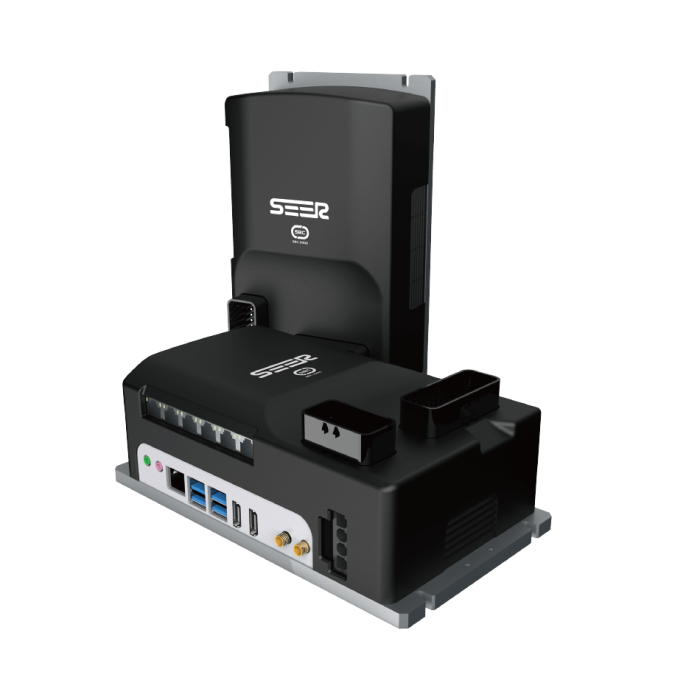
In stock
- BRAND:
- SEER ROBOTICS
- MODEL:
- SRC-2000-I(S)
- PART #:
- SRC-2000-I(S)
- ORIGIN:
- China
- Warranty:
- 12 MONTHS
- AVAILABILITY:
- SUBJECT TO AVAILABILITY
- SKU:
- SEER-Robotics-SRC-2000-I-S
SEER Robotics General-purpose Robot Controller (SRC-2000-I(S))
Ask an integrator where a mobile robot project loses its weeks, and the answer is seldom the chassis or the motors. It is the work in between: persuading a laser scanner, a set of drives, safety inputs, a wireless link and a fleet management system to agree on what the robot should do next. The SEER Robotics General-purpose Robot Controller (SRC-2000-I(S)) is aimed squarely at that gap. It is a single navigation and control unit around which carrying robots of quite different designs can be built, not a controller tied to one vehicle type. For engineering teams that would rather standardise on one platform across several projects than relearn a new controller each time, that general-purpose positioning is the whole point.
Robots Middle East sells the SRC-2000-I(S) to robot builders, system integrators and industrial operators across the Middle East. Each order is supplied against a formal quotation that covers the configuration, delivery and technical support for the project in question. Robots Middle East can also advise on where this controller sits alongside the rest of the SEER range before you commit to a design.
Background
SEER Robotics and its controller family
SEER Robotics is a Chinese developer that concentrates on the brain of the autonomous mobile robot rather than on the vehicle itself. Its approach is to provide controllers, navigation software and fleet tools that third-party manufacturers can build into their own machines. The result is a family of controllers with distinct roles: entry-level units, controllers specified for particular vehicle types such as pallet-handling robots and autonomous forklifts, safety-oriented models and general-purpose units such as this one. The full line-up can be browsed in our Controllers category. Within the 2000 series the sources name two versions: the SRC-2000-I(S) described here and the SRC-2000-F(S), which SEER presents as the specified controller for autonomous forklifts.
Navigation as the core technology
What distinguishes a robot controller from a general industrial computer is the navigation stack it carries. The SRC-2000-I(S) supports four navigation types: SLAM, QR Code, Laser Reflector and NFL. In practice this means a single controller can work in a facility that is mapped from its natural surroundings, in one that uses floor codes for precise stopping points, or in one fitted with reflectors for repeatable positioning. The manufacturer quotes a navigation accuracy of ±5 mm, ±1° and a single-frame map area of up to 400000 m², which together describe a unit intended for large sites where docking and handover points must still be met precisely.
Technical Specifications
| Specification | Value |
|---|---|
| Weight | 1.41 kg |
| Dimensions (L x W x H) | 225 x 128 x 84 mm |
| Working voltage | 24 V |
| Power consumption | 48 W (excluding DO output current) |
| Power DO | 8-Way (single-loaded 24 V / 2 A; 8-Way total load capacity ≤5 A) |
| DO | 2-Way (400 mA) |
| DI | 11-Way (NPN) |
| CAN | 2-Way |
| RS485 | 3-Way |
| Ethernet | 6+1 Way Gbps (1 is for extended Wi-Fi client) |
| Wi-Fi | Dual-band 2.4G / 5G 802.11ac 1T1X |
| USB3.0 | 4-Way |
| Navigation type | SLAM, QR Code, Laser Reflector, NFL |
| Navigation accuracy | ±5 mm, ±1° |
| Driving speed | ≤2 m/s |
| Map area (single frame) | ≤400000 m² |
| Operating temperature and humidity | TEMP: 0°C to 50°C / RH: 10% to 90%, no compression, no condensation |
| IP rating | IP42 |
| Certifications | CE · Conform to EN 61010-1:2010, CE-EMC (IEC 61326-1) Standards |
Specifications are as published by the manufacturer and are confirmed against the datasheet at quotation.
The manufacturer has not published the package contents, the processor, the memory and storage, the mounting method or the operating system version; these details are confirmed at quotation.
What makes the SRC-2000-I(S) different from the SRC-2000-F(S)?
Both controllers belong to the same series, but they answer different briefs. The SRC-2000-F(S) is presented by SEER as a specified controller for autonomous forklifts, which means it is shaped around one vehicle category and the tasks that category performs. The SRC-2000-I(S), by contrast, is described as general-purpose: it is meant to be adapted to many kinds of carrying robot, from compact transfer vehicles to custom platforms an integrator designs for a single customer.
That difference matters most at the planning stage. A team building forklifts alone will naturally look first at the SEER Robotics Specified Controller for Autonomous Forklift (SRC-2000-F(S)). A team that builds several robot types, or that does not yet know what the next customer will ask for, gains more from a controller whose interface set and navigation options are deliberately broad. Note that the figures on this page belong to the SRC-2000-I(S) only; the forklift version is specified separately and should be assessed on its own datasheet.
How many devices can the SRC-2000-I(S) connect to?
Connectivity is where a general-purpose controller earns its name, and the input and output provision here is generous. Seven Gigabit Ethernet ports are listed as 6+1, with one reserved for an extended Wi-Fi client, leaving six for laser scanners, cameras, industrial PCs or other networked equipment. Two CAN channels and three RS485 channels cover the field buses commonly used by motor drives, battery management systems and auxiliary modules, while four USB3.0 ports serve peripherals and service access.
For discrete signals the controller offers eleven NPN digital inputs, suited to limit switches, buttons and sensor outputs, together with two standard digital outputs rated at 400 mA. Eight power digital outputs are rated at 24 V / 2 A each, with a combined load capacity of no more than 5 A across all eight, which allows the controller to drive indicators, relays and small actuators directly. Wireless communication runs on dual-band 2.4G / 5G 802.11ac, so the robot can stay connected to a fleet server across large facilities. Taken together, this is a unit designed to sit at the centre of a robot's wiring rather than to need a separate interface board alongside it.
Who is the SRC-2000-I(S) for?
The first group is the robot manufacturer that builds its own vehicles and wants a proven navigation core instead of developing one in-house. For such a company, a single general-purpose controller across several product lines simplifies training, spares and software maintenance. The second group is the system integrator delivering intralogistics projects to factories, warehouses and distribution centres, where the choice of navigation method often depends on the site and a controller supporting SLAM, QR Code, Laser Reflector and NFL removes one constraint from the design. Engineers can explore related platforms in our Factory Robots category.
Research groups, universities and innovation centres form a third group, using the controller to prototype mobile platforms with a commercial-grade navigation stack. Buyers whose vehicles are autonomous forklifts will usually be better served by the dedicated SRC-2000-F(S). Those looking for a simpler starting point within the range can consider the SEER Robotics Entry-level Robot Controller (SRC-880), and those whose requirement centres on a dedicated safety controller may look at the SEER Robotics Safety Robot Controller (SRC-3000FS).
What is the SRC-2000-I(S) used for?
- Line-side material delivery — moving parts and components between stores and production lines in manufacturing plants.
- Warehouse transfer — shuttling goods between receiving, storage and dispatch areas in distribution centres.
- Custom AMR development — serving as the navigation and control core of a new carrying robot designed by an OEM.
- Mixed-navigation sites — operating where some zones suit SLAM and others need QR codes or reflectors for precise stops.
- Large-facility logistics — covering extensive sites that benefit from a large single-frame map and wireless fleet connectivity.
- Research and education — giving laboratories and training centres a commercial controller for mobile robot experiments.
Pricing and Availability
The SRC-2000-I(S) is supplied on a quotation basis, as the right configuration depends on the robot, the site and the integration work involved. Send us your project details and our team will prepare a quotation that reflects your requirements. Delivery, customs clearance and technical support are arranged with the quotation, so you have a single point of contact from order to commissioning. To begin, use the quotation request available on this page.
Frequently Asked Questions
What navigation methods does the SRC-2000-I(S) support?
It supports SLAM, QR Code, Laser Reflector and NFL navigation. This allows one controller to be used across sites with different infrastructure.
How accurate is its navigation?
SEER states a navigation accuracy of ±5 mm, ±1°. That precision suits docking, handover and charging positions.
What power supply does the controller require?
The working voltage is 24 V, and power consumption is 48 W, excluding the DO output current.
Does the controller offer wireless connectivity?
Yes. It provides dual-band 2.4G / 5G 802.11ac 1T1X Wi-Fi, and one of its Ethernet ports is reserved for an extended Wi-Fi client.
What operating conditions is it designed for?
The controller operates from 0°C to 50°C at 10% to 90% relative humidity, without condensation, and carries an IP42 rating. Installations in hotter areas should be planned with this range in mind.
Which certifications does it hold?
It carries CE marking and conforms to EN 61010-1:2010 and CE-EMC (IEC 61326-1) standards.
Where can I buy the SRC-2000-I(S) and what does it cost?
You can buy it from Robots Middle East, which supplies it across the Middle East. The cost depends on your configuration and project, so we provide it in a formal quotation on request.
Summary
Mobile robot projects rarely stall on hardware alone; they stall where components have to be made to work together. The SEER Robotics General-purpose Robot Controller (SRC-2000-I(S)) addresses that integration problem with four navigation methods, a broad set of Ethernet, CAN, RS485, USB and digital interfaces, and dual-band wireless connectivity in one compact unit. Its general-purpose design suits manufacturers and integrators who build more than one kind of robot, while forklift projects are better matched to its SRC-2000-F(S) sibling. Robots Middle East quotes, delivers and supports the controller across the region, and for any team ready to specify its next robot, this page is the starting point.