
SEER Robotics M4 Smart Logistics Management System (m4)
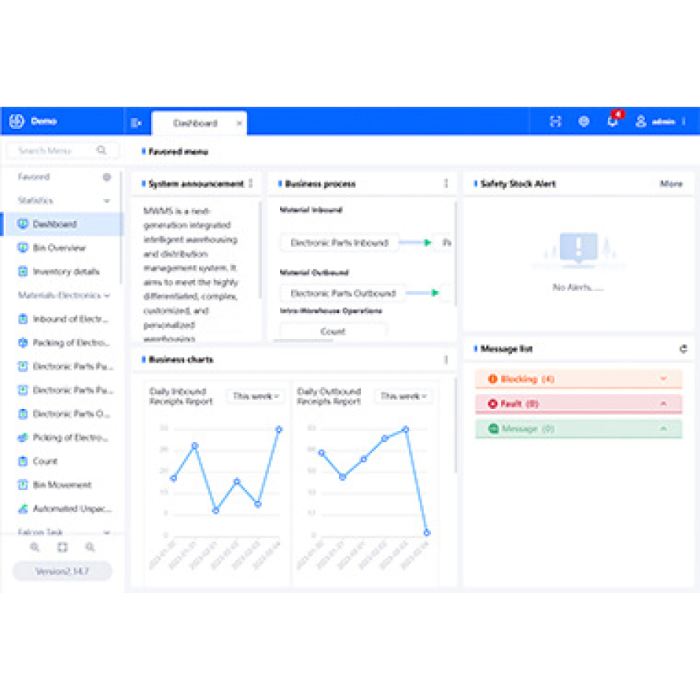
In stock
- BRAND:
- SEER ROBOTICS
- MODEL:
- m4
- PART #:
- m4
- ORIGIN:
- China
- Warranty:
- 12 MONTHS
- AVAILABILITY:
- SUBJECT TO AVAILABILITY
- SKU:
- SEER-Robotics-m4
SEER Robotics M4 Smart Logistics Management System (m4)
Most automated warehouses run on three pieces of software, each of which behaves as though it is in charge. The warehouse management system knows where stock ought to be, the control system knows what the equipment is doing, and the fleet manager knows where the robots are. Yet the decisions that matter most fall in the gaps between them. The SEER Robotics M4 Smart Logistics Management System (m4) closes those gaps. It combines the functions of a Warehouse Management System (WMS), a Warehouse Control System (WCS) and a Fleet Management System (FMS) in a single platform. Which material moves, which robot carries it and by which route are therefore decided once, rather than negotiated across three separate systems.
Robots Middle East supplies the M4 to warehouse, distribution and manufacturing operators throughout the Middle East. Robots Middle East prepares the quotation, coordinates delivery of the system to your project and remains your point of contact for support once the platform is in service. Where a project calls for detailed technical clarification, Robots Middle East works with SEER Robotics on your behalf, so that you deal with a single partner from the first enquiry onwards.
Background
SEER Robotics and the RDS lineage
SEER Robotics is based in Shanghai, China. It develops dispatching and control technology for autonomous mobile robots, alongside the vehicles and components that make up a robotic logistics installation. At the centre of its software portfolio is the Resource Dispatch System, known as RDS, which is the company's fleet management system. The M4 is built on that foundation, with RDS as its core module. For a buyer, this means the M4 is not a fresh experiment. It is an extension of an established dispatching layer upwards into the warehouse operations that robots exist to serve.
Positioning: one platform in place of three
Conventional warehouse automation layers its software. Inventory logic sits at the top, equipment control in the middle and robot dispatching at the bottom, and each layer passes instructions to the next through interfaces that have to be built and maintained. The M4 brings three product modules and multiple solutions together in one system, intended for the efficient control of robot-centred automated warehouse operations. Its architecture places WMS, WCS and FMS functionality on the same platform. Robot dispatching therefore takes place with full knowledge of what is happening in the warehouse, and warehouse decisions are made with full knowledge of what the fleet can do.
Technical Specifications
| Specification | Value |
|---|---|
| Architecture | Combines Warehouse Management System (WMS), Warehouse Control System (WCS) and Fleet Management System (FMS) functionality in a single platform |
| Product modules | Three product modules and multiple solutions |
| Core module | RDS Fleet Management System |
| Scheduling algorithm | Upgraded R-MAPF (Multi-Agent Path Finding) algorithms |
| Storage locations supported | Millions |
| Robots under coordinated control | Hundreds of heterogeneous robots |
| Task allocation factors | Task type, material status, robot condition, task progress and traffic conditions |
| Multi-robot coordination | Path planning and traffic control across multiple robots to manage congestion and route conflicts |
| Manufacturer | SEER Robotics, Shanghai, China |
Specifications are as published by the manufacturer and are confirmed against the datasheet at quotation.
The manufacturer has not published the supported operating systems, server hardware requirements, database requirements, integration interfaces and protocols, licensing model, deployment options or supported languages; these are confirmed at quotation.
What makes the M4 different from a standalone fleet manager?
A standalone fleet manager is very good at one question: where should each robot drive next? What it does not see is why the robot is driving at all. It receives a transport order from another system and executes it, but it cannot tell whether the material at the pick-up point is ready, whether a more urgent order is waiting, or whether the task it is about to assign will collide with a replenishment run elsewhere in the building.
The M4 answers these questions within the same platform. Because WMS, WCS and FMS functions sit together, task allocation can take account of the task type and the status of the material as well as the condition of the robot, the progress of tasks already under way and the traffic on the floor. This is the practical difference: the system does not simply send the nearest free robot. It weighs what the warehouse needs against what the fleet can deliver at that moment.
Scale is the second distinction. The M4 supports millions of storage locations and the coordinated control of hundreds of heterogeneous robots. A heterogeneous fleet, in which different robot types share the same floor, is precisely where separate systems tend to struggle, because each robot family often arrives with its own controller. A platform that coordinates them together removes one of the most common sources of friction in expanding automation projects.
How does the M4 decide which robot does which task?
Allocation and movement are handled as one problem. When a task arises, the M4 considers five factors together: the type of task, the status of the material involved, the condition of the candidate robots, the progress of work already in hand, and the current traffic conditions. A robot with sufficient capability but a congested route may lose out to one that is slightly further away but has a clear path, and a task waiting on material that is not yet ready need not tie up a robot prematurely.
Once a task is assigned, the M4 coordinates path planning and traffic control across the fleet to manage congestion and route conflicts. Its scheduling relies on upgraded R-MAPF (Multi-Agent Path Finding) algorithms, a class of methods designed to plan routes for many agents at once rather than one at a time. In a busy aisle this distinction matters: planning each robot in isolation tends to produce deadlocks and queues, whereas planning the fleet as a whole allows robots to give way, reroute and proceed in an orderly sequence.
Who is the SEER Robotics M4 Smart Logistics Management System for?
The M4 is aimed first at operators of large automated warehouses and distribution centres, where the number of storage locations and the volume of robot movements make coordination between inventory and fleet a daily concern. It is equally relevant to manufacturers whose intralogistics links stores, production lines and dispatch areas with autonomous vehicles, and to operators who are adding new robot types to an existing fleet and need one system to direct them all.
System integrators delivering robot-centred warehouse projects in the Middle East will also find value in a platform that already brings warehouse management, warehouse control and fleet management together, as it reduces the amount of interface engineering a project requires.
Where the requirement is limited to dispatching and managing a robot fleet, without the warehouse management and control layers, the SEER Robotics RDS: Robot Management System (rds), the module on which the M4 is built, may be the more proportionate starting point. Buyers still selecting the vehicles themselves can browse our Logistics Robots and Factory Robots categories and name the models they have in mind when they enquire.
What is the SEER Robotics M4 Smart Logistics Management System used for?
- Warehouse inventory and robot dispatching: managing storage locations and robot transport orders from the same platform.
- Mixed-fleet coordination: directing heterogeneous robots that share aisles, docks and transfer points.
- Traffic and congestion management: planning paths across the fleet so that route conflicts are resolved before they cause queues.
- Material-aware task allocation: assigning work according to material status and task progress rather than proximity alone.
- Factory intralogistics: linking stores, production lines and dispatch with autonomous transport under one control layer.
- Automation expansion: adding robots and storage capacity to a growing site without introducing another separate control system.
Pricing and Availability
The M4 is supplied on a quotation basis, because the scope of a warehouse management and fleet platform depends on the size of the site, the composition of the fleet and the systems it must work alongside. Robots Middle East will review your requirements and agree the configuration with you. Delivery, customs and support are arranged together with the quotation. To begin, please submit your project details using the quotation request available on this page.
Frequently Asked Questions
Which systems does the M4 combine?
The M4 combines the functions of a Warehouse Management System (WMS), a Warehouse Control System (WCS) and a Fleet Management System (FMS) in a single platform. It integrates three product modules and multiple solutions for robot-centred automated warehouse operations.
How large a site can the M4 manage?
The M4 supports millions of storage locations and the coordinated control of hundreds of heterogeneous robots.
Can the M4 manage different types of robot together?
Yes, the M4 is designed for the coordinated control of heterogeneous robots, meaning a fleet that is not limited to a single robot type. Please list the robots on your site when you send your enquiry.
What is the role of RDS in the M4?
The RDS Fleet Management System is the core module of the M4. It provides the fleet dispatching foundation on which the warehouse management and control functions are built.
How does the M4 prevent robots from blocking one another?
The M4 coordinates path planning and traffic control across multiple robots to manage congestion and route conflicts, using upgraded R-MAPF (Multi-Agent Path Finding) algorithms.
What server, operating system and integration requirements does the M4 have?
These details are not covered in the manufacturer's published material. Robots Middle East clarifies them with SEER Robotics for your specific project.
Where can I buy the SEER Robotics M4 Smart Logistics Management System and what does it cost?
You can buy the M4 from Robots Middle East, which supplies and supports it across the Middle East. The cost depends on the scope of your project and is provided in a tailored quotation, which you can request on this page.
Summary
The difficulty in robotic warehousing is rarely a single robot or a single shelf; it is the hand-over between the systems that manage them. The M4 removes that hand-over by placing warehouse management, warehouse control and fleet management on one platform, built on the RDS core module. It allocates tasks with regard to material, robot condition, progress and traffic, and coordinates the movements of hundreds of heterogeneous robots across millions of storage locations. For operators who want inventory and fleet to be directed by one coherent logic, with Robots Middle East handling quotation, delivery and support, this page is the starting point.