
SIASUN Cantilever Shaft Conveyor Mobile Robot (Cantilever Shaft Conveyor Mobile Robot)
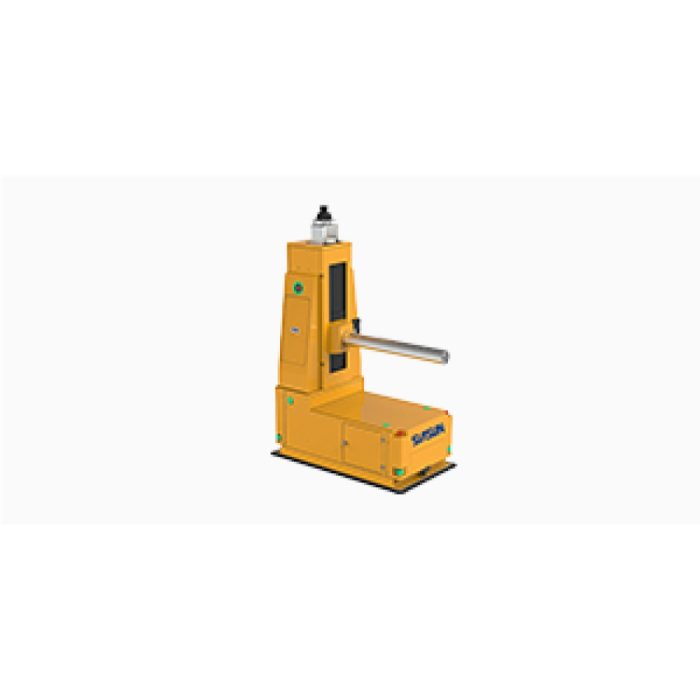
In stock
- BRAND:
- SIASUN
- MODEL:
- Cantilever Shaft Conveyor Mobile Robot
- PART #:
- Cantilever Shaft Conveyor Mobile Robot
- ORIGIN:
- China
- Warranty:
- 12 MONTHS
- AVAILABILITY:
- SUBJECT TO AVAILABILITY
- SKU:
- SIASUN-Cantilever-Shaft-Conveyor-Mobile-Robot
SIASUN Cantilever Shaft Conveyor Mobile Robot (Cantilever Shaft Conveyor Mobile Robot)
In a lithium battery plant, conveyor lines rarely share a common height. Electrode fabrication, cell assembly and PACK stations are each laid out around their own equipment, and the pallet travelling between them must arrive at whatever level the next line expects. The SIASUN Cantilever Shaft Conveyor Mobile Robot meets that challenge by carrying its own conveyor and raising it. An AGV base with an integrated roller or chain conveyor, a cantilever shaft for load handling and an electric lead screw that sets the transfer height allow one mobile platform to work with the lines a factory already has, rather than requiring the floor to be rebuilt around a single standard.
Robots Middle East supplies the SIASUN Cantilever Shaft Conveyor Mobile Robot to manufacturers, integrators and logistics operators across the Middle East. We prepare each quotation against the customer's layout, line heights and load profile, and we coordinate delivery, deployment support and after-sales assistance throughout the region.
Background
SIASUN and its mobile robot portfolio
SIASUN is a Chinese robotics manufacturer based in Shenyang, with roots in the country's research community in automation. Its catalogue spans industrial manipulators, cleanroom handling equipment and an extensive family of mobile robots, from compact transfer units to heavy-duty carriers intended for very large loads. The conveyor mobile robot belongs to the part of that family designed for production intralogistics, where a vehicle must not only move goods but hand them over to fixed equipment without human intervention. SIASUN supports its mobile robot solutions with the IMRS 2.0 platform, which brings multi-robot dispatching, route optimisation, data analytics and digital twins under one system.
Conveying, docking and the cantilever shaft
The defining feature of this robot is the way it transfers material. Instead of lifting a rack from underneath or relying on a forklift-style mast, it docks with a floor conveyor line and moves the palletised load across on its own roller or chain conveyor. Load handling is by cantilever shaft, and the electric lead screw lifting mechanism raises the conveying deck to match the receiving line. Docking relies on multi-navigation fusion with millimetre-level alignment, which is the quality that matters most when two conveyors have to meet edge to edge. The robot also offers industrial-grade reliability for long-term 24/7 running, a requirement in battery plants that operate continuously.
Technical Specifications
| Specification | Value |
|---|---|
| Product type | High-efficiency material transfer platform |
| Base | AGV base |
| Conveyor | Integrated roller/chain conveyors |
| Load handling | Cantilever shaft |
| Lifting mechanism | Electric lead screw |
| Lifting height (mm) | 750-1800 |
| Rated payload (kg) | ≤1000 |
| Robot weight (kg) | 2200 |
| Drive mode | Dual-wheel differential / steering wheel |
| Navigation and docking | Multi-navigation fusion, millimetre-level alignment |
| Reliability | Industrial-grade, for long-term 24/7 running |
| Software platform | IMRS 2.0 (multi-robot dispatching, route optimisation, data analytics, digital twins) |
| Application | Lithium battery manufacturing, from electrode fabrication and cell assembly to module and PACK processes |
Specifications are as published by the manufacturer and are confirmed against the datasheet at quotation.
The manufacturer has not published the specific navigation method, positioning or docking accuracy figures, battery type and capacity, charging method, travel speed, dimensions, safety sensors, IP rating or conveyor load size; these are confirmed at quotation.
How does a cantilever shaft conveyor robot differ from a standard lifting AGV?
A conventional lifting AGV typically drives beneath a rack or cart, raises it slightly and carries it away. That approach suits warehouses with standardised carts, but it leaves a gap wherever goods arrive on a fixed conveyor. Someone, or something, still has to move the pallet from the line onto the vehicle and off again at the destination.
The SIASUN Cantilever Shaft Conveyor Mobile Robot removes that step. Because it carries a roller or chain conveyor of its own, it can align with a floor line and run the pallet straight across, so the handover becomes part of the automated flow rather than an interruption to it. The lifting range of 750-1800 mm is what makes this practical in a mixed plant: the same robot can receive a load at one height and deliver it at another, which a fixed-height conveyor vehicle cannot do.
The figures also give a sense of the machine's build. With a robot weight of 2200 kg against a rated payload of ≤1000 kg, this is a substantial industrial vehicle rather than a light shuttle, and site planners should treat it accordingly when assessing floor loading and aisle routes.
What does the IMRS 2.0 platform add to the robot?
A single conveyor robot can close one gap; a fleet can carry an entire production flow. The IMRS 2.0 platform is the layer that turns individual vehicles into that fleet. It dispatches multiple robots, optimises their routes, analyses operational data and supports digital twins, giving engineering teams a model of their intralogistics in which changes can be tested before they reach the floor.
For plants that intend to plan and simulate their material flow in detail, the SIASUN Mobile Robot Digital Twin System (Mobile Robot Digital Twin System) is the related product to review alongside this robot. Together they allow a factory to plan conveyor handoffs, monitor them in operation and refine them as production volumes change.
Who is the SIASUN Cantilever Shaft Conveyor Mobile Robot for?
The clearest fit is the lithium battery manufacturer. The robot supports end-to-end intralogistics across electrode fabrication, cell assembly, module and PACK processes, and those are precisely the stages where palletised material moves between conveyor-fed equipment at differing heights. Cell and PACK producers building new gigafactory-scale lines, as well as those automating existing halls, will recognise the problem it addresses.
System integrators form the second group. An integrator designing a line-to-line transfer solution needs a vehicle that docks with conveyors rather than replacing them, and a fleet platform that can coordinate several robots. Plant engineering and operations teams in other conveyor-based industries, where palletised loads move between fixed lines around the clock, may also find the format suitable for their application.
Buyers whose loads exceed this robot's rated payload should look instead at SIASUN's heavy-duty carriers, such as the SIASUN 3T Heavy-Duty Mobile Robot and the SIASUN 5T Heavy-Duty Mobile Robot. The wider range is presented in our Mobile Robots category.
What is the SIASUN Cantilever Shaft Conveyor Mobile Robot used for?
- Electrode fabrication transfer – moving palletised material between coating, pressing and slitting lines.
- Cell assembly feeding – delivering components to assembly stations and collecting finished output.
- Module and PACK logistics – carrying modules and packs between assembly, testing and dispatch lines.
- Line-to-line pallet handover – docking with floor conveyors to bridge gaps between fixed lines.
- Height-matched transfer – raising the conveyor deck to meet lines set at different levels within the lifting range.
- Continuous fleet operation – running round the clock under IMRS 2.0 dispatching and route optimisation.
Pricing and Availability
The SIASUN Cantilever Shaft Conveyor Mobile Robot is supplied on a quotation basis, as each project depends on the layout, line heights, load profile and fleet size involved. Robots Middle East reviews your requirements and prepares a configuration suited to your site. Delivery, customs clearance and support are arranged together with the quotation. To begin, please send us your project details through the quotation request available on this page.
Frequently Asked Questions
What loads can the robot carry?
It handles palletised loads with a rated payload of ≤1000 kg, transferred by its integrated roller or chain conveyor.
What height range can it transfer at?
The lifting height is 750-1800 mm, set by an electric lead screw lifting mechanism, so the robot can meet conveyor lines at different levels.
How does it align with fixed conveyor lines?
The robot docks using multi-navigation fusion with millimetre-level alignment, so the load passes from one conveyor to the other edge to edge.
Which drive configuration does it use?
The drive mode is dual-wheel differential / steering wheel. Robots Middle East advises on the configuration appropriate to your site.
Can it operate continuously?
Yes. The robot is designed for industrial-grade reliability in long-term 24/7 running.
Can several robots work together?
Yes. SIASUN mobile robot solutions run on the IMRS 2.0 platform, which provides multi-robot dispatching, route optimisation, data analytics and digital twins.
Where can I buy the SIASUN Cantilever Shaft Conveyor Mobile Robot and what does it cost?
You can buy it from Robots Middle East, which supplies it across the Middle East. The cost depends on configuration and project scope, so we provide it in a tailored quotation on request.
Summary
The difficulty in battery intralogistics is rarely distance alone; it is the moment a pallet must leave one line and enter another at a different height. The SIASUN Cantilever Shaft Conveyor Mobile Robot addresses that moment directly, combining an AGV base, an integrated roller or chain conveyor, cantilever shaft load handling and a 750-1800 mm lifting range with millimetre-level docking and fleet control through IMRS 2.0. For manufacturers and integrators who want their existing lines connected rather than replaced, working with a specialist supplier in the region, this page is the starting point.