
SIASUN Four-Lift Automotive Assembly Mobile Robot (Four-Lift Automotive Assembly Mobile Robot)
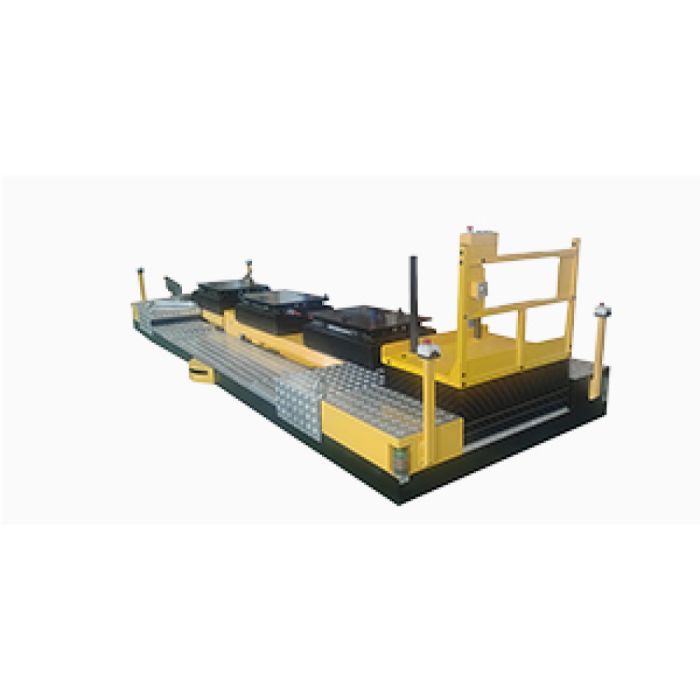
In stock
- BRAND:
- SIASUN
- MODEL:
- Four-Lift Automotive Assembly Mobile Robot
- PART #:
- Four-Lift Automotive Assembly Mobile Robot
- ORIGIN:
- China
- Warranty:
- 12 MONTHS
- AVAILABILITY:
- SUBJECT TO AVAILABILITY
- SKU:
- SIASUN-Four-Lift-Automotive-Assembly-Mobile-Robot
SIASUN Four-Lift Automotive Assembly Mobile Robot (Four-Lift Automotive Assembly Mobile Robot)
A conventional final-assembly hall puts its decisions into concrete. Lift tables are anchored, pits are dug and conveyors are bolted down for the vehicle the line was designed around, and every later model change has to negotiate with that floor. The SIASUN Four-Lift Automotive Assembly Mobile Robot takes the opposite approach. It is a self-driving lift platform that carries the heavy underbody components of a car, the powertrain, the front and rear axles and the battery pack, to the station where they are needed and then raises them into the body with four lift points working in step. What used to be fixed in the floor becomes a matter of routing and fleet scheduling, so the plant layout can follow the production plan rather than dictate it.
Robots Middle East supplies the SIASUN Four-Lift Automotive Assembly Mobile Robot to vehicle manufacturers, assembly plants and automation integrators across the Middle East. Robots Middle East prepares the quotation for your project, coordinates delivery to your site and remains your point of contact for support once the robot is working on your line, so that specification, logistics and after-sales care are handled by one supplier.
Background
SIASUN and its mobile robot range
SIASUN is a Chinese robotics and automation manufacturer whose portfolio includes mobile robots for industrial transport and assembly, from heavy-duty load carriers to platforms designed for specific production processes. The automotive assembly family is one of those process-specific lines. The manufacturer names four versions of it, the Single-Lift, Dual-Lift, Triple-Lift and Four-Lift Automotive Assembly Mobile Robots, which differ in how many lift points they bring to the work. The Four-Lift model described on this page is the version built around four synchronised lift points and is aimed at the most demanding stations in final assembly.
A scissor structure driven by spiral lifts
At the core of the robot is a four-point scissor-lift structure. Each lift point uses a spiral lift mechanism rated for a single-point load of 1,000 kg, including spring force, and the four points rise synchronously. The scissor geometry gives a long vertical stroke from a compact platform, while the synchronised spiral lifts keep the load level as it climbs. Above the lift sits a floating platform that can shift along two horizontal axes and rotate slightly, so the component can be aligned with the body by hand once the robot has arrived. Underneath, a four-wheel steering drive gives the vehicle omnidirectional mobility, letting it approach a station from the direction the layout requires.
Technical Specifications
| Specification | Value |
|---|---|
| Load capacity | 3500 kg |
| Navigation accuracy | ±10 mm / ±1° |
| Drive system | Four-wheel steering drive |
| Mobility | Omnidirectional |
| Lifting stroke | 1050 mm |
| Lift platform float | X ±125 mm; Y ±50 mm; Angle ±2° |
| Lifting mechanism | Spiral lift, single-point load 1,000 kg (incl. spring force) |
| Lift structure | Four-point scissor-lift structure |
| Lift synchronisation | 4-point synchronous lift |
| Operator support | Assisted assembly with onboard operator |
| Fleet control | Intelligent fleet scheduling |
| Application area | Automotive manufacturing |
Specifications are given as published by the manufacturer and are confirmed against the datasheet at quotation.
SIASUN has not published the dimensions, weight, battery capacity, travel speed, operating time, charging method, safety sensors, IP rating or power supply voltage; these are confirmed with you at quotation.
Why does four-point synchronous lifting matter on an assembly line?
Raising a heavy, wide component into a vehicle body is less about strength than about attitude. If one corner of a battery pack or an axle module rises ahead of the others, the part tilts, the mounting points no longer line up and the operator has to fight the load instead of fastening it. The Four-Lift robot addresses this by sharing the load between four spiral lift points, each rated for 1,000 kg including spring force, and driving them synchronously. The 4-point synchronous lift exists for higher stability and accuracy, and that is precisely what a marriage operation needs: a component that climbs flat through the full 1050 mm stroke and reaches the body in the attitude it left the robot.
The arrangement also explains the total load capacity of 3500 kg. Four lift points give a broad, stable base under long and heavy assemblies, which is why this version is the one SIASUN positions for combined requirements covering powertrain, axles, battery and manned operations rather than a single task.
How does the floating platform help operators finish the job?
A mobile robot stops within a tolerance, not at an absolute point. This model navigates to ±10 mm and ±1°, which is close enough to bring the component under the body but not the final word on alignment with fixing holes and studs. The lift platform float closes that gap: the top plate can move X ±125 mm, Y ±50 mm and turn ±2°, so the operator can nudge a heavy assembly into register without repositioning the whole vehicle. Because the robot supports assisted assembly with an operator on board, the person doing that final alignment can ride with the load and work from the platform itself. The result is a division of labour that suits final assembly well: the robot handles transport, height and stability, while human judgement handles the last few millimetres.
Who is the SIASUN Four-Lift Automotive Assembly Mobile Robot for?
The first audience is the vehicle manufacturer running mixed-model final assembly. Where saloons, SUVs and light commercial vehicles share a hall, fixed lifts tuned to one wheelbase quickly become a constraint, and a fleet of scheduled mobile platforms that supports complex layouts and multi-process combinations is far easier to adapt.
The second is the electric vehicle programme. Battery packs are heavy, wide and sensitive to how they are presented to the body, which makes synchronised four-point lifting and a floating platform particularly relevant to pack installation.
The third group is the automation integrator and the plant engineering team planning a new line or the retrofit of an existing one. For them the attraction is that stations can be defined by fleet routing rather than by civil works, which matters wherever floor alterations are slow or expensive.
Plants whose stations only need simpler lifting may find that one of the other members of the family, the Single-Lift, Dual-Lift or Triple-Lift version, fits the task, and Robots Middle East reviews that choice with you against your process. Other mobile platforms for production environments can be found among our Factory Robots.
What is the SIASUN Four-Lift Automotive Assembly Mobile Robot used for?
- Powertrain installation: carrying engine, motor or drive units to the body and raising them level into position.
- Front axle assembly: presenting the front axle module at the correct height for fastening from below.
- Rear axle assembly: supporting the rear axle as it is aligned with its mounting points using the floating platform.
- Battery pack installation: lifting traction batteries into electric vehicle bodies with four points rising in step.
- Manned assisted assembly: giving an onboard operator a stable working position alongside the component being fitted.
- Mixed-model, multi-station flow: serving several stations and vehicle variants under intelligent fleet scheduling.
Pricing and Availability
The SIASUN Four-Lift Automotive Assembly Mobile Robot is supplied on a quotation basis, because each installation depends on the vehicles you build, the components you lift and the layout of your hall. Delivery, customs clearance and support are arranged together with the quotation. To begin, send Robots Middle East a short description of your line and the stations you wish to automate, using the quotation request available on this page.
Frequently Asked Questions
What load can the SIASUN Four-Lift Automotive Assembly Mobile Robot carry?
The load capacity is 3500 kg. Each of the four spiral lift points carries a single-point load of 1,000 kg, including spring force.
How high does the platform lift?
The lifting stroke is 1050 mm, delivered by a four-point scissor-lift structure with synchronised spiral lifts.
How precisely does the robot position itself?
Navigation accuracy is ±10 mm / ±1°. Final alignment is then made with the floating lift platform, which moves X ±125 mm, Y ±50 mm and rotates ±2°.
Can an operator ride on the robot?
Yes. The robot supports assisted assembly with an onboard operator, so the person fitting the component can work from the platform.
Can it work with several vehicle models on one line?
It is designed for multi-model, multi-station production. Omnidirectional mobility and intelligent fleet scheduling let it adapt to complex layouts and multi-process combinations.
What drive system does the robot use?
It uses a four-wheel steering drive, which gives it omnidirectional mobility. This lets it approach and leave stations from the direction your layout requires.
Where can I buy the SIASUN Four-Lift Automotive Assembly Mobile Robot and what does it cost?
You can buy it from Robots Middle East, which supplies it across the Middle East. The cost depends on your configuration and project scope, so it is provided in a tailored quotation rather than as a list price.
Summary
The SIASUN Four-Lift Automotive Assembly Mobile Robot moves the logic of an assembly station out of the concrete and into the fleet. Four synchronised spiral lift points in a scissor structure raise up to 3500 kg through 1050 mm while keeping the load level, a floating platform lets an onboard operator complete the final alignment, and four-wheel steering with fleet scheduling lets the same robots serve different stations and models as production changes. For manufacturers, battery programmes and integrators in the Middle East who want a final-assembly line that can be reshaped by planning rather than by building work, this page is the starting point.