
SIASUN GCR20-1400-EX (GCR20-1400-EX)
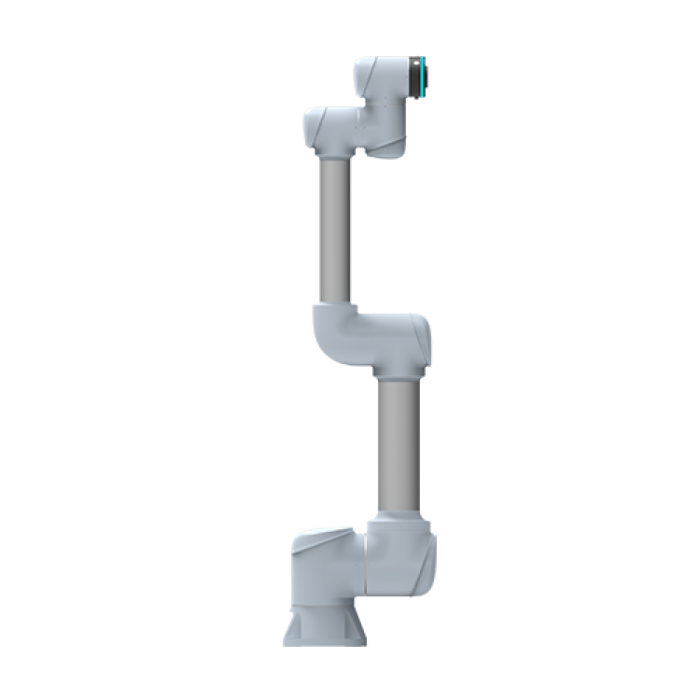
In stock
- BRAND:
- SIASUN
- MODEL:
- GCR20-1400-EX
- PART #:
- GCR20-1400-EX
- ORIGIN:
- China
- Warranty:
- 12 MONTHS
- AVAILABILITY:
- SUBJECT TO AVAILABILITY
- SKU:
- SIASUN-GCR20-1400-EX
SIASUN GCR20-1400-EX (GCR20-1400-EX)
In many factories the difficult part of automation is not buying a robot; it is teaching one. Programming time, scarce integration specialists and code that only one engineer fully understands can hold a project back long after the arm has been bolted to its base. The SIASUN GCR20-1400-EX addresses that problem from the operator's side. Its drag-and-drop teaching programming allows staff to guide the arm through a task by hand and build the program from the movement itself. A maximum payload of 20 kg and a reach of 1,400 mm give that taught motion genuine working capacity. Sixteen TUV-certified safety functions for human–machine collaboration keep the person doing the teaching at the centre of the design.
Robots Middle East sells the SIASUN GCR20-1400-EX and supplies it to customers throughout the Middle East. Our team prepares the quotation, coordinates delivery to your site and remains your point of contact for technical support once the arm is in service. A single partner therefore looks after the project from the first enquiry to steady production.
Background
SIASUN and the DUCO sub-brand
SIASUN DUCO is the sub-brand of SIASUN dedicated to intelligent robotics. It has broken foreign technology monopolies in multiple fields, and all of its core components are independently developed. For a buyer, that lineage has a practical side. A manufacturer that designs its own core components keeps control over how the arm, its drives and its control software work together, and that shapes how the product is supported over its service life. The GCR family, to which the GCR20-1400-EX belongs, is offered in several versions, among them the GCR10-1300-EX and the GCR16-2000-EX. A project can therefore be matched to the version whose figures suit the task.
Teaching by hand within a collaborative safety concept
Two features define the positioning of this arm. The first is drag-and-drop teaching programming, which lowers the threshold for use and makes operation simpler. Rather than writing every waypoint in code, an operator moves the arm into position and records the motion. The second is its safety concept. The arm carries 16 TUV-certified safety functions designed for human–machine collaboration, with safety placed first. Together these features describe a robot intended to be set up, adjusted and re-taught by the people who work beside it, not only by a specialist programmer.
Technical Specifications
| Specification | Value |
|---|---|
| Maximum payload | 20 kg |
| Reach | 1,400 mm |
| Repeatability | ±0.05 mm |
| Maximum TCP speed | 2.2 m/s |
| IP class (manufacturer page) | IP54/IP65 |
| Degrees of freedom | 6 |
| Safety functions | 16 TUV-certified safety functions |
Specifications are as published by the manufacturer and are confirmed against the datasheet at quotation.
SIASUN has not published the weight of the arm, its mounting footprint, the package contents, the explosion-proof rating of the arm or its product certifications; each of these is confirmed at quotation.
How does drag-and-drop teaching change the way the GCR20-1400-EX is deployed?
With a conventional industrial arm, every change to a task tends to pass through a programming specialist, and every visit from that specialist costs production time. Drag-and-drop teaching shortens that chain. The person who knows the task best is often the operator who has performed it by hand for years. That operator can guide the GCR20-1400-EX through the required positions and let the controller record the path. When a fixture moves or a part changes, the program can be re-taught at the cell rather than rewritten at a desk.
The figures in the table support that way of working. A repeatability of ±0.05 mm means that a position taught once is returned to consistently, which matters for placing parts into fixtures or presenting them to a machine. Six degrees of freedom allow the tool to be oriented freely, so the operator can teach the angle of approach as naturally as the position itself. A maximum TCP speed of 2.2 m/s gives the arm room to move briskly between taught points once the program is running. The safety functions govern how it behaves when people share the space.
The practical result is a cell that can be adapted by its own team. For plants that run varied batches or change product frequently, that flexibility often carries as much weight in the decision as the payload figure.
What does the IP54/IP65 class mean for the GCR20-1400-EX?
The manufacturer page lists the IP class of the GCR20-1400-EX as IP54/IP65. In the IP code system, the first digit describes protection against solid particles such as dust, and the second describes protection against water. An IP54 rating indicates protection against dust ingress to a degree that does not interfere with operation, together with protection against splashing water. IP65 indicates that the enclosure is dust-tight and protected against water jets.
One distinction deserves emphasis. An IP class describes ingress protection and is not an explosion-proof rating. It should therefore not be read as approval for use in a potentially explosive atmosphere, whatever the designation in the model name.
Who is the SIASUN GCR20-1400-EX for?
The arm is well suited to manufacturers whose tasks combine mid-weight handling with frequent change. The combination of a 20 kg payload and hand-guided teaching is most useful in plants that need a robot to lift meaningful loads but cannot dedicate a full-time programmer to the cell. Production engineers in automotive supply, metalworking, plastics and general assembly will recognise the profile. Their tasks are repetitive enough to automate, but varied enough that rigid programming becomes a burden.
System integrators form a second group. For them, an arm that customers' own staff can re-teach reduces the number of call-outs after commissioning and makes a proposal easier to hand over. Training centres, technical colleges and research laboratories form a third, because hand-guided programming makes the principles of robot motion visible to students before they have to master a programming language.
Process-industry teams evaluating the EX family are a fourth group. For them, the distinction between ingress protection and explosion protection described above is the first point to discuss with our engineers.
Where a task calls for a different balance of payload and reach, the sibling versions are worth comparing. The SIASUN GCR10-1300-EX (GCR10-1300-EX) and the SIASUN GCR16-2000-EX (GCR16-2000-EX) belong to the same family, and our team can set the versions side by side for your task. Buyers still surveying the field can browse the wider ranges of Robot Arms and Industrial Robots.
What is the SIASUN GCR20-1400-EX used for?
- Machine tending — loading and unloading machine tools, presses or moulding machines, with positions taught by hand at the machine.
- Palletising and depalletising — building and breaking down loads at the end of a line, where reach and payload decide what the cell can handle.
- Material handling between stations — transferring parts from conveyor to fixture or between process steps without a dedicated operator.
- Assembly — placing and joining components where consistent repeatability keeps parts aligned shift after shift.
- Inspection and testing — presenting parts to cameras, gauges or test rigs in a fixed, repeatable orientation.
- Training and research — teaching the fundamentals of collaborative robotics through hand-guided programming in colleges and laboratories.
Pricing and Availability
Robots Middle East supplies the SIASUN GCR20-1400-EX on the basis of a quotation prepared for your application. Tell us about the task, the workpiece and the environment in which the arm will operate, and we will propose a configuration that fits them. Delivery, customs and support are arranged with the quotation. To begin, use the quotation request available on this page.
Frequently Asked Questions
What payload can the SIASUN GCR20-1400-EX carry?
The arm has a maximum payload of 20 kg. When sizing a cell, remember that the weight of the gripper or tool forms part of the load the arm carries.
How far can the GCR20-1400-EX reach?
Its reach is 1,400 mm. Together with the position of the base, that reach defines the working envelope of the cell.
How is the arm programmed?
It uses drag-and-drop teaching programming: the operator guides the arm through the task and the motion is recorded. This lowers the threshold for use and allows staff without deep programming experience to set up and adjust tasks.
What safety features does it have?
The GCR20-1400-EX carries 16 TUV-certified safety functions for human–machine collaboration. The safety assessment of the complete cell, including the tool and the workpiece, remains part of every installation project.
Is the GCR20-1400-EX certified for explosive atmospheres?
The explosion-proof rating and the certifications are among the specifications listed as unpublished beneath the table. Robots Middle East settles them with the manufacturer before the arm is specified for any classified area.
How does it differ from the GCR10-1300-EX and the GCR16-2000-EX?
All three belong to the same SIASUN family, but each version has its own payload and reach. Robots Middle East can compare them side by side for your task.
Where can I buy the SIASUN GCR20-1400-EX and what does it cost?
You can buy it from Robots Middle East, which supplies the arm throughout the Middle East. The cost depends on the configuration and scope of your project and is set out in a quotation prepared for you.
Summary
The SIASUN GCR20-1400-EX treats teaching as the centre of automation rather than an obstacle to it. Drag-and-drop programming lets the people who know a task pass that knowledge to the arm directly. A 20 kg payload, a 1,400 mm reach, ±0.05 mm repeatability and six degrees of freedom give that knowledge the capacity to do real work. Sixteen TUV-certified safety functions keep the collaboration safe, and the independently developed technology of SIASUN DUCO stands behind the design. For a team that wants a robot its own operators can teach, this page is the starting point.