
SIASUN Mobile Manipulator Robot (Mobile Manipulator Robot)
In stock
- BRAND:
- SIASUN
- MODEL:
- Mobile Manipulator Robot
- PART #:
- Mobile Manipulator Robot
- ORIGIN:
- China
- Warranty:
- 12 MONTHS
- AVAILABILITY:
- SUBJECT TO AVAILABILITY
- SKU:
- SIASUN-Mobile-Manipulator-Robot
SIASUN Mobile Manipulator Robot (Mobile Manipulator Robot)
Every mobile manipulator works to two tolerances at once. The base that crosses the factory floor stops within ±10 mm and ±1° of its target, while the gripper at the end of the arm must arrive within ±0.5 mm of the workpiece. The SIASUN Mobile Manipulator Robot (Mobile Manipulator Robot) is designed to close the distance between those two figures. It fuses vision with navigation, so a vehicle parked to logistics accuracy can still handle parts to the precision of a fixed cell. One machine can therefore transport, sort, load and unload without an operator stepping in to make up the difference.
Robots Middle East supplies the SIASUN Mobile Manipulator Robot to manufacturers, logistics operators and technical facilities across the Middle East. We prepare each quotation around the collaborative arm you select and the conditions of your site. Robots Middle East also arranges delivery to your premises and remains your point of contact for support once the system is in service.
Background
SIASUN: robot arms and AGVs from one manufacturer
SIASUN is a Chinese robotics manufacturer whose portfolio covers both industrial robot arms and automated guided vehicles. Many integrators source these two technologies from different suppliers and join them on site. SIASUN builds both, and this product brings its robot and AGV expertise together in a single intelligent solution. A buyer therefore deals with one manufacturer for the mobile base, the arm and the way the two cooperate, rather than reconciling separate control philosophies after installation.
For a plant manager, that lineage matters in practical terms. Mobility and manipulation were engineered by the same organisation, so the hand-over between driving to a station and working at it is part of the product rather than a custom integration project.
Key technology: vision and navigation working as one
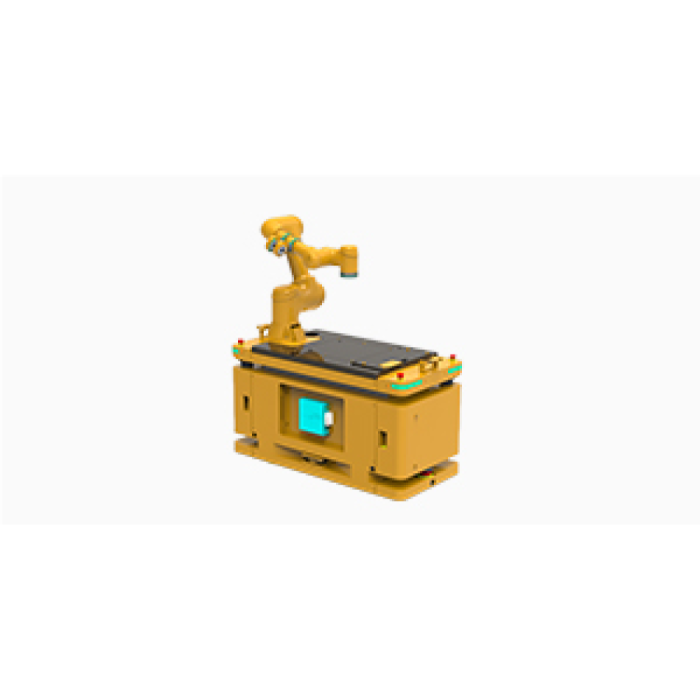
The product mounts an industrial robotic arm on a mobile base. It moves autonomously between stations and captures or picks workpieces with high precision. Navigation combines SLAM with QR code positioning, so the vehicle can map its surroundings while also referencing fixed markers where a route demands it. At the station, vision and navigation are fused for precision work: the robot does not rely on parking perfectly, because its perception corrects the arm's approach to the part in front of it.
The platform is offered with a choice of three SIASUN collaborative arms, the GCR10, GCR14 and GCR20, which differ in end-effector payload. The design concept is deliberately flexible, aimed at the varied and changing requirements of modern industrial intralogistics, from material feeding to unloading.
Technical Specifications
| Specification | Value |
|---|---|
| End-effector payload | 10 kg / 14 kg / 20 kg (for collaborative arm GCR10/14/20) |
| Platform payload | 670 kg max |
| Navigation method | SLAM & QR CODE |
| Parking accuracy | ±10 mm / ±1° |
| End-effector overall accuracy | ±0.5 mm |
| Safety devices | Collision detection / safety edge / obstacle-avoidance LiDAR / E-stop, etc. |
| Supported environments | Cleanroom, explosion-proof and hazardous use |
Specifications are as published by the manufacturer and are confirmed against the datasheet at quotation.
The manufacturer has not published the overall dimensions, robot weight, battery capacity, runtime, travel speed, IP rating, arm reach, power supply, package contents or communication interfaces; these are confirmed at quotation.
How does a mobile robot reach ±0.5 mm when it parks to ±10 mm?
This is the question that separates a mobile manipulator from a transport robot that happens to carry an arm. A vehicle stopping within ±10 mm and ±1° is well suited to delivering a trolley or a pallet. On its own, however, it would leave the gripper too far from where a fixture or a tray position actually sits. The SIASUN Mobile Manipulator Robot does not try to make the base park more accurately than it needs to. Instead, it fuses vision with navigation: once the platform has arrived, perception establishes where the workpiece really is, and the arm adjusts its approach. The result is an end-effector overall accuracy of ±0.5 mm.
For the buyer, this division of labour has a practical consequence. Stations do not need to be rebuilt with mechanical docking fixtures for every stop, and the robot can serve several machines along a route. The combination of SLAM and QR code navigation also gives the planning team a choice. Open areas can be handled by mapping, while markers can anchor the stops where repeatability matters most.
Which arm should you choose: GCR10, GCR14 or GCR20?
The published figures that are tied to a specific version concern the arm itself: how much it can hold at its end-effector. The GCR10 arm handles 10 kg, the GCR14 arm 14 kg and the GCR20 arm 20 kg. The platform payload, navigation method and accuracy figures are published for the product as a whole.
The choice should follow the heaviest item the gripper must lift, together with the weight of the gripper or tooling itself, rather than the weight of everything the platform carries. A robot feeding light machined parts or electronic components is well served by the GCR10. Heavier castings, larger trays or tooling-heavy grippers point towards the GCR14 or GCR20. Because arm reach is among the figures not yet published, it is worth comparing your fixture layout with the datasheet before a version is finalised.
Who is the SIASUN Mobile Manipulator Robot for?
The first group is manufacturers whose parts already move automatically between areas but still depend on people at each machine to load and unload. For them, the robot removes the manual step at the station itself. It belongs naturally alongside the other systems in our Factory Robots range.
The second group is intralogistics and warehouse operators who want one platform that can carry goods, sort them and place them, rather than separate transport and picking equipment. The broader Mobile Robots category shows how this product sits among SIASUN's other autonomous vehicles.
The third group is operators of controlled or demanding environments. Semiconductor, pharmaceutical and laboratory facilities need handling in cleanrooms, while process industries have areas where explosion-proof equipment or hazardous-area operation is required. The platform supports cleanroom, explosion-proof and hazardous use, and Robots Middle East works with you to define the configuration for your zone.
Within each group, the arm decides the fit. Light-part handling suits the GCR10 arm, while heavier workpieces call for the GCR14 or GCR20 arm.
What is the SIASUN Mobile Manipulator Robot used for?
- Material feeding – bringing raw parts to production machines and placing them where the process needs them.
- Unloading – removing finished or semi-finished workpieces from machines and carrying them on to the next step.
- Machine loading and tending – serving several machines along one route with the same robot, rather than fitting an arm to each.
- Sorting – picking items from mixed loads and placing them by type, order or destination.
- Cleanroom handling – moving and placing sensitive components where people and contamination must be kept to a minimum.
- Hazardous-area operations – transporting and handling material in explosion-proof or hazardous zones, keeping personnel away from risk.
Pricing and Availability
The SIASUN Mobile Manipulator Robot is supplied on quotation, because the right offer depends on the arm version, the gripper, the navigation set-up and the environment in which the robot will work. Tell us about your parts, stations and site conditions, and Robots Middle East will prepare a quotation that reflects your application. Delivery, customs clearance and support are arranged together with the quotation. To begin, please use the quotation request available on this page.
Frequently Asked Questions
Which navigation method does the SIASUN Mobile Manipulator Robot use?
It navigates using SLAM combined with QR code positioning. This allows the robot to map its working area while referencing fixed markers where needed.
How much can the robotic arm lift?
The end-effector payload depends on the collaborative arm fitted: 10 kg with the GCR10, 14 kg with the GCR14 and 20 kg with the GCR20.
How much can the mobile platform carry?
The platform payload is 670 kg max. This is separate from the load the arm handles at its end-effector.
How precise is the robot?
The mobile base parks to ±10 mm / ±1°, and the end-effector achieves an overall accuracy of ±0.5 mm. The fusion of vision and navigation is what closes the gap between the two.
Which safety devices are fitted?
The safety equipment includes collision detection, a safety edge, obstacle-avoidance LiDAR and an E-stop, among other devices.
Can it operate in cleanrooms or hazardous areas?
Yes, the platform supports cleanroom, explosion-proof and hazardous use. Robots Middle East will discuss the configuration your specific zone requires.
Where can I buy the SIASUN Mobile Manipulator Robot and what does it cost?
Robots Middle East supplies the SIASUN Mobile Manipulator Robot across the Middle East. The cost depends on the arm version and the configuration you need, so please request a quotation and our team will prepare an offer for your application.
Summary
The SIASUN Mobile Manipulator Robot is built around a simple idea: a vehicle does not need to park with the precision of a fixture if the arm can see what it is reaching for. By fusing vision with navigation, it turns a stop of ±10 mm / ±1° into handling at ±0.5 mm. On that basis it combines transport, sorting and loading or unloading in one SIASUN platform, with a 670 kg max platform payload and a choice of GCR10, GCR14 or GCR20 arms. For manufacturers, logistics operators and facilities with cleanroom or hazardous areas who want to remove the manual step at the station, this page is the starting point.