
SIASUN Mobile Robot Transport Control System (Mobile Robot Transport Control System)
In stock
- BRAND:
- SIASUN
- MODEL:
- Mobile Robot Transport Control System
- PART #:
- Mobile Robot Transport Control System
- ORIGIN:
- China
- Warranty:
- 12 MONTHS
- AVAILABILITY:
- SUBJECT TO AVAILABILITY
- SKU:
- SIASUN-Mobile-Robot-Transport-Control-System
SIASUN Mobile Robot Transport Control System (Mobile Robot Transport Control System)
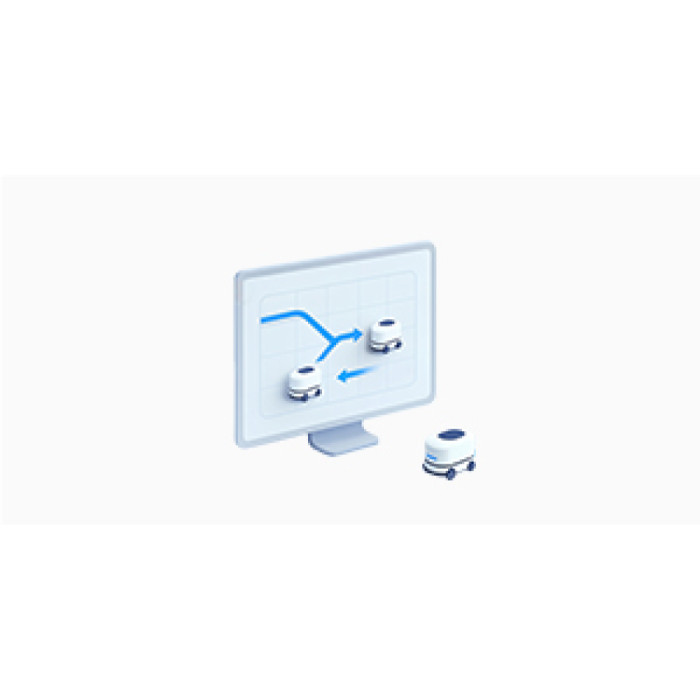
On a railway, the timetable promises a train every few minutes, yet the signalling decides whether that promise holds. The locomotives can be powerful and the track new, but without a system that tells each train when to proceed, where to wait and which line to take, capacity collapses at the first busy junction. Fleets of mobile robots behave in much the same way. Once vehicles share aisles, crossings and handover points, throughput depends less on the robots and more on the logic that sequences them. The SIASUN Mobile Robot Transport Control System (Mobile Robot Transport Control System) is that signalling layer for the factory floor. It uses AI-powered traffic models to raise transport efficiency through congestion estimation, intelligent detours, intelligent obstacle avoidance and dynamic congestion resolution.
Robots Middle East supplies the SIASUN Mobile Robot Transport Control System to manufacturers, logistics operators and system integrators across the Middle East. Our team prepares each quotation around the site and the fleet in question, arranges delivery and import formalities into the customer's country, and remains the point of contact for support once the system is in daily use.
Background
SIASUN Mobile Robotics and its scheduling heritage
SIASUN Mobile Robotics has independently developed mobile robot scheduling and management systems since its establishment in 2000. Its work has concentrated on a demanding set of industries: automotive manufacturing, new energy power batteries, semiconductors and photovoltaics. These are sectors in which material must arrive at the line on time, in the correct sequence and without disruption to production, so the software that directs vehicles is treated as part of the production system rather than an accessory to it. The Transport Control System grows out of that history of in-house scheduling development.
TCS within the iMRS 2.0 platform
TCS is not offered as an isolated tool. SIASUN positions it as a module of the iMRS 2.0 platform, alongside the LWS and SAS modules. The iMRS platform encompasses six key sub-modules, intended to provide an end-to-end solution across processes, scenarios and customer needs. All of SIASUN's solutions are supported by the IMRS 2.0 platform, which enables multi-robot dispatching, route optimisation, data analytics and digital twins. Within that structure, TCS carries the traffic intelligence: it is the part that judges where congestion is building and how vehicles should be routed to avoid it.
Technical Specifications
| Specification | Value |
|---|---|
| Product function (TCS) | AI-powered traffic models for congestion estimation, intelligent detours, intelligent obstacle avoidance and dynamic congestion resolution |
| Platform | iMRS 2.0, with TCS, LWS and SAS modules |
| Platform sub-modules (iMRS) | Six key sub-modules |
| Supported protocols (iMRS 2.0 platform) | VDA5050, Alliance Protocol, SIASUN's proprietary protocol |
| Scheduling scale (iMRS 2.0 platform) | Large-scale, hybrid scheduling for up to thousands of units |
| Platform capabilities (iMRS 2.0) | Multi-robot dispatching, route optimisation, data analytics, digital twins |
| Customisation services (iMRS 2.0 platform) | Secondary development, low-code development, predictive maintenance |
| Deployment time (iMRS 2.0 platform) | A relatively mature scenario within one month; more complex scenarios within two months, once customer site conditions are met |
Specifications as published by the manufacturer; confirmed against the datasheet at quotation.
The manufacturer has not published the server hardware requirements, the supported operating systems, the maximum fleet size for TCS on its own, the interfaces and APIs, the licensing model, the package contents or the software version; each of these is confirmed at quotation.
How does the Transport Control System deal with congestion?
Most fleet software reacts once vehicles have already stopped. TCS is designed to look further ahead. Congestion estimation lets the system judge where traffic is likely to build, so routing decisions can be taken before a junction fills rather than after. Intelligent detours then send vehicles along alternative paths when the preferred route is busy, keeping material moving even when the shortest line is not the fastest one.
Intelligent obstacle avoidance addresses the unplanned: a pallet left in an aisle, a person crossing a lane, a vehicle halted for a fault. Dynamic congestion resolution handles what remains when a jam does form, untangling the vehicles involved and restoring flow. Together, these four functions turn traffic control from a fixed set of rules into a model that adapts to the state of the floor, which matters most on sites where production priorities and material flows change throughout the shift.
What does the iMRS 2.0 platform add to TCS?
Traffic control is only as useful as the fleet it can reach. At platform level, iMRS 2.0 supports cross-platform integration, multiple languages, various vehicle models and multiple protocols, namely VDA5050, the Alliance Protocol and SIASUN's proprietary protocol. For a site that already runs, or plans to run, vehicles from more than one source, protocol support of this kind is often the deciding factor between one coordinated fleet and several separate ones.
The platform also sets the scale. iMRS 2.0 is capable of large-scale, hybrid scheduling for up to thousands of units, offering an integrated solution for material storage and distribution at plant and workshop level. Beyond scheduling, it adds data analytics and digital twins, which allow operators to study fleet behaviour and test changes away from the live floor. Because processes rarely stay still, SIASUN offers secondary development, low-code development and predictive maintenance so that features can be tailored as requirements evolve. Finally, the platform addresses project time: where customer site conditions are met, a relatively mature scenario can be implemented within one month, and more complex scenarios within two months.
Who is the SIASUN Mobile Robot Transport Control System for?
The clearest fit is the set of industries SIASUN has focused on since its foundation. Automotive plants need parts delivered to the line in sequence; manufacturers of new energy power batteries move sensitive material between process stages; semiconductor and photovoltaic producers require controlled, predictable flows through dense facilities. In each case, traffic between vehicles is a production concern, and a dedicated transport control layer earns its place.
Operators planning large or growing fleets form a second group. The scheduling scale of the iMRS 2.0 platform means a project can begin with a defined area and extend across a plant without changing the underlying system. Sites with mixed fleets, or with a requirement to work to an open standard such as VDA5050, will find the protocol support relevant.
System integrators are the third audience. The customisation services, including low-code development, give integrators room to adapt the platform to a customer's processes rather than reshaping the processes to fit the software. Buyers still selecting vehicles can browse the Mobile Robots range or the wider Factory Robots category, and Robots Middle East can advise which combination of vehicles and control software suits a given site.
What is the SIASUN Mobile Robot Transport Control System used for?
- Production line supply: keeping vehicles that feed assembly stations moving through shared aisles without queuing at crossings.
- Congestion management: estimating where traffic will build and resolving jams dynamically before they halt material flow.
- Plant-wide material distribution: coordinating storage and distribution at plant and workshop level within the iMRS 2.0 platform.
- Mixed-fleet coordination: bringing vehicles that use VDA5050, the Alliance Protocol or SIASUN's proprietary protocol under one scheduling layer.
- Process change and expansion: adapting routes and features through secondary and low-code development as layouts and priorities shift.
- Planning and optimisation: using data analytics and digital twins to examine fleet behaviour and refine routing away from the live floor.
Pricing and Availability
The SIASUN Mobile Robot Transport Control System is supplied on a quotation basis, because the right configuration depends on the size of the fleet, the vehicles involved, the protocols in use and the layout of the site. Robots Middle East reviews these points with each customer before preparing an offer. Delivery, customs clearance and ongoing support are arranged together with the quotation. To begin, please submit your project details through the quotation request available on this page.
Frequently Asked Questions
What does the SIASUN Mobile Robot Transport Control System do?
It coordinates traffic within a mobile robot fleet, using AI-powered traffic models for congestion estimation, intelligent detours, intelligent obstacle avoidance and dynamic congestion resolution. Its purpose is to raise transport efficiency on busy sites.
Is TCS part of a larger platform?
Yes. TCS is a module of SIASUN's iMRS 2.0 platform, alongside the LWS and SAS modules. The iMRS platform encompasses six key sub-modules in total.
Which communication protocols are supported?
The iMRS 2.0 platform supports VDA5050, the Alliance Protocol and SIASUN's proprietary protocol. It also supports cross-platform integration, multiple languages and various vehicle models.
How large a fleet can the platform schedule?
The iMRS 2.0 platform is capable of large-scale, hybrid scheduling for up to thousands of units. Robots Middle East assesses the fleet planned for your site when preparing the offer.
How long does deployment take?
Once customer site conditions are met, a relatively mature scenario can be implemented within one month. More complex scenarios can be implemented within two months.
Can the system be adapted to our own processes?
SIASUN offers secondary development, low-code development and predictive maintenance, allowing features to be customised as processes change. Robots Middle East can discuss the scope of such work as part of the quotation.
Where can I buy the SIASUN Mobile Robot Transport Control System and what does it cost?
Robots Middle East supplies the system across the Middle East. Pricing depends on the configuration of each project, so it is provided in a tailored quotation once your requirements have been reviewed.
Summary
A railway gains capacity through better signalling as much as through more trains, and a robot fleet is no different. The SIASUN Mobile Robot Transport Control System provides that signalling intelligence: it anticipates congestion, reroutes vehicles, avoids obstacles and clears jams as conditions change. Backed by the iMRS 2.0 platform, with its protocol support, large-scale hybrid scheduling, analytics, digital twins and customisation services, it draws on SIASUN's scheduling development since 2000 in automotive, battery, semiconductor and photovoltaic production. For organisations across the Middle East that want their fleet to move as one coordinated system, and wish to discuss configuration, delivery and support with Robots Middle East, this page is the starting point.