
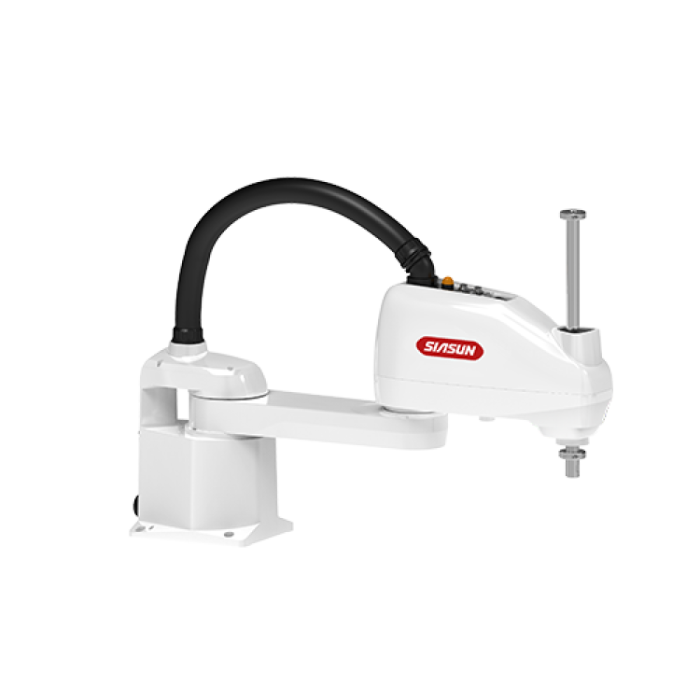
SIASUN SA7A-7/0.50 (SA7A-7/0.50)
In stock
- BRAND:
- SIASUN
- MODEL:
- SA7A-7/0.50
- PART #:
- SA7A-7/0.50
- ORIGIN:
- China
- Warranty:
- 12 MONTHS
- AVAILABILITY:
- SUBJECT TO AVAILABILITY
- SKU:
- SIASUN-SA7A-7-0-50
SIASUN SA7A-7/0.50 (SA7A-7/0.50)
A single repeatability figure on a datasheet can hide more than it reveals, because a SCARA arm does not move as one piece: its shoulder and elbow sweep the tool across the plane, its vertical axis lowers it and its wrist turns it. The SIASUN SA7A-7/0.50 (SA7A-7/0.50) is specified joint by joint: ±0.02mm for J1 and J2 combined, ±0.01mm for J3 and ±0.01° for J4. For anyone placing small components where a tenth of a millimetre decides whether a part seats or jams, that breakdown is the more useful way to read a robot, and it sits on a compact arm with a 7 kg (15.4 lbs) payload and a 500mm reach.
Robots Middle East supplies the SIASUN SA7A-7/0.50 to manufacturers, system integrators and research facilities across the Middle East. We prepare each quotation against your application, coordinate delivery to your site and remain your point of contact for technical questions and after-sales support throughout the life of the installation.
Background
SIASUN and the SA7A generation
SIASUN builds industrial robots across several families, and the SA7A series is the company's brand-new generation of SCARA robots. It is a ground-up redesign rather than a minor revision: the series is equipped with all-new proprietary core components, which means that the parts governing motion and precision are SIASUN's own work. Within the series, the sources name three versions — the SA7A-7/0.50 described on this page, together with the SA7A-7/0.60 and the SA7A-7/0.70. The figures on this page belong to the SA7A-7/0.50 alone; the other versions should be quoted against their own datasheets.
Modularity and the dual-support structure
Two design decisions define the series. The first is a modular design, which SIASUN describes as catering to more automation scenarios while reducing maintenance costs. The second is a dual-support structure, which the manufacturer credits with enhanced load capacity, higher precision, faster speed, greater rigidity and reduced vibration. Around these sit practical choices for the integrator: abundant user cables routed on the main unit, a new generation of S series control cabinet, and support for multiple programming and teaching methods. The main body is lighter and the overall height is lower, so deployment is convenient and the robot imposes fewer space constraints on the cell.
Technical Specifications
| Specification | Value |
|---|---|
| Model | SA7A-7/0.50 |
| Robot type | SCARA |
| Payload | 7 kg (15.4 lbs) |
| Reach | 500mm |
| Repeatability J1+J2 | ±0.02mm |
| Repeatability J3 | ±0.01mm |
| Repeatability J4 | ±0.01° |
| Protection | IP20 |
| Control cabinet | New generation S series |
Specifications are as published by the manufacturer and are confirmed against the datasheet at quotation.
SIASUN has not published the robot weight, base dimensions, maximum speed, cycle time, power supply, rated power, joint motion ranges, Z-axis stroke, operating temperature, controller communication interfaces or the contents of the box, so these are confirmed with you at quotation.
Why does the SA7A-7/0.50 list repeatability axis by axis?
On a SCARA robot, each axis contributes differently to where the tool ends up. The first two joints carry the arm across the horizontal plane, and their combined repeatability of ±0.02mm describes how closely the tool returns to the same point in X and Y. The third axis is the vertical stroke, and at ±0.01mm it governs how consistently a part is pressed, inserted or released at height. The fourth axis rotates the tool, and ±0.01° describes how reliably a component is oriented before it is placed.
Separating these figures lets an engineer match the robot to the tolerance stack of a real process. A connector insertion may depend chiefly on vertical consistency; a camera module placement may depend on rotational accuracy; a pick from a tray depends on planar return. With the figures stated per joint, the question of whether the SA7A-7/0.50 meets a tolerance becomes a matter of comparison rather than interpretation, and it can be answered before the cell is built.
What does the dual-support structure change in practice?
Stiffness is what allows a fast arm to stop cleanly. SIASUN attributes greater rigidity and reduced vibration to the dual-support structure of the SA7A series, and those two qualities are closely linked to the repeatability shown above: an arm that settles quickly after a move can place a part without waiting for oscillation to die away. The same structure is credited with enhanced load capacity, which matters when a gripper, vacuum tool or small dispensing head adds weight at the end of the arm.
The modular design works on a different timescale. Production lines in electronics and battery manufacturing are retooled often, and a robot that can be adapted to a new scenario, and serviced at a lower cost, holds its value across several product generations. The abundant user cables on the main unit reduce the need for external cable dressing to the tool, and the choice of programming and teaching methods lets a team work in the way that suits its experience. The protection rating of IP20 indicates a clean, dry indoor environment, which is typical of electronics assembly rather than of wash-down or heavily contaminated areas.
Who is the SIASUN SA7A-7/0.50 for?
The first group is manufacturers in the sectors SIASUN names for the series: 3C electronics, lithium battery, photovoltaic and automotive electronics. These plants handle small, precise components in high volumes, and a 500mm reach suits compact workstations where the robot serves a fixture, a feeder and an outfeed within a short radius.
The second group is system integrators who build turnkey cells. For them, the user cables on the main unit, the new S series control cabinet and the multiple teaching methods shorten engineering time, while the lower overall height and lighter main body ease mechanical integration into frames and enclosures.
The third group is technical colleges, research laboratories and pilot lines that need an industrial-grade SCARA robot for process development before scaling up. Where a project needs a longer reach within the same series, the SA7A-7/0.60 and SA7A-7/0.70 are the versions to discuss with us, and buyers comparing other arm sizes can browse our full SCARA range or the wider selection of SIASUN Industrial Robots.
What is the SIASUN SA7A-7/0.50 used for?
- 3C electronics assembly — placing, inserting and fastening small components in phones, computers and consumer devices.
- Lithium battery production — handling cells, tabs and small sub-assemblies at stations where consistent placement matters.
- Photovoltaic manufacturing — transferring and positioning components in the assembly of solar products.
- Automotive electronics — assembling sensors, control units and connectors that require repeatable, low-vibration motion.
- Pick-and-place and sorting — moving parts between feeders, trays and conveyors within a compact working area.
- Process development and training — giving engineering teams and students an industrial SCARA platform to programme and test new cells.
Pricing and Availability
Robots Middle East quotes the SIASUN SA7A-7/0.50 on request, so that the offer reflects your configuration, tooling and project requirements. Delivery to your site, customs clearance and technical support are arranged together with the quotation. To receive an offer tailored to your application, use the quotation request available on this page.
Frequently Asked Questions
What payload does the SIASUN SA7A-7/0.50 carry?
The SA7A-7/0.50 has a payload of 7 kg (15.4 lbs). The weight of your gripper or tool counts towards this figure, so it is worth sharing the tooling design when you request a quotation.
What is the reach of the SA7A-7/0.50?
The reach is 500mm. The SA7A series also includes the SA7A-7/0.60 and SA7A-7/0.70, whose figures we confirm separately.
How repeatable is the robot?
Repeatability is ±0.02mm for J1 and J2 combined, ±0.01mm for J3 and ±0.01° for J4.
Is the SA7A-7/0.50 suitable for dusty or wet environments?
The robot is rated IP20, which points to clean, dry indoor use. For harsher conditions, please describe the environment so that we can advise on suitable options.
How is the robot programmed?
It is controlled by a new generation of S series control cabinet and supports multiple programming and teaching methods. The specific interfaces are confirmed at quotation.
What makes the SA7A series easy to maintain?
SIASUN uses a modular design for the series, which the manufacturer states reduces maintenance costs while adapting the robot to more automation scenarios.
Where can I buy the SIASUN SA7A-7/0.50 and what does it cost?
You can buy the SIASUN SA7A-7/0.50 from Robots Middle East, which supplies it across the Middle East. The cost depends on your configuration and project, so we provide it in a tailored quotation on request.
Summary
The SIASUN SA7A-7/0.50 rewards a careful reading of its datasheet. Its repeatability is stated axis by axis, its dual-support structure is designed for rigidity and low vibration, and its modular construction is aimed at lines that change often and must be maintained economically. With a 7 kg (15.4 lbs) payload, a 500mm reach and a lower, lighter body, it suits the compact, precise work of 3C, battery, photovoltaic and automotive electronics production. Robots Middle East supplies, delivers and supports it across the region; to match its per-joint precision to your own tolerances, this page is the starting point.