
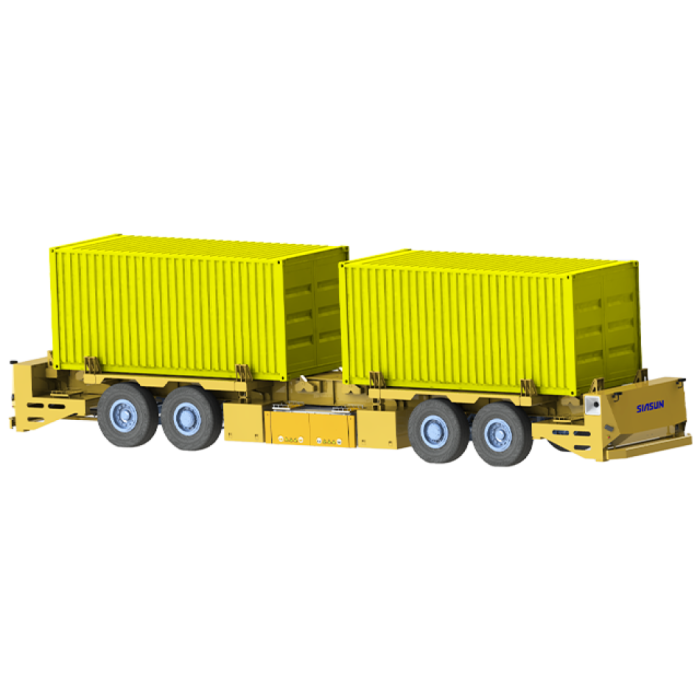
SIASUN Outdoor Trackless Guided Heavy Payload Mobile Robot (Harbour)
In stock
- BRAND:
- SIASUN
- MODEL:
- Outdoor Trackless Guided Heavy Payload Mobile Robot (Harbour)
- PART #:
- Outdoor Trackless Guided Heavy Payload Mobile Robot (Harbour)
- ORIGIN:
- China
- Warranty:
- 12 MONTHS
- AVAILABILITY:
- SUBJECT TO AVAILABILITY
- SKU:
- SIASUN-outdoor-trackless-guided-heavy-payload-mobile-robot-harbo
SIASUN Outdoor Trackless Guided Heavy Payload Mobile Robot (Harbour)
Few places punish a fixed plan as quickly as a container quay. A vessel discharges a run of 40ft boxes, then a pair of 20ft tanks, then a 45ft unit, and the transport between crane and stack must absorb each change without a pause and without a new set of rails. The SIASUN Outdoor Trackless Guided Heavy Payload Mobile Robot (Harbour) is built around that variability: an unmanned carrier that receives containers beneath the shore bridge, finds its own way through several work areas and delivers them to the yard, changing lane as the terminal system directs.
Robots Middle East supplies this SIASUN harbour robot to port operators, terminal developers and logistics authorities across the Middle East. Robots Middle East prepares the quotation, coordinates delivery to the terminal and remains your point of contact for support once the fleet is in operation, so that one regional partner accompanies the project from the first technical discussion to daily work on the quay.
Background
SIASUN and its heavy payload line
SIASUN builds mobile robots across a broad spectrum, from forklift units for warehouse aisles to heavy carriers for open-air industrial sites. Its heavy payload mobile robots have gone global since 2020, with large batches supplied to the world's largest transshipment hub ports. The harbour robot is part of that export history: it has been shipped overseas, stationed at world-famous ports and put into use. For a buyer, this matters less as a marketing point than as evidence that the design has already met the practical demands of high-volume terminal operation outside its home market.
Trackless guidance and system-directed movement
The word trackless describes the core idea. Rather than following a single fixed path, the robot draws on a wide set of navigation methods: inertial guidance positioning, magnetic peg positioning, RTK differential positioning, UWB positioning, laser contour positioning, vision positioning, 5G positioning technology and GPS positioning, among others. Positioning accuracy can be controlled at ±5cm, which is what allows the robot to stop precisely beneath a shore bridge for the crane to set a container on top of it. Movement is coordinated by the terminal system: the robot performs a wedge-shaped lane change according to the system calculation, which improves its flexibility and passing ability and keeps operations efficient when traffic builds between quay and yard.
Technical Specifications
| Specification | Value |
|---|---|
| Function | Carries containers from the shore bridge to the yard area |
| Cargo per single trip | 2x20ft containers, 2x20ft tanks, 40ft containers or 45ft containers, respectively |
| Travelling speed | Up to 7m/s for 95 tonnes of heavy loads |
| Positioning accuracy | ±5cm |
| Navigation methods | Inertial guidance, magnetic peg, RTK differential, UWB, laser contour, vision, 5G and GPS positioning, and others |
| Collision avoidance | Automatic stopping function |
| Lane change | Wedge-shaped lane change according to the system calculation |
| Battery swapping | Heavy-duty battery swap technology; batteries weighing up to 7 tonnes, swapped in 5 minutes |
| Fault diagnosis | Self-test, self-assessment and advance judgement |
Specifications are as published by the manufacturer and are confirmed against the datasheet at quotation.
The manufacturer has not published the dimensions, the weight, a rated payload for this model, the battery capacity, the ingress protection rating, the gradeability, the power supply voltage, the operating temperature range, the drive and steering type or the contents of the delivery; these are confirmed at quotation.
How does a trackless harbour robot differ from rail-guided or manned terminal transport?
Horizontal transport on a terminal has traditionally relied either on drivers in tractor units or on vehicles bound to a fixed infrastructure. A driver brings judgement but also shift patterns, fatigue and variability; a fixed path brings repeatability but little room to adapt when the yard layout or the traffic pattern changes. The SIASUN harbour robot takes a different route. Because it can position itself through several independent methods, from RTK differential and UWB to laser contour and vision, a terminal can choose the combination that suits its quay surface, its existing infrastructure and its communications network, including 5G where it is available.
Safety and flow are handled by the machine and the system together. As the robot passes through multiple work areas, its automatic stopping function prevents collisions, while the wedge-shaped lane change calculated by the system lets it pass and reposition without bringing a whole lane to a standstill. Self-test, self-assessment and advance judgement allow the robot to recognise developing faults before they interrupt the operation. The result is transport that behaves less like a vehicle on a route and more like a coordinated element of the terminal's operating system.
How does battery swapping keep the robot working through a shift?
An electric carrier that must stop to recharge for long periods would sit uneasily beside cranes that work around the clock. SIASUN addresses this with heavy-duty battery swap technology: batteries weighing up to 7 tonnes can be exchanged in 5 minutes. In practice, this turns energy management into a short, scheduled service stop rather than an extended absence from the fleet, and it allows a terminal to plan robot availability around vessel windows instead of charging cycles. The number of moves per battery and the number of spare packs a fleet requires are worked out with our team and modelled against your own traffic.
Who is the SIASUN Outdoor Trackless Guided Heavy Payload Mobile Robot (Harbour) for?
The first audience is container terminal operators who are automating horizontal transport between the quay and the stack, whether on an established terminal or a new berth. Transshipment hubs, where container volumes are high and cargo formats change constantly, are a natural fit, given that SIASUN's heavy payload robots already serve some of the world's largest hubs. Port developers planning new automated terminals in the Gulf and the wider region will also find the range of supported navigation methods useful when designing positioning infrastructure from the outset.
A further group consists of system integrators and terminal operating system specialists, who need a carrier that accepts system-calculated movements such as lane changes and reports its own condition through self-assessment. For outdoor service in the regional climate, environmental requirements are best discussed early in the project.
Buyers whose loads are palletised rather than containerised, or who work indoors, will be better served elsewhere in SIASUN's range, for example by the SIASUN Forklift Mobile Robot (D20S-1). The wider selection is presented in our Mobile Robots and Logistics Robots categories.
What is the SIASUN Outdoor Trackless Guided Heavy Payload Mobile Robot (Harbour) used for?
- Quay-to-yard transport: receiving containers set down by the shore bridge and carrying them to the yard area.
- Mixed cargo moves: carrying 2x20ft containers, 2x20ft tanks, 40ft containers or 45ft containers in a single trip.
- Tank container handling: moving pairs of 20ft tanks alongside standard boxes within the same fleet.
- Automated terminal operation: unmanned transport across several work areas under the direction of the terminal system.
- High-volume transshipment: supporting the sustained container flows typical of large hub ports.
- Continuous shift working: short battery swaps that return the robot to service quickly.
Pricing and Availability
Each terminal differs in layout, traffic volume, navigation infrastructure and fleet size, so Robots Middle East prices the SIASUN harbour robot by quotation, prepared around your project. Delivery, customs and support are arranged with the quotation. To begin, please share your terminal profile, cargo mix and planned fleet size with our team; the request form for a quotation is available on this page.
Frequently Asked Questions
What cargo can the robot carry in one trip?
It can carry 2x20ft containers, 2x20ft tanks, 40ft containers or 45ft containers in a single trip, respectively.
How precisely does the robot position itself?
Positioning accuracy can be controlled at ±5cm, allowing precise placement beneath the shore bridge for container transfer.
Which navigation methods does it support?
It supports inertial guidance, magnetic peg, RTK differential, UWB, laser contour, vision, 5G and GPS positioning, among other methods. The appropriate combination is selected for each terminal during project planning.
How does the robot avoid collisions?
It is equipped with an automatic stopping function to avoid collision as it passes through multiple work areas. Lane changes follow the system calculation, which helps keep traffic moving.
How long does a battery change take?
Batteries weighing up to 7 tonnes can be swapped in 5 minutes using SIASUN's heavy-duty battery swap technology.
Can the robot detect faults on its own?
Yes. The robot performs self-test and self-assessment and makes an advance judgement, which helps maintain operational efficiency.
Where can I buy the SIASUN Outdoor Trackless Guided Heavy Payload Mobile Robot (Harbour) and what does it cost?
You can obtain it from Robots Middle East, which supplies it across the Middle East. The cost depends on fleet size and project scope, so it is provided in a tailored quotation on request.
Summary
A container quay rewards equipment that adapts, and the SIASUN harbour robot is designed for exactly that. It accepts several cargo formats in a single trip, positions itself through a wide set of navigation methods with ±5cm accuracy, changes lane as the system calculates, stops automatically to avoid collisions, assesses its own condition and returns to work after a 5-minute battery swap. Its record at major overseas ports shows that the concept already functions at scale. For terminal operators across the Middle East who want quay-to-yard transport that keeps pace with changing vessel work, Robots Middle East offers a direct route from enquiry to operation, and this page is the starting point.