
Softbank Robotics NAO V6 Humanoid Robot
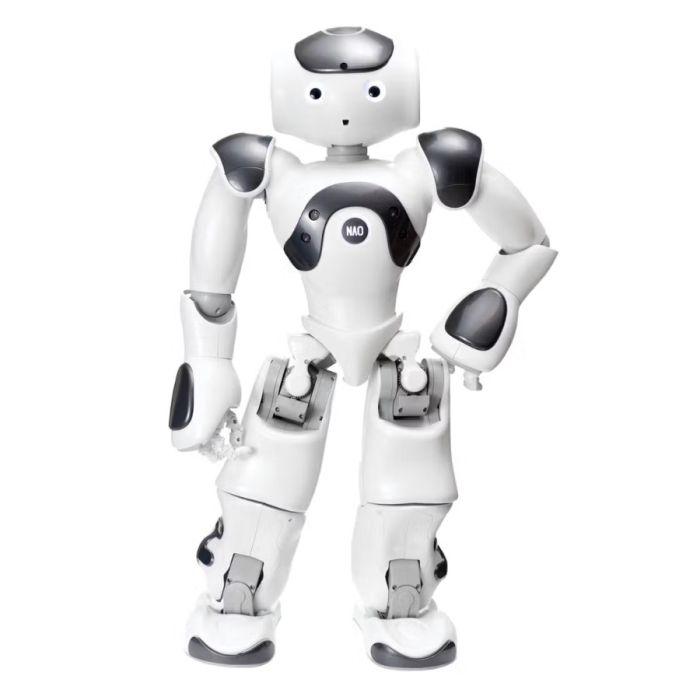
In stock
- BRAND:
- SOFTBANK
- MODEL:
- NAO
- AVAILABILITY:
- SUBJECT TO AVAILABILITY
- SKU:
- SoftBank-NAO
Softbank Robotics NAO V6 Humanoid Robot
Most machines in a robotics laboratory are built to be operated. A few are built to be met. The Softbank Robotics NAO V6 Humanoid Robot belongs firmly to the second group. It is a humanoid standing 574 mm tall, designed to interact naturally with people, and it turns the abstract business of perception, speech and movement into something a class, a research team or a care setting can watch unfold at table height. That shift, from controlling a device to holding an exchange with one, is what has made NAO a lasting reference point for anyone who needs to study, teach or demonstrate how robots and people behave together.
Robots Middle East supplies the NAO V6 to schools, universities, research institutes and healthcare organisations across the Middle East. Our team prepares each quotation around the configuration you require, arranges delivery to your premises and remains your point of contact for technical support once the robot is in service, so that a single, accountable partner stands behind the platform from the first enquiry onwards.
Background
From Aldebaran to Softbank Robotics
NAO began life at Aldebaran, the company that developed the humanoid before it was acquired by Softbank Robotics. That lineage matters to buyers today because it explains the character of the platform: NAO was conceived from the outset as a robot for working alongside people rather than as an industrial mechanism given a friendly face. Successive generations have refined the hardware while keeping the same essential proposition, and the V6 is the generation that Robots Middle East offers to institutions in the region.
A humanoid designed around interaction
The defining technology in NAO is not a single component but the way its parts work together. Twenty-five degrees of freedom give the robot a range of posture and gesture that reads naturally to an onlooker, while two front cameras, four microphones and two speakers let it see, listen and reply. Sonar sensors add awareness of nearby obstacles, and an onboard Intel Atom processor runs behaviours locally. For an educator or researcher, this combination means that a single robot can carry an entire interaction loop, from noticing a person to responding with movement and speech, without additional hardware bolted on.
Technical Specifications
| Specification | Value |
|---|---|
| Height | 574 mm |
| Dimensions | 574mm x 275mm x 311mm |
| Weight | About 5.48 kg |
| Degrees of freedom | 25 |
| Processor | Intel Atom E3845 (1.91 GHz) |
| Memory | 4 GB DDR3 |
| Storage | 32 GB eMMC |
| Cameras | 2 front cameras (OV5640 sensor, 5 MP) |
| Camera resolution and frame rate | Up to 2560*1920 at 1 fps or 640*480 at 30 fps |
| Audio | 4 microphones; 2 speakers (2 W input) |
| Sonar frequency | 40kHz |
| Sonar detection range | 0.20 m - 0.80 m |
| Connectivity | Ethernet (RJ45), Wi-Fi (802.11a/b/g/n), Bluetooth 4.0 (LE) |
| Battery | Li-ion 21.6 V / 2.9 Ah (62.5 Wh) |
| Battery runtime | ~60 min (active use) / ~90 min (standard use) |
| Programming | Python, C++ (via SDK); scenario design via Choregraphe |
| Software supplied | Complete software suite (Choregraphe, Monitor & SDK) |
Specifications are as published by the manufacturer and are confirmed against the datasheet at quotation.
The manufacturer has not published the payload, the IP rating, the walking speed, the charging time or the operating noise level; these are confirmed at quotation.
How is the NAO V6 programmed?
NAO is supplied with a complete software suite comprising Choregraphe, Monitor and the SDK, which allows the same robot to serve very different levels of experience. Choregraphe is the scenario design environment, in which behaviours are assembled visually, making it a natural entry point for pupils and for staff who are new to robotics. Monitor gives a view of what the robot is perceiving, which is valuable when a behaviour does not do what was intended and the class needs to understand why.
For more advanced users, the SDK opens the platform to Python and C++. A university course can therefore begin with visual scenarios in the first weeks and move to written code later, without changing hardware. Researchers can work directly in the language their group already uses, and the onboard Intel Atom E3845 processor with 4 GB DDR3 memory and 32 GB eMMC storage gives behaviours a home on the robot itself. Ethernet, Wi-Fi and Bluetooth 4.0 (LE) connectivity mean that programs can be deployed from a workstation and that the robot can be integrated into a wider laboratory network.
How does the NAO V6 perceive the people around it?
Interaction depends on perception, and NAO approaches it through several channels at once. The two front cameras use the OV5640 sensor and offer a choice between detail and fluidity: up to 2560*1920 at 1 fps for still, high-resolution capture, or 640*480 at 30 fps where smooth video matters more. Four microphones give the robot a sense of the sound around it, and two speakers allow it to answer. Sonar operating at 40kHz detects objects at distances of 0.20 m - 0.80 m, giving NAO awareness of what is immediately in front of it.
For a teacher, these channels make it possible to show how a machine turns raw sensor data into a decision. For a researcher, they provide a consistent, well-understood sensing suite on which experiments can be repeated across sessions and institutions, which is precisely why a standard humanoid platform is so useful in human-robot interaction studies.
Who is the NAO V6 for?
The NAO V6 suits organisations for which the human side of robotics is the point of the exercise. Schools and STEM centres use a humanoid of this kind because pupils respond to a robot that gestures and speaks, and that response keeps them engaged with the underlying programming. Universities value a platform that spans introductory teaching and graduate research, so that one investment serves several departments. Research laboratories studying human-robot interaction, social robotics or artificial intelligence benefit from a recognised platform on which results can be compared with published work. Healthcare and elderly care environments, both among the settings NAO is designed for, explore the robot as a means of engagement and structured interaction.
NAO is offered in two versions, the NAO V6 Standard Edition and the NAO AI Edition. If your project leans heavily on artificial intelligence work, Robots Middle East will set out the contents of each edition in your quotation so that you can choose with full information. Institutions assembling a broader fleet can also browse the Robot Store for complementary platforms.
What is the NAO V6 used for?
- Teaching programming — pupils see code become visible behaviour, from a gesture to a spoken reply.
- University robotics courses — one platform supports both visual scenario design and Python or C++ development.
- Human-robot interaction research — a recognised humanoid makes experiments repeatable and comparable with published studies.
- Healthcare engagement — the robot offers structured, interactive sessions in clinical and therapeutic settings.
- Elderly care environments — NAO provides conversation and activity prompts designed around natural interaction.
- Artificial intelligence development — cameras, microphones and onboard computing give AI projects a physical body to act through.
Pricing and Availability
Robots Middle East supplies the NAO V6 by quotation, which allows us to define the edition, the software suite and any accessories your institution requires before you commit. Delivery, customs clearance and after-sales support are arranged together with your quotation. To begin, simply send us an enquiry using the request form available on this page.
Frequently Asked Questions
What software is included with the NAO V6?
The robot is supplied with a complete software suite comprising Choregraphe, Monitor and the SDK.
Which programming languages does NAO support?
NAO can be programmed in Python and C++ via the SDK, and behaviours can also be designed visually in Choregraphe.
How long does the battery last?
The Li-ion 21.6 V / 2.9 Ah (62.5 Wh) battery gives ~60 min in active use and ~90 min in standard use.
How large is the NAO V6?
NAO V6 measures 574mm x 275mm x 311mm and weighs about 5.48 kg, making it compact enough to work on a table or a classroom floor.
How does NAO connect to a network?
It offers Ethernet (RJ45), Wi-Fi (802.11a/b/g/n) and Bluetooth 4.0 (LE) connectivity.
What is the difference between the Standard Edition and the AI Edition?
NAO is offered as the NAO V6 Standard Edition and the NAO AI Edition. Robots Middle East will set out the contents of each edition in your quotation.
Where can I buy the Softbank Robotics NAO V6 Humanoid Robot and what does it cost?
You can buy it from Robots Middle East, which supplies the robot across the Middle East. The cost depends on the edition and configuration you choose and is provided in a tailored quotation.
Summary
The value of NAO lies in the difference between operating a machine and meeting one. With 25 degrees of freedom, cameras, microphones, sonar and a software suite that runs from visual scenarios to Python and C++, the Softbank Robotics NAO V6 gives classrooms, laboratories and care settings a humanoid built for exchange rather than mere command. Robots Middle East supplies, delivers and supports it throughout the region, and for any institution ready to put human-robot interaction at the centre of its work, this page is the starting point.