
UBTECH Smart Companion Robot WELLI
In stock
- BRAND:
- UBTECH
- PART #:
- WELLI
- ORIGIN:
- China
- AVAILABILITY:
- SUBJECT TO AVAILABILITY
- SKU:
- UBTECH-WELLI
UBTECH Smart Companion Robot WELLI
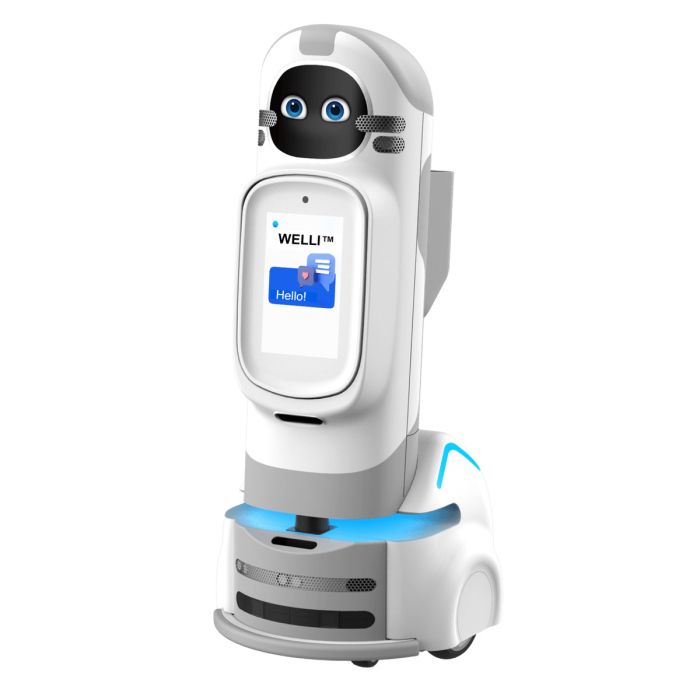
A screen mounted on a wall waits for someone to walk up to it. A companion is expected to take the first step. That gap, between technology that only responds and care that reaches out, is the brief behind the UBTECH Smart Companion Robot WELLI. It is a mobile robot that meets the daily psychological needs of older people by providing proactive care as a companion. It recognises the person it is meant to serve and greets them with a customised menu or by voice command. It follows how their cognition is holding up and helps them stay in touch with family. Between those tasks, it can find its own way along a corridor to show a visitor where they need to go.
Robots Middle East supplies the UBTECH Smart Companion Robot WELLI to care homes, hospitals, rehabilitation centres and senior-living operators across the Middle East. Our team prepares each quotation for the configuration you require and coordinates delivery to your site. We also remain your point of contact for support once the robot is in daily service.
Background
UBTECH Robotics and its care portfolio
Ubtech Robotics Corp Ltd was incorporated in 2012 and is headquartered in Shenzhen, China. The company develops service robots for public, commercial and care environments. WELLI belongs to its healthcare line, a group of products built for the people who live in, work in and visit care facilities. You can browse this line in our Healthcare category. WELLI's role within that range is distinctive. It is not designed to carry loads or replace a member of staff. It is designed to keep a person company and pay attention to them over time.
Proactive care as the central idea
Most assistive devices wait for a request. WELLI is built around the opposite principle. It understands the cognitive status of its owner through hospital admission information and regular evaluations. It then intervenes positively in the decline of cognitive capability through daily training. The same platform supports the social side of care. It can strengthen family ties by helping seniors communicate more easily with their relatives.
Around this core sit the practical functions that make the robot useful throughout the day:
- facial recognition to confirm the intended user
- a question-and-answer function drawing on a preset knowledge base
- autonomous navigation with obstacle avoidance for guiding visitors
Together they turn a single robot into a familiar presence rather than another piece of equipment in the room.
Technical Specifications
| Specification | Spec set with 10.1" main screen | Spec set with 13.3" main screen |
|---|---|---|
| Display | Dual-screen display, the 10.1" main screen shows service content, and the 5.5" sub-screen shows expressions | Dual-screen display, the 13.3" main screen shows service content, and the 5.5" sub-screen shows expressions |
| Dimensions | 47.5 x 44 x 102 cm | 48.3 x 43 x 100 cm |
| Weight | 31 kg | 25kg |
| Audio/Speaker | 5 W hi-fi speaker x 2 | — |
| Battery | 20 Ah lithium battery, compliant with UL1642, UN38.3, IEC62133, UL2054 | — |
| Speed | Up to 1 m/s | — |
| Network | 802.11 B/G/N/AC + BT4.2 | — |
| Obstacle crossing | 2 cm high obstacle; 3.5 cm gap | — |
| Lidar | Small-sized measuring Lidar with a 270° scanning angle, 0.33° angle resolution, and scanning frequency of 15 Hz | — |
| Camera | 1080p; output format: JPEG/YUV | — |
Specifications are given as published by the manufacturer and are confirmed against the datasheet at quotation.
The manufacturer has not published the IP rating, battery runtime, charging time, box contents, operating software, payload or operating temperature; we confirm these with you at quotation.
What is the difference between the 10.1" and 13.3" WELLI?
Both specification sets share the same layout: a dual-screen design in which the main screen presents service content and a 5.5" sub-screen shows the robot's expressions. That second screen gives WELLI a face, so residents talk to a character rather than to a tablet.
The main screen is where the sets part ways. The first carries a 10.1" main screen. The second moves to a 13.3" main screen, which gives more room for menus, training exercises and family video content. The two bodies also differ physically. The 10.1" set measures 47.5 x 44 x 102 cm and weighs 31 kg. The 13.3" set measures 48.3 x 43 x 100 cm and weighs 25kg, so the version with the larger screen is also the lighter of the two.
The remaining figures, from the dual 5 W hi-fi speakers to the Lidar, camera, network and battery, belong to the 10.1" set. For the 13.3" set, figures are given for the display, dimensions and weight. Robots Middle East therefore treats the two sets separately rather than assuming they are identical.
How does WELLI support cognitive care in daily life?
Cognitive decline in older people is rarely sudden. It shows itself in small changes noticed over weeks. WELLI is designed to work at that pace. It draws on hospital admission information and regular evaluations to build an understanding of its owner's cognitive status. It then offers daily training intended to counter the decline of cognitive capability. For care teams, this means engagement continues on the days between formal assessments, not only when a therapist is present.
Recognition makes this personal. Facial recognition confirms the intended user before WELLI greets them with a customised menu or responds to a voice command. A resident is met with their own content rather than a generic home screen. When they have a question, the robot answers from its preset Q&A base, so routine queries are handled consistently and at any hour.
The emotional side of care is addressed as well. Isolation weighs heavily on many seniors, and WELLI helps them communicate more easily with family members. For many residents, that contact is the part of the day they look forward to most.
Who is the UBTECH Smart Companion Robot WELLI for?
The clearest fit is residential care: nursing homes and senior-living communities where staff cannot spend long periods with each resident and companionship matters as much as clinical attention. Memory-care units and geriatric wards benefit from the combination of regular evaluation and daily cognitive training. Hospital admission information can feed directly into how the robot understands its owner.
Rehabilitation centres and day-care facilities for older adults form a second group. Here, structured daily exercises and easy contact with family support the work of therapists and carers. A third group is facilities that receive many visitors. WELLI's autonomous navigation and obstacle avoidance let it guide guests to a room or department, which eases the load on reception and nursing staff.
When choosing between the two specification sets, consider how residents will use the screen. The 13.3" main screen gives more space for content and comes in a lighter body. The 10.1" set comes with the fuller technical profile, including the Lidar, camera and battery figures. Our team is glad to discuss which suits your setting. Operators building a wider care-robotics programme can compare WELLI with the other products in our Healthcare category.
What is the UBTECH Smart Companion Robot WELLI used for?
- Personal greetings: recognising the intended user by face and welcoming them with a customised menu or by voice command.
- Cognitive status tracking: building an understanding of the owner's cognition from hospital admission information and regular evaluations.
- Daily cognitive training: offering routine exercises that intervene positively in the decline of cognitive capability.
- Family communication: helping seniors keep in touch with relatives more easily and strengthening family ties.
- Visitor guidance: leading guests to their destination using autonomous navigation and obstacle avoidance.
- Answering questions: responding to residents' and visitors' queries from a preset Q&A base.
Pricing and Availability
Robots Middle East supplies the UBTECH Smart Companion Robot WELLI on a quotation basis. This lets us match the specification set, quantity and service arrangements to your facility rather than offer a one-size-fits-all package. Delivery, customs clearance and after-sales support are arranged together with your quotation. To begin, please share a few details about your site and intended use through the enquiry form available on this page.
Frequently Asked Questions
Does WELLI recognise individual residents?
Yes. WELLI uses facial recognition to confirm the intended user and then greets them with a customised menu or responds to their voice commands.
Can WELLI move around a facility on its own?
Yes. It guides visitors to their destination using autonomous navigation and obstacle avoidance. On the 10.1" set, this is supported by a Lidar with a 270° scanning angle and a speed of up to 1 m/s, and the robot can cross a 2 cm high obstacle and a 3.5 cm gap.
Which screen sizes are available?
WELLI comes in two specification sets: one with a 10.1" main screen and one with a 13.3" main screen. Both pair the main screen with a 5.5" sub-screen that shows the robot's expressions.
What battery does WELLI use?
The 10.1" set uses a 20 Ah lithium battery compliant with UL1642, UN38.3, IEC62133 and UL2054.
How does WELLI connect to a network?
The 10.1" set supports 802.11 B/G/N/AC Wi-Fi together with BT4.2.
Can WELLI answer residents' questions?
Yes. WELLI answers questions from its preset Q&A base, which gives consistent responses to the queries that come up most often in a care setting.
Where can I buy the UBTECH Smart Companion Robot WELLI and what does it cost?
You can buy it from Robots Middle East, which supplies the robot across the Middle East. Pricing depends on the configuration and services you require, so we provide it in a tailored quotation that you can request through this page.
Summary
The UBTECH Smart Companion Robot WELLI answers a simple question: what if the technology in a care home took the first step? It recognises its owner and follows their cognitive status through admission information and regular evaluations. It offers daily training, keeps families close and still has the navigation skills to guide a visitor down the corridor. Two specification sets, with 10.1" and 13.3" main screens, let operators choose the screen and body that suit their residents. Robots Middle East handles the quotation, delivery and support. If proactive companionship belongs in your care strategy, this page is the starting point.