
Unitree A2-W Pro Wheeled Quadruped Robot Dog (A2W-PRO)
In stock
- BRAND:
- UNITREE ROBOTICS
- PART #:
- A2W-PRO
- ORIGIN:
- China
- AVAILABILITY:
- SUBJECT TO AVAILABILITY
- SKU:
- Unitree-A2W-PRO
Unitree A2-W Pro Wheeled Quadruped Robot Dog (A2W-PRO)
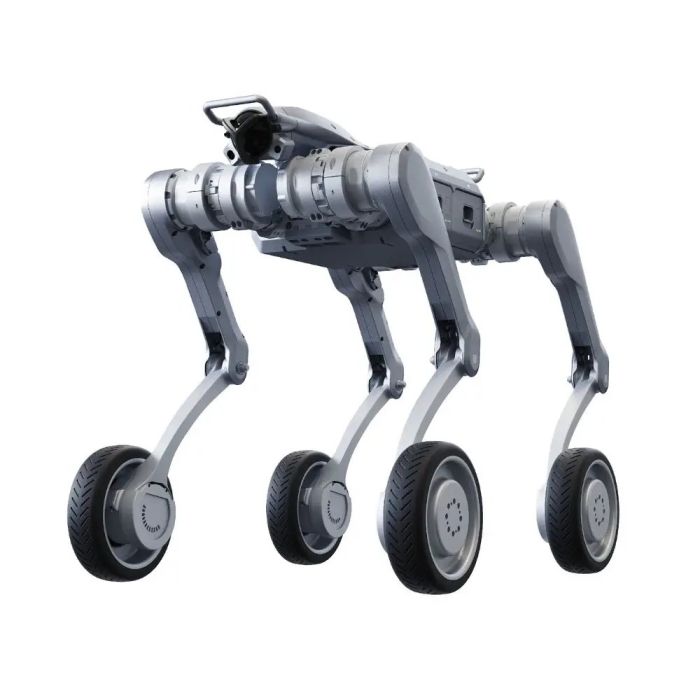
In a Gulf summer the tarmac between process units can shimmer by mid-morning, yet the inspection round still has to be completed on every shift. Long, flat runs favour wheels; the stairways, kerbs and pipe-rack crossings between them favour legs. The Unitree A2-W Pro Wheeled Quadruped Robot Dog (A2W-PRO) declines to choose between the two. It is a quadruped that rolls as readily as it walks, built for autonomous inspection, security patrol, logistics and robotics research. In its Pro configuration it adds the sensing, sealing and long-range connectivity that outdoor work throughout the year demands.
Robots Middle East sells the A2-W Pro and supplies it to industrial operators, security integrators, logistics teams, universities and research institutes across the Middle East. Each order is quoted individually by Robots Middle East, which also arranges delivery to site and provides support once the robot is in service.
Background
Unitree Robotics and the A2 family
Unitree Robotics is one of the best-known manufacturers of legged robots, with a portfolio that runs from compact platforms for teaching and development to heavier machines intended for industrial duty. The A2-W belongs to the Unitree A2 range, the generation in which the company concentrates its industrial quadruped engineering. The manufacturer offers the wheeled A2-W in two versions, Standard and Pro. Both share the same body, drive train and battery system, while the Pro is equipped for more demanding deployments.
The wheel-legged principle
A conventional legged robot spends energy on every step, even on a smooth corridor. A wheeled robot travels efficiently but is halted by the first flight of stairs. A wheel-legged design combines the two approaches: it rolls where the ground allows and lifts, steps and balances where it does not. For the A2-W this is delivered through 16 motorised joints with a maximum joint torque of approximately 180 N·m, which is enough to carry a working load while negotiating slopes and steps. On a mixed site, where the paved distance far exceeds the stair count, this combination determines how much ground a single robot can cover on one battery.
Technical Specifications
| Specification | Value |
|---|---|
| Standing dimensions | 900 × 440 × 625 mm |
| Prone dimensions | 930 × 685 × 210 mm |
| Tyre size | 190 mm diameter × 51 mm width |
| Weight without battery | Approximately 45 kg |
| Weight with battery | Approximately 52 kg |
| Degrees of freedom | 16 motorized joints |
| Maximum joint torque | Approximately 180 N·m |
| Battery capacity | Single battery: 9,000 mAh / 453.6 Wh Dual batteries: 18,000 mAh / 907.2 Wh |
| Supply voltage | 50.4 V |
| Wireless connectivity | Wi-Fi 6 and Bluetooth 5.2 |
| External interfaces | RS485 × 2, CAN × 2, Gigabit Ethernet × 2, USB 3.0 Type-C for 8-core CPU × 2, USB 3.0 Type-C for Intel Core i7 × 2 |
| Operating temperature | −20°C to 55°C |
| No-load endurance | More than 3.5 hours of continuous travel or approximately 35 km |
| Maximum standing payload | Approximately 100 kg |
| Continuous walking payload | Approximately 25 kg; up to approximately 35 kg under ideal conditions |
| Speed | 0–3 m/s operating range; up to approximately 6 m/s |
| Slope capability | Approximately 45° |
| Maximum step height | Approximately 30 cm |
| Sensors (Pro) | LiDAR ×2 + HD camera ×1 |
| Protection rating (Pro) | IP56 to IP67, main components certified IP67 |
| GPS, 4G and wireless vector module (Pro) | Included through expanded configuration |
Specifications are as published by the manufacturer and are confirmed against the datasheet at quotation.
The manufacturer has not published the test standard behind the ingress rating, the list of included accessories, the charger specification, the maximum wheel speed on slopes, the camera resolution or the LiDAR model; these are confirmed at quotation.
What does the A2-W Pro add over the A2-W Standard?
On the tape measure and the scales the two versions are identical. The dimensions, weights, joint torque, battery options, speed, slope and step figures above apply equally to the Standard and the Pro. The difference lies in what the robot can perceive, how well it is sealed and how far it can communicate.
For perception, the Pro carries two LiDAR units alongside its HD camera. A pair of scanners gives the navigation stack a richer view of its surroundings, which matters when a route runs past parked vehicles, stacked materials or people moving through the area. For protection, the Pro's rating spans IP56 to IP67, with its main components certified IP67. That is a meaningful margin for a machine expected to work through dust, wind-blown sand and the occasional downpour rather than remaining in a laboratory. For connectivity, GPS, 4G and the wireless vector module are included in the Pro's expanded configuration, whereas on the A2-W Standard they are options. A robot on a long perimeter or a remote yard, beyond the reach of site Wi-Fi, therefore leaves the factory with the means to locate itself and report back over the mobile network.
In practical terms, the Standard is a capable platform that a buyer can build upon, while the Pro is the version prepared for field deployment from the outset.
Can a wheeled quadruped cope with Middle Eastern site conditions?
Three figures address this question directly. The operating temperature range extends to 55°C at the upper end, which is the threshold that matters for outdoor summer work in the region; the lower bound of −20°C is more relevant to winter deployments at altitude. The Pro's sealing, with main components certified IP67, is aimed at dust and water, the two contaminants that most often end the service life of mobile electronics on desert and coastal sites. Mobility figures of approximately 45° on slopes and approximately 30 cm in step height mean that ramps, loading-bay edges and typical stairways fall within the robot's capability.
Endurance completes the picture. With the dual-battery option of 18,000 mAh / 907.2 Wh, the manufacturer quotes more than 3.5 hours of continuous no-load travel, or approximately 35 km. Real routes with sensors running and a load on board will differ, so a sensible deployment plan should allow for charging intervals between rounds. Because the test standard behind the ingress rating is not published, buyers with formal site-qualification requirements should raise it when requesting their quotation.
Who is the Unitree A2-W Pro Wheeled Quadruped Robot Dog (A2W-PRO) for?
The first group is asset-intensive operators: oil and gas facilities, utilities, desalination and power plants, and large industrial estates, where repetitive inspection rounds cover long distances and include stairs and raised walkways. For these organisations the Pro's sealing, dual LiDAR and integrated 4G are the deciding features.
The second group is security integrators and facility managers who patrol perimeters, car parks and logistics yards, often at night and away from site Wi-Fi. Included GPS and mobile connectivity allow the robot to operate across open ground and remain in contact with a control room.
The third group is logistics and site-services teams that need a mobile carrier for tools, samples or sensor payloads. The continuous walking payload of approximately 25 kg suits light transport between buildings.
The fourth group is universities, research centres and system integrators developing autonomy, perception or manipulation. Dual Ethernet, CAN and RS485 ports, together with USB 3.0 Type-C connections to both onboard processors, give them room to attach their own hardware.
Laboratories working indoors, or teams that intend to fit their own navigation and communications equipment, may find that the Unitree A2-W Standard Wheeled Quadruped Robot Dog (A2W-STANDARD) meets their needs, since it shares the same chassis and mobility figures but treats GPS and 4G as options.
What is the Unitree A2-W Pro Wheeled Quadruped Robot Dog (A2W-PRO) used for?
- Plant inspection rounds: carrying cameras and sensors along fixed routes to read gauges and check equipment condition.
- Perimeter and site security: patrolling fences, gates and yards with GPS positioning and a 4G link to the control room.
- Light logistics: moving tools, spares or samples between buildings across a mixed terrain of paving and steps.
- Infrastructure surveys: covering long stretches of pipeline corridors, substations or solar fields with efficient wheeled travel.
- Robotics research: serving as a platform for work on wheel-legged locomotion, mapping and autonomous navigation.
- Payload integration: hosting custom sensors or manipulators through the robot's Ethernet, CAN, RS485 and USB interfaces.
Pricing and Availability
Robots Middle East supplies the A2-W Pro on a quotation basis, so that the configuration, battery option and any integration work can be matched to your project before an order is placed. Delivery, customs clearance and after-sales support are arranged together with your quotation. To begin, please share your intended application and deployment site, and the Robots Middle East team will respond with a tailored proposal; the request form is available on this page.
Frequently Asked Questions
How does the A2-W Pro differ from the A2-W Standard?
Both versions share the same body, mobility and battery figures. The Pro adds two LiDAR units, a protection rating of IP56 to IP67 with main components certified IP67, and GPS, 4G and the wireless vector module as part of its expanded configuration.
How far can the robot travel on a charge?
The manufacturer quotes a no-load endurance of more than 3.5 hours of continuous travel, or approximately 35 km. Endurance under load and with sensors active will be lower, and should be planned per route.
Can it climb stairs and slopes?
Yes. The published figures are approximately 30 cm in maximum step height and approximately 45° in slope capability.
Will it operate in summer heat?
The published operating temperature range is −20°C to 55°C. Robots Middle East can discuss your site's conditions as part of the quotation.
How much can it carry?
The continuous walking payload is approximately 25 kg, rising to approximately 35 kg under ideal conditions; the maximum standing payload is approximately 100 kg.
Can we integrate our own sensors and software?
The robot provides RS485 × 2, CAN × 2, Gigabit Ethernet × 2 and USB 3.0 Type-C ports to both its 8-core CPU and its Intel Core i7 processor. Specific integration requirements can be reviewed with Robots Middle East before ordering.
Where can I buy the Unitree A2-W Pro Wheeled Quadruped Robot Dog (A2W-PRO) and what does it cost?
Robots Middle East supplies the A2-W Pro across the Middle East. The cost depends on configuration and project scope, so it is provided in a personalised quotation that you can request through this page.
Summary
Industrial sites rarely offer a robot only one kind of ground: long, hot paved stretches give way to stairways, ramps and raised walkways, often several times on a single round. The Unitree A2-W Pro Wheeled Quadruped Robot Dog (A2W-PRO) meets that mixed terrain by rolling where it can and stepping where it must, and the Pro configuration equips it for the open site, with dual LiDAR, main components certified IP67, and GPS and 4G included. For operators, integrators and researchers in the region who want a single machine for both distance and obstacles, a quotation from Robots Middle East on this page is the starting point.