
NVIDIA AGX Thor Backplane Expansion Dock for Unitree G1
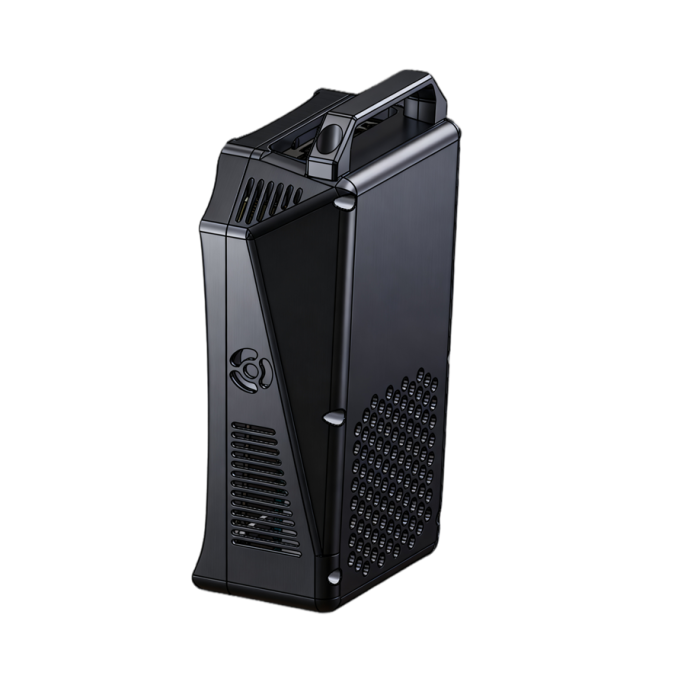
In stock
- BRAND:
- UNITREE ROBOTICS
- MODEL:
- G1-AGX-THOR-DOCK
- PART #:
- G1-AGX-THOR-DOCK
- ORIGIN:
- China
- Warranty:
- 12 MONTHS
- AVAILABILITY:
- SUBJECT TO AVAILABILITY
- SKU:
- Unitree-G1-AGX-THOR-DOCK
NVIDIA AGX Thor Backplane Expansion Dock for Unitree G1
The Unitree G1 is a humanoid of modest size, built to move and work in spaces designed for people. The models that research teams now want to run on such a body are the opposite: large, memory-hungry and usually associated with racks of data-centre hardware. The NVIDIA AGX Thor Backplane Expansion Dock for Unitree G1 is Unitree's response to that mismatch. It brings the NVIDIA Jetson AGX Thor platform to the G1 and G1-D, so that demanding inference can take place inside a compact frame rather than on a machine elsewhere in the building.
Robots Middle East supplies this dock to universities, research institutes, system integrators and corporate innovation teams across the Middle East. Robots Middle East prepares each quotation against the buyer's robot version and intended workload, arranges delivery to the destination country and remains the point of contact for technical questions once the dock is in service.
Background
Unitree Robotics and its humanoid line
Unitree Robotics was founded in 2016 in China and quickly established itself as a pioneer in robotics technology. The company built its reputation on legged robots before extending its range into humanoids, and the G1 has become one of the platforms that laboratories reach for when they need a full-body robot for research and development. Around the robot itself, Unitree offers a growing set of accessories, from hands to dedicated compute boards, which allow a single base platform to be configured for quite different programmes of work. This dock belongs to that accessory family and is listed by Unitree for both the G1 and the G1-D.
Jetson AGX Thor and the Blackwell architecture
The heart of the dock is the NVIDIA Jetson AGX Thor platform, which is based on NVIDIA's Blackwell GPU architecture. Jetson modules are NVIDIA's family of embedded computers for robots and autonomous machines: they place a GPU, a CPU and shared memory on a single board intended to run inside the machine it controls. Thor is the member of that family aimed at the most demanding robotic workloads, and in this dock it is paired with a 14-core Neoverse V3AE CPU and up to 128 GB of memory. For a humanoid, that combination matters because perception, planning and learned control all compete for the same onboard resources, and the size of the shared memory pool decides how large a model can be held on the robot at once.
Technical Specifications
| Specification | Value |
|---|---|
| Compatible robots | G1 / G1-D |
| Compute platform | NVIDIA Jetson AGX Thor |
| GPU architecture | Blackwell |
| AI performance | Up to 2070 TFLOPS (FP4) |
| CPU | 14-core Neoverse V3AE |
| Memory | Up to 128 GB |
| Memory bandwidth | 273 GB/s |
| Intended applications | Imitation learning, VLA deployment, data collection, onboard inference |
| Scope of delivery | 1× NVIDIA AGX Thor Backplane Expansion Dock for G1/G1-D |
Specifications are as published by the manufacturer and are confirmed against the datasheet at quotation.
Unitree has not published the dimensions, weight, power consumption, port types and counts, operating system, storage, wireless connectivity, IP rating or operating temperature of the dock; Robots Middle East confirms these details with the quotation.
How does the AGX Thor dock differ from the AGX Orin dock?
Unitree offers two backplane expansion docks for the G1. The NVIDIA AGX Orin Backplane Expansion Dock for Unitree G1 is built around the Jetson AGX Orin platform, the NVIDIA generation that preceded Thor, while the dock described here moves to Jetson AGX Thor and the Blackwell GPU architecture. The practical distinction lies in the kind of workload each is chosen for. Unitree positions the Thor dock explicitly for imitation learning, vision-language-action deployment, data collection and onboard inference, with up to 2070 TFLOPS (FP4) of AI performance and up to 128 GB of memory behind those tasks.
The FP4 figure deserves a word of context. FP4 is a low-precision number format used to run quantised neural networks efficiently, and performance quoted in that format is the figure most relevant to teams deploying large modern models in compressed form. Buyers comparing the two docks should therefore set their own model sizes, precision formats and software stack against each platform, rather than looking at a single headline number. Robots Middle East can set out both options side by side in one quotation, so that the choice rests on the work the robot is expected to do.
Why run models on the robot rather than on a remote server?
Many humanoid projects begin with the robot streaming sensor data to a workstation and receiving commands in return. That arrangement is convenient on the bench but fragile in the field: wireless links drop, latency varies and every additional metre between the robot and its computer becomes a possible point of failure. Onboard compute removes that dependency. When the policy runs on the robot, the loop from camera to motor stays local, and the robot can be taken to a hall, a warehouse aisle or a demonstration stage without bringing a server and a network along with it.
Onboard processing also changes how data is gathered. A robot that records, filters and partially processes its own sensor streams during a demonstration session produces cleaner datasets and depends less on external capture rigs. For teams in imitation learning, where hundreds of demonstrations may feed a single policy, that independence shortens the path from data collection to a deployable model.
Who is the AGX Thor dock for?
The first group is university and institute laboratories working on embodied AI, particularly those training vision-language-action models or learning manipulation and locomotion skills from demonstration. For them, the dock turns an existing G1 or G1-D into a self-contained test platform for models developed on larger machines.
The second group is system integrators and corporate research teams building proofs of concept for logistics, inspection or customer-facing applications. These buyers typically need a robot that can be demonstrated away from the lab, and onboard inference is what makes such demonstrations credible to stakeholders.
The third group is data-collection teams assembling training corpora for humanoid behaviour, who benefit from capturing and processing data directly on the robot during each session.
Teams whose software is already established on the Orin generation may wish to compare the AGX Orin dock before deciding. Owners of Unitree's larger humanoids should look instead at the compute options in the Unitree H1 / H1-2 range, and the full selection of add-ons is gathered under Humanoid Accessories.
What is the AGX Thor dock used for?
- Imitation learning — training and running policies that reproduce skills recorded from human demonstrations.
- VLA deployment — hosting vision-language-action models that turn camera input and spoken or written instructions into robot actions.
- Data collection — capturing and pre-processing sensor streams on the robot during demonstration and teleoperation sessions.
- Onboard inference — running perception and control models locally, without depending on a network link to a remote server.
- Field demonstrations — showing a self-contained humanoid to partners and clients at venues away from the laboratory.
- Teaching and research programmes — giving students a full-body robot on which embodied AI models can be deployed end to end.
Pricing and Availability
Robots Middle East supplies the dock on quotation, so that the offer reflects the exact robot version, the configuration and any accompanying accessories the project requires. Delivery, customs clearance and technical support are arranged together with the quotation. Please share your robot model, intended applications and destination country, and Robots Middle East will reply with a tailored offer; the request form for the NVIDIA AGX Thor Backplane Expansion Dock for Unitree G1 is available on this page.
Frequently Asked Questions
Which robots is the dock compatible with?
Unitree lists the dock for the G1 and the G1-D. Robots Middle East confirms compatibility with your specific robot when preparing the quotation.
Which compute platform does the dock carry?
It is built on the NVIDIA Jetson AGX Thor platform with the Blackwell GPU architecture and a 14-core Neoverse V3AE CPU. Unitree states up to 2070 TFLOPS (FP4) of AI performance.
How much memory is available?
The dock offers up to 128 GB of memory with a bandwidth of 273 GB/s. This shared memory pool determines how large a model can be held on the robot at once.
What is included in the delivery?
The scope of delivery is one NVIDIA AGX Thor Backplane Expansion Dock for G1/G1-D. Any further accessories are listed separately in the quotation.
Are the weight and power consumption published?
Unitree has not published the weight, dimensions or power consumption of the dock. Robots Middle East confirms these details with the quotation.
Should I consider the AGX Orin dock instead?
The AGX Orin dock is the sibling built on the earlier Jetson generation. Robots Middle East can quote both so that you can compare them against your own models and software.
Where can I buy the NVIDIA AGX Thor Backplane Expansion Dock for Unitree G1 and what does it cost?
You can purchase it from Robots Middle East, which supplies customers across the Middle East. The cost depends on configuration and destination and is set out in a personal quotation requested through this page.
Summary
The G1 offers a body of human scale; the models now driving embodied AI demand far more computing power than such a frame traditionally carried. This dock closes that distance by bringing Jetson AGX Thor, Blackwell graphics, a 14-core Neoverse V3AE CPU and up to 128 GB of memory to the G1 and G1-D, aimed squarely at imitation learning, VLA deployment, data collection and onboard inference. Robots Middle East quotes, delivers and supports it across the region, and confirms the details Unitree has not yet published. For teams ready to let their humanoid think for itself, this page is the starting point.