
Unitree G1 Basic Humanoid Robot
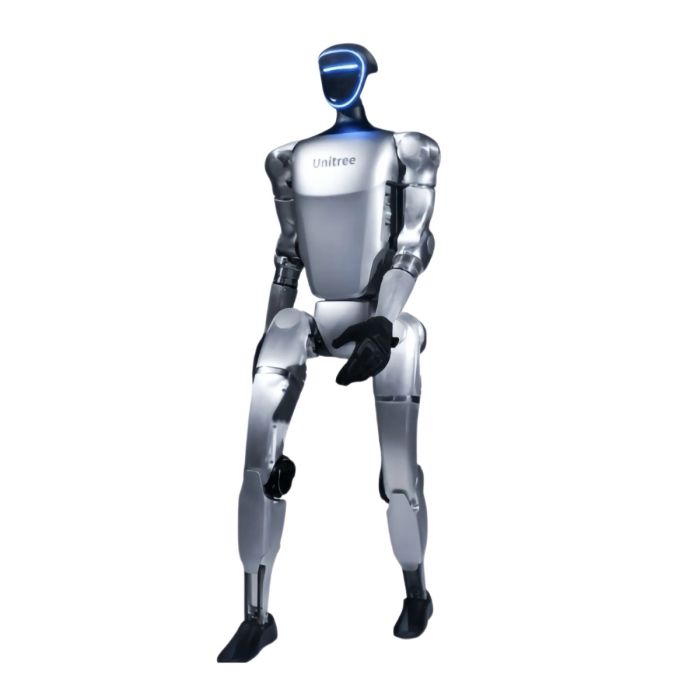
In stock
- BRAND:
- UNITREE ROBOTICS
- MODEL:
- G1 BASIC
- ORIGIN:
- China
- Warranty:
- 8 MONTHS
- AVAILABILITY:
- SUBJECT TO AVAILABILITY
- SKU:
- Unitree-G1-Basic
Unitree G1 Basic Humanoid Robot
A humanoid robot earns its place in a laboratory, a classroom or a lobby only when someone can unpack it, switch it on, walk it across the floor and pack it away again without a team of engineers standing by. The Unitree G1 Basic Humanoid Robot is built around that practical test: a human-shaped, two-legged body that folds for transport, carries its own sensing and computing, and runs from a battery that releases by hand. It is the entry point to Unitree's G1 family, and its appeal lies less in any single headline figure than in how much of a complete humanoid it places within reach of an ordinary project budget and an ordinary building.
Robots Middle East sells the Unitree G1 Basic Humanoid Robot to universities, research centres, government bodies and private companies across the Middle East. Our team prepares each quotation, arranges delivery to your site and provides after-sales support, so that one point of contact accompanies the robot from the first enquiry to its first steps in your facility.
Background
Unitree Robotics and the road to the G1
Unitree Robotics, based in Hangzhou, China, made its name with legged robots. Its quadrupeds became familiar sights in university laboratories, inspection trials and technology exhibitions, and that experience with dynamic balance, compact actuators and robust control software laid the groundwork for the company's move into humanoid robots. The G1 is the result of carrying those lessons into a bipedal form that is smaller and more approachable than a typical research humanoid, and it now anchors a family of versions presented together under the Unitree G1 range. The Basic version is the foundation of that family: the same body and electronics, configured without the development options reserved for the EDU line.
Joints, sensing and software that keeps improving
p>At the heart of every limb is Unitree's joint motor, a low inertia high-speed internal rotor PMSM (permanent magnet synchronous motor), chosen for quick response and effective heat dissipation, with local air cooling to keep the joints working through a session. Perception is handled by a depth camera paired with a 3D LiDAR, giving the robot a view of its surroundings in both image and range. An 8-core high-performance CPU provides the onboard computing, while WiFi 6 and Bluetooth 5.2 connect it to the wider network. A 4 microphone array and a 5W speaker make spoken interaction possible, and upgraded intelligent OTA updates mean the software can continue to develop after the robot has been delivered.Technical Specifications
| Specification | Value |
|---|---|
| Standing dimensions (H x W x T) | 1320x450x200mm |
| Folded dimensions (H x W x T) | 690x450x300mm |
| Weight (with battery) | About 35kg |
| Total degrees of freedom | 23 |
| Single leg degrees of freedom | 6 |
| Waist degrees of freedom | 1 |
| Single arm degrees of freedom | 5 |
| Maximum knee joint torque | 90N.m |
| Arm maximum load | About 2Kg |
| Joint motor | Low inertia high-speed internal rotor PMSM (permanent magnet synchronous motor) |
| Cooling system | Local air cooling |
| Sensing sensors | Depth Camera+3D LiDAR |
| Basic computing power | 8-core high-performance CPU |
| Wireless connectivity | WiFi 6, Bluetooth 5.2 |
| Microphone array | 4 Microphone Array |
| Speaker | 5W Speaker |
| Power supply | 13 string lithium battery |
| Smart battery (quick release) | 9000mAh |
| Battery life | About 2h |
| Charger | 54V 5A |
| Manual controller | Yes |
| Upgraded intelligent OTA | Yes |
Specifications are as published by the manufacturer and are confirmed against the datasheet at quotation.
The manufacturer has not published the maximum walking speed, the IP rating, the operating temperature, the charging time, the camera resolution, the LiDAR model, the CPU model or the operating system; Robots Middle East confirms these with you at quotation.
What does the G1 EDU add over the G1 Basic?
The two versions share the same frame: identical standing and folded dimensions, six degrees of freedom in each leg, five in each arm, the same sensing pair, the same 8-core CPU, the same 9000mAh quick-release battery and the same 54V 5A charger. Where they part company is in strength, articulation and openness to development. The G1 Basic offers 23 degrees of freedom in total, a single waist degree of freedom, a maximum knee joint torque of 90N.m and an arm maximum load of about 2Kg.
Unitree lists the G1 EDU with between 23 and 43 degrees of freedom depending on configuration, an optional two additional waist degrees of freedom, a maximum knee joint torque of 120N.m and an arm maximum load of about 3Kg. The EDU also accepts the optional Dex3-1 three-fingered dexterous hand with force control, which brings seven degrees of freedom per hand, plus an optional two additional wrist degrees of freedom, and the manufacturer lists secondary development for the EDU version only. In practical terms, the Basic is the version for those who want to operate, demonstrate and study a humanoid as delivered, while the EDU is the version for those who intend to write their own control software or manipulate objects with articulated hands.
How long does the G1 Basic work on a single battery?
The G1 Basic runs for about 2h on its 9000mAh smart battery, which is built on a 13 string lithium battery and charged through the supplied 54V 5A charger. Because the battery is a quick-release unit, a session need not end when the charge does: with a second battery on the charger, an operator can swap packs and resume within moments. For exhibitions, lecture series or day-long test programmes, we recommend discussing additional batteries when you request your quotation, so that the working day is planned around the robot rather than around the socket.
Who is the Unitree G1 Basic Humanoid Robot for?
The G1 Basic suits organisations that need a dependable, complete humanoid rather than a blank development platform. University departments of engineering and computer science use robots of this class to show students how balance, perception and actuation come together in a single body. Innovation centres, museums and corporate visitor spaces value a humanoid that folds for transport, speaks through its own speaker and listens through its microphone array. Research groups studying human-robot interaction, perception or the social acceptance of humanoids can work with the robot as supplied and focus on their questions rather than on building hardware.
Teams whose plans include writing their own locomotion or manipulation software, or who need more knee torque, greater arm load and dexterous hands, will be better served by the EDU line; the Unitree G1 Edu Standard Humanoid Robot with Fake Hands (G1EDU-U1) is the natural next step in that direction. Buyers comparing the G1 against other two-legged platforms will find the wider choice under Bipedal Humanoids. Robots Middle East is glad to advise on which version matches your objectives before you commit.
What is the Unitree G1 Basic Humanoid Robot used for?
- Teaching robotics: a physical humanoid that lets students observe gait, balance and joint control rather than only simulate them.
- Exhibitions and events: a portable, foldable robot that draws visitors to stands, launches and science festivals.
- Human-robot interaction studies: a platform with microphones and a speaker for research into how people respond to humanoids.
- Perception demonstrations: the depth camera and 3D LiDAR show how a robot builds a picture of the space around it.
- Visitor engagement: a talking point in innovation centres, museums and corporate headquarters that welcomes guests in person.
- Feasibility evaluation: a practical first humanoid for organisations assessing the technology before investing in larger programmes.
Pricing and Availability
Robots Middle East supplies the Unitree G1 Basic Humanoid Robot on quotation, prepared for your organisation, your configuration and your delivery location. Delivery, customs and support are arranged with the quotation, so that you receive a single, complete proposal rather than a series of separate arrangements. If you are weighing the Basic against an EDU version, we can quote both side by side. To begin, the quotation request form is available on this page.
Frequently Asked Questions
How large is the Unitree G1 Basic Humanoid Robot?
Standing, it measures 1320x450x200mm (height, width and thickness). Folded, it measures 690x450x300mm, which makes it considerably easier to store and transport.
How much does the robot weigh?
The G1 Basic weighs about 35kg with its battery fitted. Two people can handle it comfortably when moving it in its folded state.
What sensors does the G1 Basic use?
It combines a depth camera with a 3D LiDAR for perception, and adds a 4 microphone array and a 5W speaker for voice interaction.
Can I programme the G1 Basic with my own software?
Unitree lists secondary development for the G1 EDU version, not for the Basic. If custom software development is part of your plan, we recommend considering an EDU version, and our team can explain the differences in detail.
Does the robot receive software updates?
Yes. The G1 Basic supports upgraded intelligent OTA updates, so new software can be installed after delivery.
Is the robot safe to operate around people?
Unitree advises that a humanoid robot has a complex structure and considerable power, and asks users to keep a sufficient safe distance between the robot and people. Robots Middle East can include operator guidance as part of the support arranged with your quotation.
Where can I buy the Unitree G1 Basic Humanoid Robot and what does it cost?
You can buy it from Robots Middle East, which supplies customers across the Middle East. The cost depends on your configuration, accessories and delivery location, so we prepare a tailored quotation on request.
Summary
The measure of a first humanoid is whether it can leave the crate and do useful work in the hands of the people who bought it. The Unitree G1 Basic Humanoid Robot answers that measure with a foldable two-legged body, 23 degrees of freedom, a depth camera and 3D LiDAR, onboard computing, voice interaction and a quick-release battery that keeps sessions going. It is the version for operating, teaching and demonstrating, while the EDU line serves those who intend to develop their own software and hands. Robots Middle East quotes, delivers and supports it across the region, and for anyone ready to bring a working humanoid into their building, this page is the starting point.
Specifications
General
Physical
Mobility
Performance
Computing
Sensors
Connectivity
Software
Battery + Power
Shipping
Feature
| Height, width and thickness (standing): 1270x450x200mm |
| Height, width and thickness (folded): 690x450x300mm |
| Single-handed freedom: Dexterous hand and double-freedom wrist optional |
| Maximum arm load: 2kg |
| Calf + thigh length: 0.6m |
| Extra large joint movement space Lumbar Z-axis joint: ±155° |
| Knee joint: 0~165° |
| Hip joint: P±154°, R-30~+170°, Y±158°” |
| Full joint hollow internal alignment: Yes |
| Joint encoder: dual encoder |
| Heat dissipation system: localized air-cooled heat dissipation |
| Power supply: 13 series battery |
| Base Computing Power: 8-core high performance CPU |
| Sensor: Depth camera + 3D LIDAR |
| Stereo speakers and microphone array as standard |
| Intelligent OTA upgrade: support |
What's included
Unitree Unitree G1 Basic
Dummy Hands
Quick Release Smart Battery
Battery Charger
Handheld Remote Control