
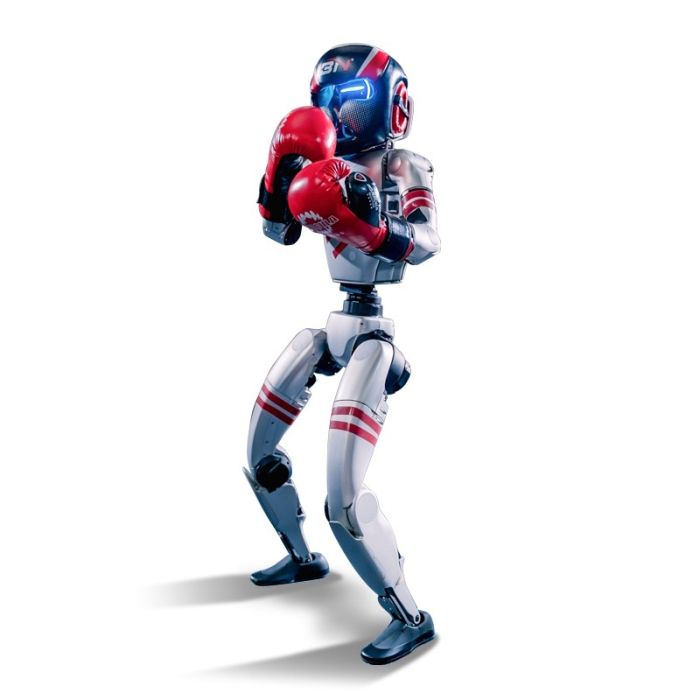
Unitree G1-Boxing Iron Fist King Humanoid Robot
In stock
- BRAND:
- UNITREE ROBOTICS
- MODEL:
- G1-BOXING
- PART #:
- G1-Boxing
- ORIGIN:
- China
- Warranty:
- 12 MONTHS
- AVAILABILITY:
- SUBJECT TO AVAILABILITY
- SKU:
- Unitree-G1-Boxing
Unitree G1-Boxing Iron Fist King Humanoid Robot
Most humanoid robots are judged by how carefully they move: a steady walk, a tidy grasp, a fall avoided. The Unitree G1-Boxing Iron Fist King Humanoid Robot invites the opposite test. It is meant to be watched while it attacks and while it is struck. It chains straight punches, left and right hooks and front kicks in seamless succession, then recovers from heavy impacts that would end the routine of a more cautious machine. For an audience, that contrast between aggression and composure is the whole show. For an engineer, it is a demanding public exercise in whole-body control.
Robots Middle East sells the Unitree G1-Boxing Iron Fist King Humanoid Robot and supplies it to customers across the Middle East, from exhibition organisers and entertainment venues to universities and corporate innovation teams. Robots Middle East prepares each quotation, coordinates delivery to the destination and remains your point of contact for support once the robot is in service.
Background
Unitree Robotics and the G1 family
Unitree Robotics has built its reputation on legged machines, first with quadrupeds and then with humanoids that bring dynamic locomotion to a human form. The company behind the brand is Yushu Technology Co., Ltd. The G1 is its compact humanoid line, offered in several configurations that range from an entry version to EDU models intended for development work. You can see the complete line-up in the Unitree G1 category. The G1-Boxing is not a separate robot designed from scratch. It is a combat-sport configuration built on the G1 EDU platform, so it inherits that platform's development-oriented hardware and adds a repertoire of trained striking movements.
Taught by people, refined in simulation
The fighting style of the G1-Boxing does not come from hand-written animation. It is powered by a motion-capture training system that enables pro-level performance. The robot is trained in virtual environments and with data gathered through human motion-sensing teleoperation. A human performer's movement therefore becomes the raw material, and simulation turns it into routines the robot can execute at speed while keeping its balance. The robot is also continuously learning new skills, so its repertoire develops over time rather than remaining a fixed set of moves.
Technical Specifications
| Specification | Value |
|---|---|
| Base platform | G1 EDU |
| Knee joint torque | Up to 120 N·m |
| Onboard compute | NVIDIA Jetson Orin compute module (100 TOPS) |
| Perception | 3D LiDAR/Depth Camera perception suite |
| Combat moves | Straight punches, left and right hooks, front kicks, in seamless succession |
| Training | Motion-capture training system; virtual environments and human motion-sensing teleoperation data |
| Control methods | Motion-sensing, controller and voice commands |
| Real-time teleoperation | VR headsets, motion-capture suits or handheld controllers |
| Balance | Recovers from heavy impacts |
| Classification | Civilian robot |
Specifications as published by the manufacturer; confirmed against the datasheet at quotation.
The manufacturer has not published the battery capacity, the battery runtime, the maximum speed, the connectivity, the included accessories, whether a dexterous hand is included, the IP rating or the payload; these are confirmed at quotation.
What makes the G1-Boxing different from a standard G1 EDU?
The hardware foundation is shared. The G1-Boxing is built on the G1 EDU platform and uses high-torque joint motors, rated at up to 120 N·m at the knees, together with rapid feedback control loops. The knees matter here because a strike only looks convincing when the legs absorb and redirect force. They are also where the robot does most of the work of staying upright after a hit.
The difference lies in purpose and training. A general EDU configuration is a blank canvas for a research team's own projects. The G1-Boxing arrives with a defined identity as a combat-sport performer. Its routines come from motion capture and simulation, and its value is measured by speed, fluency and recovery rather than by careful manipulation. The development-oriented elements of the EDU base remain: the NVIDIA Jetson Orin compute module (100 TOPS) and the 3D LiDAR/Depth Camera perception suite support custom AI training, so a team can treat the boxing repertoire as a starting point rather than a ceiling.
How is the G1-Boxing controlled during a performance?
Control is deliberately varied. The robot can be directed by motion-sensing, controller and voice commands. For real-time teleoperation, it can be driven through VR headsets, motion-capture suits or handheld controllers. This flexibility serves two audiences. On stage, an operator wearing a motion-capture suit can mirror a human fighter and make the bout feel spontaneous. In the laboratory, the same teleoperation channels serve as an intuitive way to gather movement data, which feeds the training process that gives the robot its skills in the first place.
The G1-Boxing is a civilian robot, and all users are asked to refrain from dangerous modifications or hazardous use. Any demonstration should be planned with clear safety distances and a trained operator in charge.
Who is the Unitree G1-Boxing Iron Fist King Humanoid Robot for?
The clearest fit is the events and entertainment sector. Exhibition organisers, venues, broadcasters and livestream producers want a humanoid that holds an audience's attention, and few sights do that better than a robot throwing a combination and then shrugging off a heavy blow. Brand activation teams and technology showrooms will see similar value: the routine is immediately understandable, needs no technical explanation and photographs well.
Universities and research groups working on embodied AI, motion learning or teleoperation form the second segment. For them, the attraction is the pipeline behind the performance: motion capture, training in virtual environments and teleoperation data collection on an EDU-based platform with onboard compute and 3D perception. Education providers running robotics programmes may also use the robot as a showcase that draws students towards control engineering and machine learning.
Buyers whose work centres on general research or manipulation rather than athletic demonstration may be better served by the wider G1 range. EDU configurations such as the Unitree G1 Edu Standard Humanoid Robot with Fake Hands (G1EDU-U1) are listed in the same family. Those comparing different humanoid formats can browse the Bipedal Humanoids category, and Robots Middle East can advise on which configuration matches the project.
What is the Unitree G1-Boxing Iron Fist King Humanoid Robot used for?
- Live exhibition bouts: staged robot boxing that draws crowds at trade fairs, festivals and technology events.
- Livestreamed robotic sport: broadcast-friendly matches and demonstrations for online audiences and media productions.
- Teleoperation research: studying real-time control through VR headsets, motion-capture suits and handheld controllers.
- Motion-learning experiments: exploring how human motion data and virtual training translate into athletic robot movement.
- Balance and recovery studies: observing whole-body control as the robot absorbs heavy impacts and stays on its feet.
- Showrooms and education: an engaging centrepiece for innovation centres and robotics teaching programmes.
Pricing and Availability
Robots Middle East supplies the Unitree G1-Boxing Iron Fist King Humanoid Robot on a quotation basis, so that the offer reflects your configuration, intended use and destination. Delivery, customs and support are arranged with the quotation. The quotation also sets out the scope of supply in full. To start the process, use the quotation request available on this page.
Frequently Asked Questions
Which combat moves can the G1-Boxing perform?
It performs straight punches, left and right hooks and front kicks, executed in seamless succession. The robot is also continuously learning new skills.
How does the robot learn its routines?
It is powered by a motion-capture training system. It is trained in virtual environments and with data collected through human motion-sensing teleoperation, which allows high-speed athletic movement while it keeps its balance.
Can it stay upright after being struck?
Yes. The G1-Boxing is capable of recovering from heavy impacts, supported by high-torque joint motors of up to 120 N·m at the knees and rapid feedback control loops.
How is the G1-Boxing controlled?
It responds to motion-sensing, controller and voice commands. For real-time teleoperation, it can be driven through VR headsets, motion-capture suits or handheld controllers.
What computing and sensing hardware does it carry?
Built on the G1 EDU platform, it uses an NVIDIA Jetson Orin compute module (100 TOPS) and a 3D LiDAR/Depth Camera perception suite. Together they support custom AI training.
What are the battery life, payload and IP rating?
Robots Middle East provides these details with the quotation, together with the maximum speed, the connectivity and the included accessories.
Where can I buy the Unitree G1-Boxing Iron Fist King Humanoid Robot and what does it cost?
You can buy it from Robots Middle East, which supplies customers across the Middle East. The cost depends on configuration and destination, so request a quotation and Robots Middle East will set out the full offer, including delivery, customs and support.
Summary
The Unitree G1-Boxing Iron Fist King Humanoid Robot turns the usual measure of a humanoid on its head. Instead of proving that it can avoid trouble, it seeks it out, throwing hooks, straight punches and front kicks and then recovering from heavy impacts. Behind the spectacle sits a serious foundation: the G1 EDU platform, knee torque of up to 120 N·m, an NVIDIA Jetson Orin compute module (100 TOPS), 3D perception, and a training pipeline that learns from human motion and from simulation. For event organisers it is a crowd-gatherer. For researchers it is a platform for studying teleoperation and motion learning. For anyone ready to put a fighting humanoid in front of an audience, this page is the starting point.