
Unitree Go2 Docking Station 100 Tops
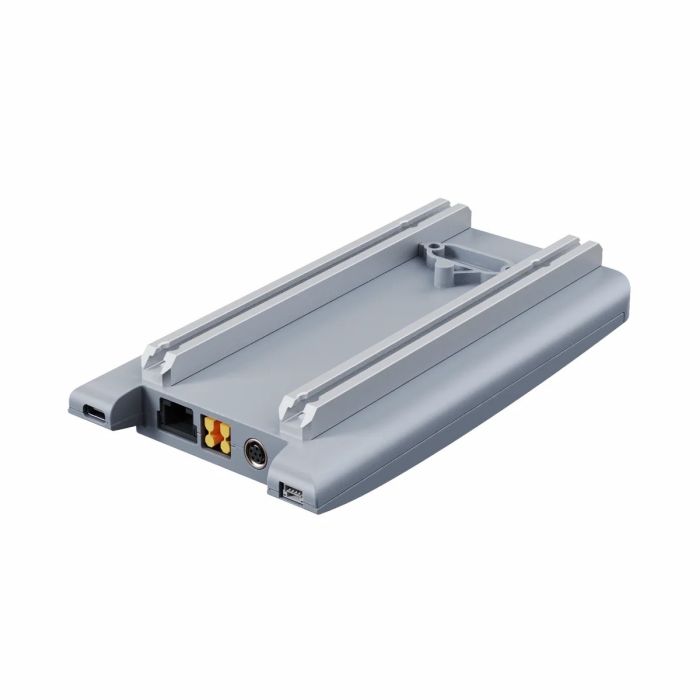
In stock
- BRAND:
- UNITREE ROBOTICS
- PART #:
- Go2 Docking Station 100Tops
- ORIGIN:
- China
- AVAILABILITY:
- SUBJECT TO AVAILABILITY
- SKU:
- Unitree-Go2-Docking-Station-100Tops
Unitree Go2 Docking Station 100 Tops
A docking station is usually something that waits on a desk for a laptop to come back to it. The Unitree Go2 Docking Station 100 Tops reverses that idea. It is an official expansion module for the Unitree Go2, and its purpose is to bring a substantial AI computer to the robot rather than ask the robot to report back to one. Built around an NVIDIA Jetson Orin NX with 16GB of LPDDR5 memory and rated at 100 TOPS, it gives developers room to run neural networks, sensor fusion and ROS 2 nodes where the data is collected: on a quadruped moving through the very space it is meant to understand.
Robots Middle East supplies the Unitree Go2 Docking Station 100 Tops to universities, research centres, system integrators and industrial teams across the Middle East. Each quotation from Robots Middle East is prepared against the buyer's existing or planned Go2 configuration, and Robots Middle East arranges delivery to the project site and provides after-sales support throughout the region.
Background
Unitree Robotics and the Go2 platform
Unitree Robotics has become one of the best-known names in legged robotics, with a portfolio that runs from compact quadrupeds for teaching and research to larger platforms for industrial work, alongside a growing range of humanoids. The Go2 occupies an important place in that line-up: it is compact enough for a laboratory or a lecture theatre, yet capable enough to serve as a serious development platform. Around it Unitree has built an ecosystem of official accessories, from controllers and batteries to manipulators, so that one robot can be shaped to many different projects. The docking station is the member of that ecosystem concerned with computing rather than movement.
Why an NVIDIA Jetson Orin NX
The NVIDIA Jetson family is widely used in robotics because it combines a capable ARM processor with a GPU designed for parallel workloads, inside a module suited to embedded deployment. In this docking station, the Orin NX pairs an 8-core ARM Cortex-A78AE processor at 2.0GHz with a 1024-core NVIDIA Ampere architecture GPU at 918MHz, equipped with 32 Tensor Cores. The software environment is equally familiar to robotics developers: Ubuntu 20.04/22.04, ROS 2, the NVIDIA JetPack SDK, CUDA and TensorRT. This means that models trained on a workstation can be optimised and deployed using established NVIDIA tooling, and that existing ROS 2 packages can be brought across without having to adopt an unfamiliar stack.
Technical Specifications
| Specification | Value |
|---|---|
| Product type | AI Computing Docking Station |
| AI performance | 100 TOPS |
| Compute module | NVIDIA Jetson Orin NX, 16GB LPDDR5 memory |
| Processor | 8-core ARM Cortex-A78AE @ 2.0GHz |
| GPU | 1024-core NVIDIA Ampere architecture GPU @ 918MHz, with 32 Tensor Cores |
| Power input | 16V-60V DC, wide input range |
| USB ports | 1× USB 3.0 Type-A, 2× USB 3.0 Type-C |
| Network | 2× Gigabit Ethernet (RJ45), 1× Fast Ethernet (GH1.25-4PIN) |
| Industrial connector | 1× M8 aviation plug interface |
| Software environment | Ubuntu 20.04/22.04, ROS 2, NVIDIA JetPack SDK, CUDA, TensorRT |
| Compatible robot | Unitree Go2 |
Specifications are as published by the manufacturer and are confirmed against the datasheet at quotation.
The manufacturer has not published the dimensions, weight, power consumption, operating temperature, IP rating, storage capacity or wireless connectivity of this module; these details are confirmed with the quotation.
What does the 100 TOPS version add over the 40 TOPS configuration?
Unitree offers the Go2 docking station in two configurations, sold separately. The 40 TOPS configuration uses the smaller NVIDIA Orin Nano with 8GB of memory, and is better suited to educational and entry-level development. The 100 TOPS version described on this page steps up to the Orin NX with 16GB of LPDDR5 memory.
In practical terms, the difference is headroom. Twice the memory gives larger models, several concurrent perception pipelines and memory-hungry mapping processes room to coexist without constant compromise. The higher rated AI performance matters when a project moves beyond a single detection network towards combining camera streams, LiDAR point clouds and planning software at the same time. A team that expects its software to grow over the life of a project will generally find the 100 TOPS configuration the more durable choice, while a course that teaches the fundamentals of ROS 2 and computer vision may find the 40 TOPS configuration entirely sufficient.
Why run AI on the robot rather than on a remote computer?
Many quadruped projects begin with the robot streaming its sensor data to a laptop or server, where the heavy computation takes place. That arrangement works on a bench, but it introduces dependence on a network link, adds latency between perception and action, and limits how far the robot can operate from its supporting infrastructure. Placing the computer on the robot removes those constraints: the robot can perceive, decide and act on its own, and the network becomes a channel for supervision rather than a lifeline.
The docking station's interfaces are chosen with this kind of work in mind. Its USB, Ethernet and aviation interfaces support the integration of cameras, LiDAR and other compatible devices, so additional sensors can be connected directly to the computer that processes them. Two Gigabit Ethernet ports suit high-bandwidth devices such as LiDAR units, the USB 3.0 ports accommodate cameras and peripherals, and the M8 aviation plug provides a robust industrial-style connection. The wide 16V-60V DC input range gives integrators flexibility in how the module is powered.
Who is the Unitree Go2 Docking Station 100 Tops for?
The first group is university and institutional research laboratories working on autonomy, perception and legged locomotion. For these teams, the ability to run full research software on the robot itself, rather than on a tethered workstation, is often what separates a demonstration from a genuine field experiment.
The second group is system integrators who build complete solutions on the Go2 for clients in sectors such as energy, construction, utilities and facilities management. They benefit from a standard, officially supported computing platform with a familiar software stack, which shortens development and simplifies long-term maintenance of a deployed solution.
The third group is industrial innovation teams running pilot projects, for example evaluating whether a quadruped can carry out routine inspection rounds. An onboard AI computer allows such pilots to test realistic workflows in which the robot interprets what it sees in real time.
Educational buyers should consider their curriculum carefully. Advanced postgraduate programmes may well make use of the 100 TOPS configuration, but for introductory courses and entry-level development the manufacturer positions the 40 TOPS configuration as the better fit. Robots Middle East is pleased to advise on which configuration suits a given programme, and buyers assembling a complete Go2 setup can browse the wider range of Accessories and Quadruped Accessories.
What is the Unitree Go2 Docking Station 100 Tops used for?
- Onboard perception research – running object detection, segmentation and tracking models directly on the Go2.
- Mapping and localisation – processing LiDAR and camera data for SLAM and navigation experiments in real environments.
- ROS 2 development – hosting ROS 2 nodes on the robot so that software behaves in the field as it does in the laboratory.
- Sensor integration – connecting additional cameras, LiDAR and compatible devices through the USB, Ethernet and M8 interfaces.
- Inspection prototyping – trialling autonomous patrol and visual inspection workflows at industrial and infrastructure sites.
- Model optimisation – deploying networks with CUDA and TensorRT to evaluate inference performance on embedded hardware.
Pricing and Availability
Robots Middle East supplies the Unitree Go2 Docking Station 100 Tops on a quotation basis, so that each offer reflects the buyer's robot configuration, the chosen accessories and the destination. Delivery, customs clearance and technical support are arranged together with the quotation. Please share details of your Go2 and your intended application, and the Robots Middle East team will confirm compatibility and prepare an offer. The form to request a quotation for the Unitree Go2 Docking Station 100 Tops is available on this page.
Frequently Asked Questions
Is the Unitree Go2 Docking Station 100 Tops an official Unitree product?
Yes. It is an official expansion module designed by Unitree for the Go2.
Which compute module does it use?
It uses an NVIDIA Jetson Orin NX with 16GB of LPDDR5 memory, combining an 8-core ARM Cortex-A78AE processor with a 1024-core NVIDIA Ampere architecture GPU that includes 32 Tensor Cores.
Which software does it support?
The software environment comprises Ubuntu 20.04/22.04, ROS 2, the NVIDIA JetPack SDK, CUDA and TensorRT.
Can I connect my own cameras or LiDAR?
Yes. The USB, Ethernet and aviation interfaces support the integration of cameras, LiDAR and other compatible devices. Robots Middle East can review the specific sensors you intend to use when preparing the quotation.
How does it differ from the 40 TOPS configuration?
The 40 TOPS configuration uses the NVIDIA Orin Nano with 8GB of memory and suits educational and entry-level development. The 100 TOPS version uses the Orin NX with 16GB of memory for more demanding research and integration work.
What are its dimensions and weight?
The manufacturer has not published the dimensions or weight. Robots Middle East confirms these details with the quotation.
Where can I buy the Unitree Go2 Docking Station 100 Tops and what does it cost?
You can obtain it from Robots Middle East, which supplies buyers across the Middle East. The cost depends on your configuration and destination, so please request a quotation through this page.
Summary
The ordinary docking station stays where it is and waits; the Unitree Go2 Docking Station 100 Tops goes where the robot goes. By pairing the Go2 with an NVIDIA Jetson Orin NX, 16GB of LPDDR5 memory and a familiar stack of Ubuntu, ROS 2, JetPack, CUDA and TensorRT, it allows perception and autonomy software to run where the sensors are, while its USB, Ethernet and M8 interfaces leave room for the cameras and LiDAR a serious project requires. For research laboratories, integrators and industrial pilot teams, it turns the Go2 from a capable walking platform into a self-contained thinking one, while the 40 TOPS configuration remains the gentler entry point for teaching. For buyers in the Middle East who wish to equip their Go2 with this level of onboard intelligence, with delivery and support arranged by Robots Middle East, this page is the starting point.
Specifications
General
Feature
The 100 TOPS GPU card is included with the docking station. Here are its specs:
1. Input voltage: 16V-60V
2. Ports:
• 1 × USB3.0 Type-A
• 1 × USB2.0 Type-C
• 1 × USB3.0 Type-C
• 2 × Gigabit Ethernet (RJ45)
• 1 × 100Mbps Ethernet (GH1.25-4PIN)
• 1 × M8 aviation connector
3. Computing power: 100 TOPS