
Unitree H2-D Standard G Humanoid Robot
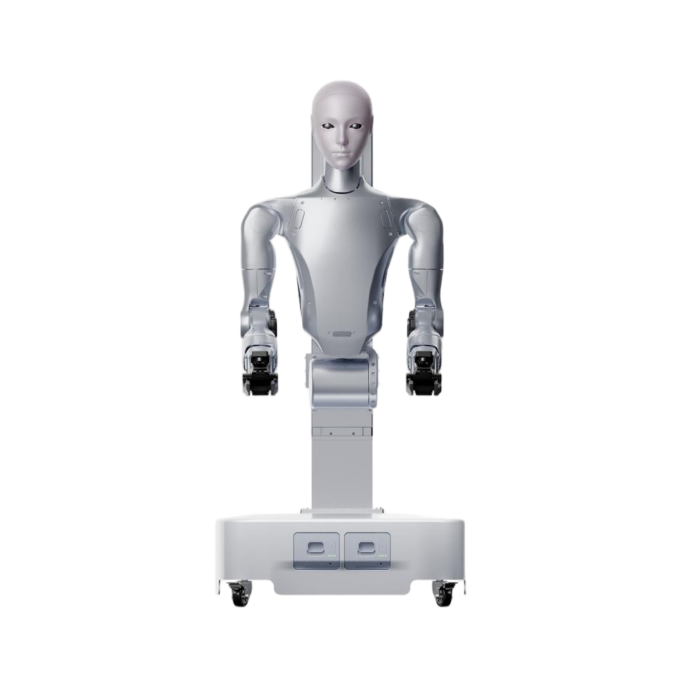
In stock
- BRAND:
- UNITREE ROBOTICS
- MODEL:
- H2-D-Standard-G
- PART #:
- H2-D-Standard-G
- ORIGIN:
- China
- Warranty:
- 12 MONTHS
- AVAILABILITY:
- SUBJECT TO AVAILABILITY
- SKU:
- Unitree-H2-D-Standard-G
Unitree H2-D Standard G Humanoid Robot
Software for humanoid robots ages in months, while the body that carries it is expected to serve for years. That mismatch shapes how laboratories and integrators choose a platform, and it is the most useful way to read the Unitree H2-D Standard G Humanoid Robot. This is a full-size machine whose motion algorithms evolve continuously through over-the-air updates. It is built on a frame of aerospace-grade aluminium, titanium alloy and high-strength engineering plastics, so the hardware can keep pace as the control software improves.
Robots Middle East supplies the Unitree H2-D Standard G Humanoid Robot to universities, research centres, system integrators and enterprises throughout the Middle East. Robots Middle East prepares each quotation for the exact configuration requested, arranges delivery to the customer's site and remains the point of contact for technical support after handover.
Background
Unitree Robotics and its move into humanoids
Unitree Robotics first became widely known for agile legged robots. The company later carried that experience in actuators and dynamic balance into humanoid platforms. The H2 family is the result of that progression: a line of adult-scale bipedal robots intended for serious development work rather than display alone. Within the network's catalogue, the H2-D Standard configurations are offered as lettered packages. Each one is identified by its own suffix, and Standard G is the configuration presented on this page.
A body designed for continuous improvement
The central idea behind the H2 is that hardware should not become the bottleneck. Unitree describes the motion system in terms of 31 degrees of freedom, 360 N.m joint torque and precise replication of dynamic movement. The algorithms that drive it are refined over time through OTA updates. In practice, the mechanical platform is specified generously, with high-torque leg joints, strong arm joints and a removable smart battery. Locomotion and behaviour then mature in software. For a research group, this means experiments carried out today and experiments planned next year can run on the same physical robot.
Technical Specifications
| Specification | H2 | H2 EDU |
|---|---|---|
| Total degrees of freedom | 31 | 31 |
| Standing dimensions | 1820 x 456 x 218 mm | 1820 x 456 x 218 mm |
| Weight with battery | Approximately 70 kg | Approximately 70 kg |
| Max. arm joint torque | 120 N.m | 120 N.m |
| Max. leg joint torque | 360 N.m | 360 N.m |
| Max. arm payload | Peak: ~15 kg; nominal: ~7 kg | Peak: ~15 kg; nominal: ~7 kg |
| Battery | 15 Ah (0.972 kWh) | 15 Ah (0.972 kWh) |
| Battery life | Approximately 3 h | Approximately 3 h |
| Connectivity | Wi-Fi 6, Bluetooth 5.2 | Wi-Fi 6, Bluetooth 5.2 |
| Vision sensor | Wide-angle humanoid binocular camera | Wide-angle humanoid binocular camera |
| Voice interaction | Array microphones + high-power speaker | Array microphones + high-power speaker |
| Basic onboard computing | PC1: Intel Core i5 | PC1: Intel Core i5 |
| High-performance computing module | Not listed | Up to Jetson AGX Thor (2070 TOPS) |
| Materials | Aerospace-grade aluminium + titanium alloy + high-strength engineering plastics | Aerospace-grade aluminium + titanium alloy + high-strength engineering plastics |
| Included accessories | Charger, manual remote controller, removable smart battery | Charger, manual remote controller, removable smart battery |
Specifications are as published by the manufacturer for the H2 family and are confirmed against the datasheet at quotation, together with the version on which the Standard G configuration is based.
The manufacturer has not published the top walking speed, the IP rating, the operating temperature range, the charging time, the weight of a separate battery or the noise level; these points are confirmed at quotation.
What does the H2 EDU add over the H2?
On paper, the two published versions share the same body. They have identical degrees of freedom, dimensions, weight, joint torques, payload, battery, sensors and materials. The difference lies in computing. Both carry a basic onboard PC1 with an Intel Core i5, which handles standard operation. The H2 EDU can also take a high-performance computing module of up to Jetson AGX Thor, rated at 2070 TOPS, while no such module is listed for the H2.
For teams training perception models, running large neural policies on the robot itself or experimenting with embodied AI, that additional computing capacity is the deciding factor. Where the work centres on motion, demonstration or application trials that rely on established behaviours, the basic computing may be sufficient. Buyers who need substantial onboard AI capacity are invited to say so in their enquiry, so that Robots Middle East can offer the matching computing arrangement for the Standard G configuration.
Is the H2 strong enough for real handling and locomotion work?
The torque figures answer much of this question. Leg joints reach a maximum of 360 N.m, which supports a robot of approximately 70 kg standing 1820 mm tall in dynamic movement. Arm joints reach 120 N.m, and the published arm payload is approximately 7 kg nominal with a peak of approximately 15 kg. Together these figures place the H2 in the territory of genuine object handling rather than gesture alone. Researchers can study lifting, carrying and placing tasks with everyday items.
Endurance matters equally. The removable smart battery is rated at 15 Ah (0.972 kWh), with a battery life of approximately 3 h. Because the battery is removable, a laboratory session need not end when one pack is depleted, provided a charged spare is available. The binocular camera, array microphones and high-power speaker complete the picture, giving the robot the sensing and voice channels that interaction studies require.
Who is the Unitree H2-D Standard G Humanoid Robot for?
The first audience is university and institutional research groups working on bipedal locomotion, whole-body control and manipulation. For these teams, 31 degrees of freedom and high joint torque provide a body capable of demanding experiments. A second audience is system integrators and corporate innovation teams. They evaluate whether humanoid platforms can take on tasks in logistics, inspection or service environments and need a full-size robot for realistic trials. Educational institutions running advanced robotics programmes form a third group, using the platform to teach control, perception and human–robot interaction on real hardware.
Teams whose work depends on heavy onboard AI computing should look closely at the H2 EDU version, which is the version listed with the Jetson AGX Thor module. Buyers who wish to compare the Standard G with the other lettered packages can review the full H2-D Standard range or the wider Unitree H2-D category. Robots Middle East can then explain how the configurations differ in what is supplied.
What is the Unitree H2-D Standard G Humanoid Robot used for?
- Locomotion research — developing and testing walking, balance and recovery controllers on a full-size bipedal body.
- Manipulation studies — investigating grasping, lifting and carrying with arms rated for a nominal payload of approximately 7 kg.
- Embodied AI development — training and deploying perception and control policies that run on the robot itself.
- Human–robot interaction — exploring voice dialogue and social behaviour through the array microphones, speaker and binocular vision.
- Advanced teaching — giving engineering students practical experience with a modern humanoid platform in laboratory courses.
- Application trials — assessing how a humanoid performs in real workplaces before wider deployment is considered.
Pricing and Availability
The Unitree H2-D Standard G Humanoid Robot is supplied by quotation, because the final offer depends on the exact configuration, the computing arrangement, any additional accessories and the destination. Robots Middle East reviews each enquiry individually and replies with an offer tailored to the project. Delivery, customs clearance and technical support are all arranged together with the quotation. To begin the process, use the quotation request available on this page.
Frequently Asked Questions
How many degrees of freedom does the H2 have?
The H2 family has 31 degrees of freedom in total, a figure the H2 and H2 EDU share.
How long does the battery last?
The removable smart battery is rated at 15 Ah (0.972 kWh) and gives a battery life of approximately 3 h. Because it is removable, a charged spare can keep longer sessions running.
What is included with the robot?
The published accessories are a charger, a manual remote controller and a removable smart battery. Any additional accessories a project requires can be added to the offer.
What computing does the robot carry?
Basic onboard computing is a PC1 with an Intel Core i5. The H2 EDU version can add a high-performance module of up to Jetson AGX Thor (2070 TOPS).
Can the robot's capabilities improve after purchase?
Yes. Unitree states that the motion algorithms evolve continuously via OTA updates, so behaviour can be refined without changing the hardware.
Which sensors and connections does the robot use?
The robot sees through a wide-angle humanoid binocular camera and interacts by voice through array microphones and a high-power speaker. It connects via Wi-Fi 6 and Bluetooth 5.2.
Where can I buy the Unitree H2-D Standard G Humanoid Robot and what does it cost?
You can buy it from Robots Middle East by requesting a quotation on this page. The cost depends on configuration and destination, and is stated in the personalised offer you receive.
Summary
The Unitree H2-D Standard G Humanoid Robot answers the problem set out at the start: software that moves quickly needs a body that does not hold it back. With 31 degrees of freedom, leg joints rated at 360 N.m, a frame of aluminium, titanium alloy and engineering plastics, and algorithms refined through OTA updates, the H2 platform is designed to remain relevant as research advances. Robots Middle East supplies it across the region with configuration guidance, delivery and support. For any team planning its next stage of humanoid work, this page is the starting point.