
Unitree H2-D Standard H Humanoid Robot
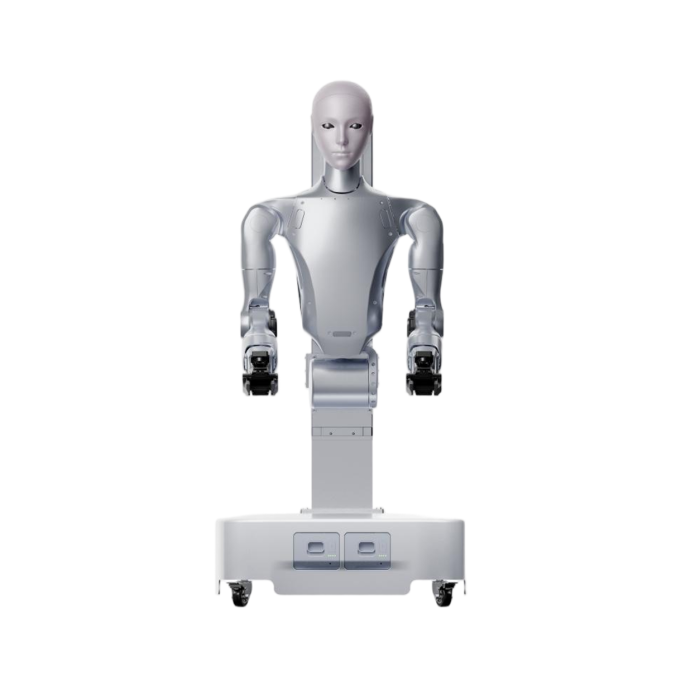
In stock
- BRAND:
- UNITREE ROBOTICS
- MODEL:
- H2-D-Standard-H
- PART #:
- H2-D-Standard-H
- ORIGIN:
- China
- Warranty:
- 12 MONTHS
- AVAILABILITY:
- SUBJECT TO AVAILABILITY
- SKU:
- Unitree-H2-D-Standard-H
Unitree H2-D Standard H Humanoid Robot
Most robots in a university laboratory are bolted to a bench or roll on wheels, and that keeps the hardest questions in robotics politely out of reach. Balance, footstep planning and whole-body coordination only become real problems when a machine of human size has to hold itself upright on two legs, carry its own battery and still keep its arms free for useful work. The Unitree H2-D Standard H Humanoid Robot brings those problems into the room. It is a configuration in the H2-D family, which builds on Unitree's H2 humanoid platform: a machine that stands 1820 mm tall and weighs approximately 70 kg with its battery fitted. That makes it a genuine test bed for full-scale research rather than a scaled-down model of one.
Robots Middle East sells the Unitree H2-D Standard H Humanoid Robot to universities, research institutes, government innovation programmes and private companies across the Middle East. Robots Middle East prepares each quotation, arranges delivery to your site and provides support once the robot is in service. Its role is to make sure that the configuration you order matches the work you have planned for it.
Background
Unitree Robotics and its path to full-size humanoids
Unitree Robotics, based in Hangzhou, China, built its reputation on agile quadruped robots before extending its engineering into bipedal humanoids. The same approach runs through the company's catalogue: in-house actuators, compact high-torque joints, and control software that is refined over time and delivered to the machine as updates. The H2 family is the full-size branch of that work. It is intended for organisations that need a humanoid at human scale rather than a smaller, child-sized or desktop platform.
This lineage matters to buyers because it shapes the ecosystem around the robot. A platform from an established manufacturer tends to gather a community of researchers, published experiments and shared tooling. That community shortens the time between unpacking the robot and producing results that can be presented, published or put to work.
The H2 platform and what the H2-D Standard H name signals
The figures for this product are given for the H2 platform. The sources name several versions in the family: H2, H2 EDU, H2 BASIC, H2 EDU STANDARD and H2 EDU SMART. Of these, the H2 BASIC has its package described in detail. It is the entry-level configuration, with one computing unit, no PC dedicated to user development, no support for secondary development and no robotic hands included.
The H2-D Standard H name identifies one lettered configuration within the H2-D Standard range. Robots Middle East sets out its exact package contents, including computing, development access and hand options, before an order is placed.
Technical Specifications
| Specification | Value (Unitree H2) |
|---|---|
| Standing dimensions (H x W x D) | 1820 x 456 x 218 mm |
| Weight with battery | Approximately 70 kg |
| Total degrees of freedom | 31 |
| DoF per leg | 6 |
| DoF per arm | 7 |
| Waist DoF | 3 |
| Head DoF | 2 |
| Max. arm joint torque | 120 N.m |
| Max. leg joint torque | 360 N.m |
| Battery | 15 Ah (0.972 kWh) |
| Battery life | Approximately 3 h |
| Basic onboard computing | PC1: Intel Core i5 |
| Vision sensor | Wide-angle humanoid binocular camera |
| Voice interaction | Array microphones + high-power speaker |
| Connectivity | Wi-Fi 6, Bluetooth 5.2 |
| Materials | Aerospace-grade aluminium + titanium alloy + high-strength engineering plastics |
| Intelligent OTA | Yes |
| Charger | Yes |
| Manual remote controller | Yes |
Specifications are as published by the manufacturer for the Unitree H2 platform and are confirmed against the datasheet at quotation.
The manufacturer has not published the top walking speed, the IP rating, the charging time, the operating temperature range, the camera resolution or whether LiDAR is fitted; Robots Middle East confirms these points at quotation.
How does the H2 platform use its 31 degrees of freedom?
The H2 distributes its 31 degrees of freedom much as a human body would. Each leg has 6, each arm has 7, the waist has 3 and the head has 2. The six-joint legs give the robot the hip, knee and ankle articulation needed to place each foot deliberately, to recover from a disturbance and to adapt its stance to the ground beneath it. With up to 360 N.m available at the leg joints, the platform has the strength to carry its own weight through dynamic movements rather than shuffling cautiously.
The arms are where the platform separates itself from simpler humanoids. A seven-joint arm is redundant in the way a human arm is: the hand can hold a fixed position while the elbow moves. That lets researchers study obstacle avoidance, natural reaching and tool handling in cluttered spaces. The arm joints deliver up to 120 N.m. The three-joint waist allows the robot to lean, bend and twist its upper body, which extends its reach without moving its feet. The two-joint head lets the wide-angle binocular camera follow a person or a task across the room.
Inside, a PC1 with an Intel Core i5 provides the basic onboard computing. Array microphones and a high-power speaker handle voice interaction, and Wi-Fi 6 and Bluetooth 5.2 connect the robot to the surrounding network. The structure combines aerospace-grade aluminium, titanium alloy and high-strength engineering plastics. Intelligent OTA support means software improvements can reach the robot without returning it to a workshop.
What should a buyer ask about the H2-D Standard H configuration?
The body, joints and battery are documented for the H2 platform, but a humanoid's value to a research team depends just as much on what the package includes. The H2 BASIC shows why this matters. Its single computing unit, the absence of a PC dedicated to user development and the lack of secondary development support suit it to demonstration and operation rather than to writing your own controllers. It also ships without robotic hands.
Before ordering the H2-D Standard H, a buyer should therefore establish four things. Is there a dedicated development computer? Is secondary development supported? Which hands, if any, are included? And how does the package compare with the other lettered configurations in the range? Robots Middle East answers each of these in writing.
Endurance deserves the same attention when planning sessions. The H2 carries a 15 Ah (0.972 kWh) battery with a battery life of approximately 3 h. Laboratories planning long days of experiments should agree a battery and charging plan with Robots Middle East before ordering.
Who is the Unitree H2-D Standard H Humanoid Robot for?
The first and most natural audience is the university or research institute working on locomotion, whole-body control, manipulation or human–robot interaction. For these teams, full human scale is the point: results obtained on the H2 transfer more directly to environments designed for people.
A second audience is the teaching programme that wants students to work with a real full-size humanoid rather than a simulation alone. A third is the innovation centre, museum or corporate showroom where a human-sized robot that can speak, listen and turn its head towards visitors makes a strong impression. A fourth is the system integrator or industrial research team evaluating whether humanoid platforms can take on tasks in spaces built for human workers.
Teams that intend to write their own software should make sure that the configuration they choose supports secondary development. The H2 BASIC, for example, does not. Buyers who want to weigh this configuration against its siblings can review the full Unitree H2-D range and ask Robots Middle East which package best fits their programme.
What is the Unitree H2-D Standard H Humanoid Robot used for?
- Locomotion research: studying bipedal balance, gait generation and recovery on a full-size body with strong leg joints.
- Manipulation studies: exploring reaching and grasping with redundant seven-joint arms and a flexible waist.
- Human–robot interaction: testing dialogue, attention and gesture using the array microphones, speaker and articulated head.
- Teaching and training: giving engineering students hands-on experience with a real humanoid platform.
- Public engagement: welcoming and informing visitors in exhibitions, innovation centres and corporate showrooms.
- Applied evaluation: assessing how a human-scale robot copes with doors, corridors and workstations designed for people.
Pricing and Availability
Robots Middle East supplies the Unitree H2-D Standard H Humanoid Robot on a quotation basis. The cost depends on the configuration, the hand and computing options, and the services your project requires. Each quotation states the package contents in detail, so that you can compare it accurately with other configurations before committing. Delivery, customs and support are arranged with the quotation. To begin, please use the quotation request available on this page.
Frequently Asked Questions
How large is the Unitree H2 platform?
The H2 measures 1820 x 456 x 218 mm when standing and weighs approximately 70 kg with its battery. It is a full-size humanoid at adult human scale.
How many degrees of freedom does the H2 have?
The H2 has 31 degrees of freedom in total: 6 per leg, 7 per arm, 3 in the waist and 2 in the head.
How long does the battery last?
The H2 uses a 15 Ah (0.972 kWh) battery with a battery life of approximately 3 h.
Can I develop my own software for this robot?
That depends on the configuration. The entry-level H2 BASIC does not support secondary development, so please ask Robots Middle East about the development PC and secondary development access for the H2-D Standard H.
How does the robot connect to other systems?
The H2 offers Wi-Fi 6 and Bluetooth 5.2 and supports intelligent OTA updates, so new software can be delivered to the robot over the network.
What comes with the robot?
A charger and a manual remote controller are listed for the H2. Robots Middle East details the hand and computing options of the H2-D Standard H package on request.
Where can I buy the Unitree H2-D Standard H Humanoid Robot and what does it cost?
You can buy it from Robots Middle East, which supplies it across the Middle East. The cost depends on the configuration and services you require and is given in a tailored quotation.
Summary
Robotics stays comfortable for as long as robots stay on benches and wheels. The Unitree H2-D Standard H Humanoid Robot removes that comfort deliberately. It places 31 degrees of freedom, strong leg and arm joints, binocular vision and voice interaction in a body of adult human size, so that balance, reach and interaction can be studied as they really occur. Its body and battery are documented for the H2 platform, while Robots Middle East sets out its package, arranges delivery and provides support. For any team ready to take its research off the bench and onto two feet, this page is the starting point.