
Unitree H2-D Standard M Humanoid Robot
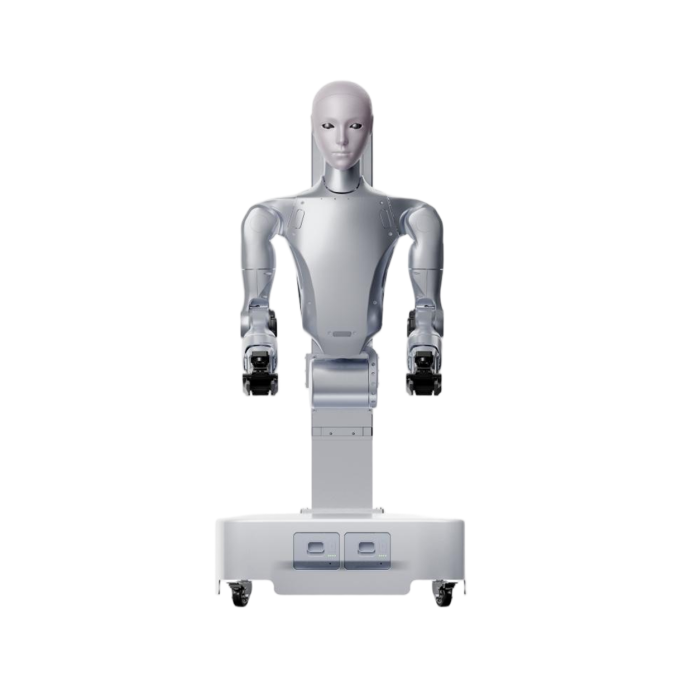
In stock
- BRAND:
- UNITREE ROBOTICS
- MODEL:
- H2-D-Standard-M
- PART #:
- H2-D-Standard-M
- ORIGIN:
- China
- Warranty:
- 12 MONTHS
- AVAILABILITY:
- SUBJECT TO AVAILABILITY
- SKU:
- Unitree-H2-D-Standard-M
Unitree H2-D Standard M Humanoid Robot
Almost every corridor, workbench, doorway and control panel in a modern building was sized for a human body, and that is exactly where a wheeled cart or a bolted-down arm runs out of answers. The Unitree H2-D Standard M Humanoid Robot approaches the problem from the opposite side: instead of rebuilding the room around the machine, it brings a machine proportioned like a person into the room as it already stands. Behind that idea is a platform with 31 degrees of freedom, leg joints rated to 360 N.m and control software that Unitree continues to refine over the air. For teams that want to study, test and demonstrate full-body humanoid work rather than merely observe it, that combination turns a striking figure into a working instrument.
Robots Middle East sells the Unitree H2-D Standard M Humanoid Robot to universities, research centres, system integrators and corporate innovation teams throughout the Middle East. Robots Middle East prepares each quotation, arranges delivery to the customer's site and remains the point of contact for support after commissioning, so that a project anywhere in the region has one accountable partner from the first technical question to the robot's first steps in your facility.
Background
Unitree Robotics and its route to full-size humanoids
Unitree Robotics, based in Hangzhou, built its reputation on agile legged robots before extending its range into humanoids. That lineage matters to buyers: the company's experience lies in high-torque joint actuators, dynamic balance and locomotion control, which are precisely the disciplines a bipedal robot depends upon. The H2 family is Unitree's full-size humanoid line, and the H2-D Standard configurations offered on this network are packages built on that platform. Customers comparing the available packages can review them side by side in the H2-D Standard category.
Where the H2-D Standard M sits in the family
Unitree names three versions of the H2: the H2, the H2 EDU and the H2 Plus. The distinction that most affects a buyer is computing and openness. The entry-level H2 carries one computing unit, an Intel Core i5 that runs the robot's own functions, with no PC dedicated to user development and no support for secondary development. The H2 EDU adds a second computing unit, an Intel Core i7 reserved for user development, and secondary development is supported. Neither of these two versions includes robotic hands. The letter suffix on an H2-D Standard listing identifies a specific package, and Robots Middle East confirms in writing which computing, hand and accessory configuration the Standard M quotation covers before an order is placed. The wider range is gathered under Unitree H2-D.
Technical Specifications
The figures below are those Unitree publishes for the H2 platform; where a row applies to a particular version, the version is named in the row.
| Specification | Value |
|---|---|
| Standing dimensions | 1820 x 456 x 218 mm |
| Weight with battery | Approximately 70 kg |
| Total degrees of freedom | 31 |
| Degrees of freedom per leg | 6 |
| Degrees of freedom per arm | 7 |
| Maximum leg joint torque | 360 N.m |
| Maximum arm payload | Peak: ~15 kg; nominal: ~7 kg |
| Materials | Aerospace-grade aluminium + titanium alloy + high-strength engineering plastics |
| Battery | 15 Ah (0.972 kWh), removable smart battery |
| Battery life | Approximately 3 h |
| Onboard computing (H2) | PC1: Intel Core i5 |
| Onboard computing (H2 EDU) | Intel Core i5 + Intel Core i7, secondary development supported |
| Vision sensor | Wide-angle humanoid binocular camera |
| Voice interaction | Array microphones + high-power speaker |
| Connectivity | Wi-Fi 6, Bluetooth 5.2 |
| Software updates | OTA |
| Included accessories | Charger, manual remote controller, removable smart battery |
| Robotic hands (H2 and H2 EDU) | Not included |
Specifications are as published by the manufacturer and are confirmed against the datasheet for your exact configuration at quotation.
Unitree has not published the top speed, the IP rating, the charging time, whether a lidar is fitted, the camera resolution, the operating temperature range or the weight of the robot without its battery; Robots Middle East confirms each of these at quotation.
How much of the H2 platform can your team actually programme?
This is the question that separates a demonstration robot from a research platform, and the H2 family answers it through its computing architecture. On the entry-level H2, the single Intel Core i5 is occupied by the robot's own locomotion, balance and interaction functions, and Unitree states that secondary development is not supported. Such a configuration suits organisations that want to operate the robot, present it and evaluate its behaviour as Unitree delivers it, with improvements arriving through over-the-air updates rather than through their own code.
The H2 EDU changes the relationship. By adding an Intel Core i7 dedicated to user development, it separates the team's experiments from the controller that keeps the robot upright. A perception pipeline, a task planner or a speech application can run on the second computer without competing for the resources the balance controller needs, and secondary development is formally supported. For any programme whose deliverables include its own software, this distinction outweighs almost every other line in the table, which is why Robots Middle East asks about your development plans before confirming the Standard M package.
What do 31 degrees of freedom and 360 N.m mean in practice?
A degree of freedom is one independently controlled axis of motion. The H2 distributes six to each leg and seven to each arm. A six-axis leg gives the hip, knee and ankle enough freedom to place the foot on uneven or angled ground while the body stays balanced. The seventh axis in each arm matters for manipulation: a redundant joint allows the elbow to be repositioned while the hand holds its pose, so the arm can reach around an obstacle or approach a shelf from a more natural angle.
Torque is what turns those joints into useful force. Leg joints rated to 360 N.m give the controller headroom to recover from a push, to rise and to carry the body's own weight of approximately 70 kg with battery through dynamic movement. At the hands, the published arm payload is nominal ~7 kg and peak ~15 kg, a distinction worth keeping in mind when planning a task: the nominal figure is the one to design sustained handling around. The aluminium, titanium and engineering-plastic structure is chosen to keep that strength without an unnecessarily heavy frame, and the removable 0.972 kWh battery, rated for approximately 3 h, can be exchanged so that a test session is not limited to a single charge.
Who is the Unitree H2-D Standard M Humanoid Robot for?
University laboratories studying bipedal locomotion, whole-body control and human-robot interaction will find a full-size platform whose joint layout mirrors the human body closely enough for meaningful comparison. Research centres and national innovation programmes across the region can use it as a shared reference platform for embodied artificial intelligence work. System integrators evaluating humanoids for logistics, inspection or service roles gain a robot that operates in spaces designed for people, which is the core of any business case for this class of machine. Corporate innovation teams, science museums and exhibition organisers can draw on its voice interaction and human proportions for public engagement.
One segment deserves a direct recommendation: if your team intends to write and deploy its own software, the published information favours the H2 EDU computing arrangement, with its dedicated Intel Core i7 and support for secondary development. Robots Middle East will confirm whether the Standard M package includes that capability, and the other configurations can be compared in the H2-D Standard range.
What is the Unitree H2-D Standard M Humanoid Robot used for?
- Locomotion research: studying balance, gait and push recovery on a full-size bipedal platform.
- Manipulation studies: testing grasp planning and reach with two seven-axis arms.
- Embodied AI development: connecting perception, language and action on a robot that moves in human spaces.
- Teaching and training: giving engineering students hands-on experience with a modern humanoid.
- Integration trials: evaluating whether a humanoid can take on tasks in an existing facility without redesign.
- Public engagement: greeting visitors and speaking with audiences at exhibitions, showrooms and events.
Pricing and Availability
The cost of a humanoid project depends on the configuration, the computing and hand options, the accessories and the level of support required, so Robots Middle East prepares a written quotation for each enquiry rather than publishing a single figure. Delivery, customs clearance and technical support are arranged together with your quotation. To begin, please share your intended application and whether your team plans its own software development, and request your quotation for the Unitree H2-D Standard M Humanoid Robot through the enquiry form available on this page.
Frequently Asked Questions
How many degrees of freedom does the H2 platform have?
The H2 has 31 degrees of freedom in total, with six in each leg and seven in each arm.
Can my team develop its own software for the robot?
That depends on the computing configuration. The entry-level H2 does not support secondary development, whereas the H2 EDU adds an Intel Core i7 dedicated to user development; Robots Middle East confirms which applies to your Standard M package.
Are robotic hands included?
Unitree lists both the H2 and the H2 EDU without robotic hands. The hand configuration of the Standard M package is stated in writing on your quotation.
How long does the battery last?
The 15 Ah (0.972 kWh) battery is rated for approximately 3 h. Because it is a removable smart battery, it can be exchanged to extend a working session.
What is supplied with the robot?
The H2 is supplied with a charger, a manual remote controller and a removable smart battery.
Is the robot suitable for outdoor or dusty environments?
Unitree has not published an IP rating or an operating temperature range for the H2. Please describe your environment when you enquire so that Robots Middle East can confirm suitability.
Where can I buy the Unitree H2-D Standard M Humanoid Robot and what does it cost?
You can buy it from Robots Middle East, which supplies customers across the Middle East. The cost depends on configuration and support, and is set out in a written quotation prepared for your project.
Summary
The case for a humanoid has always rested on the spaces it can enter without anyone rebuilding them, and the Unitree H2-D Standard M Humanoid Robot makes that case with substance: 31 degrees of freedom arranged like a human body, leg joints rated to 360 N.m, two seven-axis arms, binocular vision, voice interaction and software that keeps improving over the air. The decision that shapes its value most is how far your team intends to programme it, and that is settled when the package is confirmed. With Robots Middle East handling the quotation, delivery and support across the region, bringing a robot built for human spaces into your own this page is the starting point.