
Unitree H2-D Ultimate C Humanoid Robot
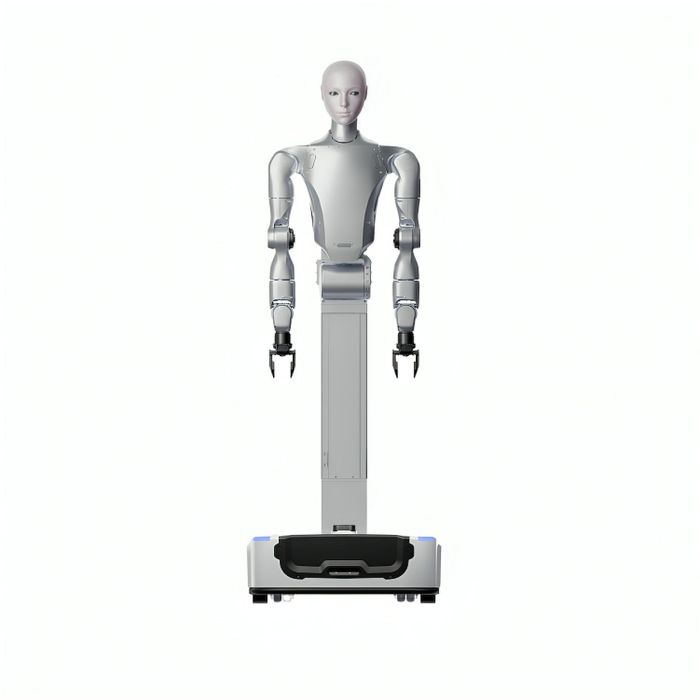
In stock
- BRAND:
- UNITREE ROBOTICS
- MODEL:
- H2-D-Ultimate-C
- PART #:
- H2-D-Ultimate-C
- ORIGIN:
- China
- Warranty:
- 12 MONTHS
- AVAILABILITY:
- SUBJECT TO AVAILABILITY
- SKU:
- Unitree-H2-D-Ultimate-C
Unitree H2-D Ultimate C Humanoid Robot
Two computers sit inside the H2-D, and only one of them is there to run the robot. An Intel Core i5 carries the platform's own capabilities, while an Intel Core i7 is set aside for custom development. That is a quiet admission about who buys a humanoid of this kind. Few of these buyers want a sealed appliance. They want a capable body that does useful work from the first week, and a clean space in which to build whatever the application demands next. The Unitree H2-D Ultimate C Humanoid Robot belongs in that space between product and platform: a dual-arm humanoid from the H2-D line, offered as one of several Ultimate packages, for organisations that intend both to deploy it and to develop on it.
Robots Middle East supplies the Unitree H2-D Ultimate C Humanoid Robot to industrial, commercial, research and academic customers throughout the Middle East. Robots Middle East prepares each quotation against the buyer's intended configuration and application. It also arranges delivery and import into the destination country and provides technical support once the robot is in service. A single point of contact therefore handles the project from first enquiry to operation.
Background
Unitree Robotics and the H2 Series
Unitree Robotics built its reputation on legged robots and compact humanoids that brought advanced motion control within reach of universities, laboratories and commercial integrators. The H2 Series extends that work towards practical manipulation. It is a dual-arm humanoid family divided into two product lines, H2-D and H2-A. Together they are designed to support diverse deployment configurations for industrial operations, commercial services, research and development, and embodied intelligence training. Within the H2-D line, Unitree offers a Standard version and a Flagship version. The Ultimate packages, among them Ultimate C, are configurations offered within the H2-D range. You can compare them in the H2-D Ultimate category.
An upper body designed for reach and development
The H2-D combines a humanoid torso and two arms with a lifting column and a bending waist. The waist supports 0–115° of body pitch, so the robot can move from floor-level picking to overhead handling with a natural, ergonomic posture. The column lifts at up to 200 mm/s. Each arm supports a rated payload of up to 7 kg, which is intended for the handling and assembly of heavy industrial components. The structure uses aerospace-grade aluminium, titanium alloy and high-strength engineering plastics. A humanoid binocular camera with a wide field of view sits in the head, and each wrist carries its own HD camera. The arms accept an optional 2-finger gripper, a 3-finger dexterous hand or a 5-finger dexterous hand. For software, Unitree provides comprehensive SDKs and APIs together with a mature navigation software stack. The stated aim is to let developers concentrate on the application itself and shorten development cycles from months to weeks.
Technical Specifications
| Specification | H2-D Standard | H2-D Flagship |
|---|---|---|
| Total weight (with battery) | Approx. 148Kg | Approx. 120Kg |
| Overall dimensions (min. column height) | 1200x560x605mm | 1200x576x633mm |
| Rated arm payload | Up to 7 kg per arm | Up to 7 kg per arm |
| Waist pitch range | 0–115° | 0–115° |
| Lift speed | Up to 200 mm/s | Up to 200 mm/s |
| Maximum mobility speed | — | Up to 1.5 m/s |
| Navigation sensors | — | LiDAR, depth cameras and multiple sensors |
| Base computing | PC1: Intel Core i5 (Platform Capabilities) | PC1: Intel Core i5 (Platform Capabilities) |
| Development computing | PC2: Intel Core i7 (Custom Development) | PC2: Intel Core i7 (Custom Development) |
| Head camera | Humanoid Binocular Camera with Wide Field of View ×1 | Humanoid Binocular Camera with Wide Field of View ×1 |
| Wrist cameras | Wrist HD Camera ×2 | Wrist HD Camera ×2 |
| End-effector options | Optional 2-Finger Gripper / 3-Finger Dexterous Hand / 5-Finger Dexterous Hand | Optional 2-Finger Gripper / 3-Finger Dexterous Hand / 5-Finger Dexterous Hand |
| Connectivity | WiFi 6 & Bluetooth 5.2 | WiFi 6 & Bluetooth 5.2 |
| Battery | Quick-Release Base Battery: 48V/18Ah (864Wh) | Quick-Release Base Battery: 48V/30Ah (1.44 kWh) |
| Battery life | — | Approx. 5h (Replaceable Battery / Auto Charging) |
| Materials | Aerospace-Grade Aluminium, Titanium Alloy, High-Strength Engineering Plastics | Aerospace-Grade Aluminium, Titanium Alloy, High-Strength Engineering Plastics |
Specifications are as published by the manufacturer and are confirmed against the datasheet at quotation.
The manufacturer has not published the following: the contents of the Ultimate C configuration, the end-effector and hand specifications for this trim, the ingress protection rating, the payload at full arm extension, the camera resolution, the contents of the box, or the mobility speed and battery life of the Standard version; all of these are confirmed at quotation.
What separates the H2-D Standard from the H2-D Flagship?
The two published versions share the same upper body. The rated arm payload, waist pitch, lift speed, cameras, computing, connectivity and end-effector options are listed identically for both. The differences lie in the base. The Standard version weighs approx. 148Kg with its battery and measures 1200x560x605mm at minimum column height. It carries a quick-release 48V/18Ah battery of 864Wh. The Flagship version is lighter at approx. 120Kg and slightly larger at 1200x576x633mm. It carries a larger 48V/30Ah battery of 1.44 kWh.
The Flagship is also the version for which a mobile platform is described. Its base integrates LiDAR, depth cameras and multiple sensors for autonomous navigation and intelligent obstacle avoidance. It moves at up to 1.5 m/s and runs for approx. 5h, with a replaceable battery and auto charging. In practice, the Flagship suits work that moves between stations, such as fetching, delivering and serving across a site. The Standard profile suits work brought to the robot at a defined cell.
Why does the H2-D carry two computers?
The answer lies in the way development teams actually work. The PC1 computer, an Intel Core i5, is dedicated to the platform's own capabilities. The PC2 computer, an Intel Core i7, is reserved for custom development. Keeping the two apart gives a team its own space in which to load models, test new behaviours and run experimental code, while the platform computer continues to look after the robot's built-in functions. Unitree's comprehensive SDKs and APIs, together with its mature navigation software stack, connect that development space to the robot. WiFi 6 and Bluetooth 5.2 link it to the wider network. For a laboratory or an integrator, this arrangement turns the H2-D into a working base for new applications rather than a fixed tool.
Who is the Unitree H2-D Ultimate C Humanoid Robot for?
Manufacturers and industrial integrators are the first group. They are looking at assembly and component handling, where a rated payload of up to 7 kg per arm and a waist that reaches from floor level to overhead positions open up work that fixed arms struggle to cover. Logistics and commercial service operators form a second group, particularly where a robot must work at varied heights or, on the Flagship base, move autonomously through a facility.
Research institutes and university laboratories form the third group. For them, the dedicated Intel Core i7 development computer, the SDKs and APIs, and the navigation software stack make the H2-D a platform for experiments rather than a closed product. Teams in embodied intelligence training, the fourth group, gain a humanoid form with binocular head vision and wrist cameras for collecting and testing manipulation behaviours. Buyers who are still deciding which Ultimate package fits their project are best served by comparing the options in the H2-D Ultimate category alongside this page.
What is the Unitree H2-D Ultimate C Humanoid Robot used for?
- Industrial assembly – handling and fitting heavy components with two arms rated up to 7 kg each.
- Picking at every height – using 0–115° of waist pitch and the lifting column to reach from floor-level bins to overhead shelves.
- Commercial services – carrying out customer-facing or back-of-house tasks in retail, hospitality and facilities settings.
- Research and development – building custom applications on the PC2 development computer with Unitree's SDKs and APIs.
- Embodied intelligence training – gathering manipulation data through the binocular head camera and the two wrist HD cameras.
- Autonomous site logistics – on the Flagship base, navigating with LiDAR and depth cameras to move items between workstations.
Pricing and Availability
Because the Ultimate C package is defined by its configuration, Robots Middle East quotes it against your specific requirements rather than publishing a fixed figure. Please describe your application, the end-effector you expect to use and your intended working environment. The quotation will then set out the configuration in full, together with the matching datasheet. Delivery, customs clearance and after-sales support are all arranged with the quotation. The quotation request form for the Unitree H2-D Ultimate C Humanoid Robot is available on this page.
Frequently Asked Questions
What is the H2-D built from?
The H2-D is built from aerospace-grade aluminium, titanium alloy and high-strength engineering plastics.
How much can each arm carry?
The H2-D supports a rated payload of up to 7 kg per arm, enabling the handling and assembly of heavy industrial components.
Which hands or grippers can be fitted?
The H2-D offers an optional 2-finger gripper, a 3-finger dexterous hand or a 5-finger dexterous hand. Tell Robots Middle East which suits your task when you enquire.
Can I develop my own software for the robot?
Yes. A dedicated Intel Core i7 computer is reserved for custom development, alongside Unitree's SDKs, APIs and navigation software stack.
Does the robot move around on its own?
The H2-D Flagship integrates LiDAR, depth cameras and multiple sensors for autonomous navigation and obstacle avoidance, at up to 1.5 m/s.
How is the robot powered?
Both published H2-D versions use a quick-release base battery: 48V/18Ah (864Wh) on the Standard and 48V/30Ah (1.44 kWh) on the Flagship. The Flagship runs for approx. 5h, with a replaceable battery and auto charging.
Where can I buy the Unitree H2-D Ultimate C Humanoid Robot and what does it cost?
You can buy it from Robots Middle East, which supplies customers across the Middle East. The cost depends on the configuration and is set out in a quotation that also covers delivery, customs and support.
Summary
The H2-D's two computers sum up the proposition. One keeps the robot working, with two arms rated up to 7 kg each, a waist that bends through 0–115°, a fast lifting column and vision in both the head and the wrists. The other leaves room for the application your team has yet to write. The Ultimate C package places that combination within a family of configurations, and Robots Middle East specifies it in full with each quotation. For organisations across the Middle East that want a humanoid they can both deploy and develop, with Robots Middle East handling supply and support, this page is the starting point.