
Unitree H2-Dedicated Dex3-1 Tactile Three-Finger Dexterous Hand — Single Unit
In stock
- BRAND:
- UNITREE ROBOTICS
- MODEL:
- H2-Dex3-1-TACTILE
- PART #:
- H2-Dex3-1-TACTILE
- ORIGIN:
- China
- Warranty:
- 12 MONTHS
- AVAILABILITY:
- SUBJECT TO AVAILABILITY
- SKU:
- Unitree-H2-Dex3-1-TACTILE
Unitree H2-Dedicated Dex3-1 Tactile Three-Finger Dexterous Hand — Single Unit
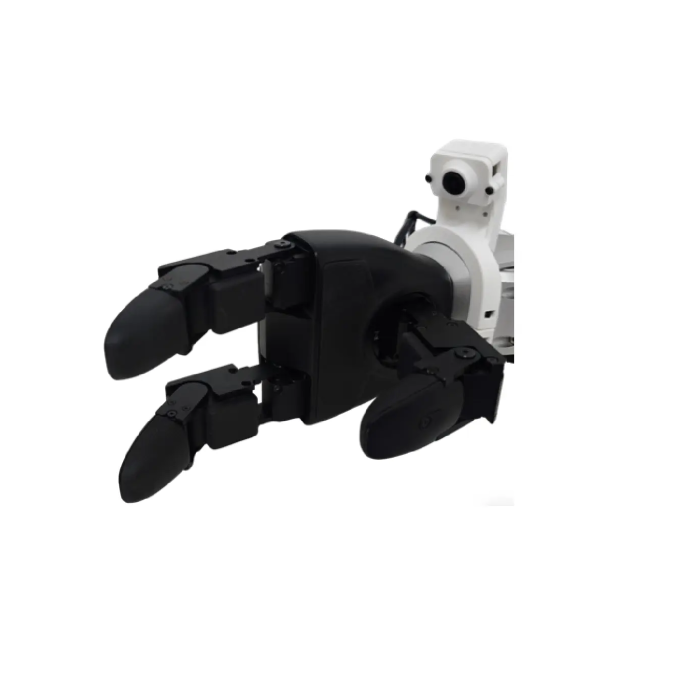
Every grasp a humanoid performs can become training data, but only if that data records what the fingers actually felt. A camera sees a cup begin to tilt; it cannot see how firmly the thumb pressed in the moment before. The Unitree H2-Dedicated Dex3-1 Tactile Three-Finger Dexterous Hand — Single Unit is built for the teams who need that missing channel. It is a compact three-finger hand for the Unitree H2 humanoid that pairs force-controlled joints with tactile sensing, so contact becomes something the robot measures rather than something the controller has to infer from motor current and camera frames.
Robots Middle East supplies this hand to universities, research laboratories, innovation centres and system integrators across the Middle East. Our team prepares the quotation, checks the hand against your H2 configuration and the side you require, arranges delivery to your site and remains your point of contact for technical support once the hand is fitted and in use.
Background
Unitree Robotics and the move from legs to hands
Unitree Robotics built its reputation on legged machines, first with quadrupeds and then with full-size and compact humanoids. As those platforms matured, the question facing researchers shifted from whether a humanoid could walk to what it could do once it arrived somewhere useful. Hands became the deciding component. Unitree answered with its own Dex3-1 family, a three-finger design that also appears in the company's material for its other humanoids, and with H2-dedicated versions intended for the larger H2 platform. The sources name the Dex3-1 with and without tactile sensing, and offer the H2 tactile version as a left hand, a right hand or a pair. This listing covers a single tactile unit.
Force, position and touch in one hand
The Dex3-1 has seven degrees of freedom spread across three fingers: three in the thumb, two in the index finger and two in the middle finger. Six of its joints are micro brushless force-control joints with direct drive, and the seventh is a micro brushless force-control joint driven through gears. Direct drive keeps the path between motor and finger short, which favours responsive force control and reduces the backlash associated with geared transmissions. Control combines force and position in a hybrid scheme, so the hand can follow a planned trajectory while regulating how hard it presses once contact is made. The tactile version adds pressure sensing with a published range of 10g-2500g, giving the controller a direct reading of contact from a light touch through to a firm grip.
Technical Specifications
| Specification | Value |
|---|---|
| Hand type | Three-finger dexterous hand, tactile version |
| Intended platform | Unitree H2 (H2-Dedicated) |
| Degrees of freedom | 7 |
| Degrees of freedom per finger | Thumb x 3, Index Finger x 2, Middle Finger x 2 |
| Joints | 6 micro brushless force-control direct-drive joints; 1 micro brushless force-control gear-drive joint |
| Transmission mechanism | 6 Motors Drive Directly, 1 Motor Drive with Gears |
| Control | Combined force and position hybrid control |
| Fingertip repeat positioning accuracy | ±2mm |
| Pressure sensing range | 10g-2500g |
| Weight | 710g |
Specifications are as published by the manufacturer and are confirmed against the datasheet at quotation.
The manufacturer has not published an IP rating, a list of included accessories and cables, or a part number for this hand; Robots Middle East confirms these details with the quotation.
What does tactile sensing add over the standard Dex3-1?
Both versions share the same mechanical layout: seven degrees of freedom, the same split between direct-drive and geared joints, and the same hybrid force and position control. The difference lies in what the hand can report about contact. The non-tactile Unitree H2-Dedicated Dex3-1 Force-Controlled Three-Finger Dexterous Hand — Single Unit regulates force through its joints, which suits a great deal of manipulation work. The tactile version adds a sensing layer at the point of contact, with a range from 10g to 2500g.
That matters most where the object, not the robot, sets the limits. Soft packaging, thin-walled containers, fruit, cables and laboratory consumables respond badly to a grip that is merely approximately right. With pressure readings available, a grasp policy can close until contact is registered, hold a target pressure and react if an object begins to slip. For learning-based research, the tactile stream is often the point of the purchase: demonstrations recorded through teleoperation can carry contact information alongside joint positions and images, giving models a signal that vision alone cannot provide.
Why choose three fingers rather than five?
A five-finger hand resembles the human hand more closely and suits research into human-like grasps and in-hand manipulation. A three-finger hand makes a different trade. With fewer fingers, each degree of freedom carries more of the task, the kinematics are simpler to model and calibrate, and grasp strategies are quicker to design and to learn. For many industrial and laboratory tasks, such as picking, placing, pinching, holding tools and opening containers, a thumb opposing two fingers covers the essential grasp types.
Teams whose research specifically requires five fingers can compare the Unitree H2-Dedicated Dex5-1P Tactile Five-Finger Dexterous Hand with RGB— Single Unit (Left or Right), while those evaluating other manufacturers' hands for the same platform will find them in the H2 Accessories category. Robots Middle East can advise on which hand suits a given task before you commit.
Who is the Unitree H2-Dedicated Dex3-1 Tactile Three-Finger Dexterous Hand — Single Unit for?
The first group is academic and institutional research teams working on dexterous manipulation, tactile perception and robot learning on the H2 humanoid. For them, the combination of force control and pressure sensing in a hand designed for the platform removes much of the integration work that a third-party gripper would require.
The second group is data-collection and teleoperation programmes. Laboratories building manipulation datasets value a hand whose contact data can be logged with every demonstration, because that data supports policies that handle delicate objects more reliably.
The third group is system integrators and corporate innovation teams running applied evaluations: proof-of-concept work in logistics, light assembly, retail or service scenarios where a humanoid must handle varied objects without damaging them.
Buyers whose tasks involve rigid, robust objects and who do not need contact data may find the non-tactile Unitree H2-Dedicated Dex3-1 Force-Controlled Three-Finger Dexterous Hand — Single Unit sufficient. Teams planning bimanual work should consider ordering a left and a right hand together, as the sources list a pair option for this tactile version.
What is the Unitree H2-Dedicated Dex3-1 Tactile Three-Finger Dexterous Hand — Single Unit used for?
- Tactile manipulation research: studying how pressure feedback improves grasp stability and the handling of fragile objects.
- Robot learning datasets: recording teleoperated demonstrations that combine contact data with joint states and vision.
- Grasp policy development: training and testing controllers that adjust grip force in response to measured contact.
- Delicate object handling: picking soft, deformable or thin-walled items in laboratory and logistics trials.
- Bimanual humanoid tasks: pairing left and right hands on the H2 for coordinated two-handed manipulation.
- Teaching and demonstration: giving students hands-on experience with force control and tactile sensing on a full humanoid.
Pricing and Availability
The cost of this hand depends on the side or pair you choose, your existing H2 configuration and any integration support you require, so Robots Middle East prices it by individual quotation rather than publishing a fixed figure. Delivery, customs clearance and technical support are arranged together with the quotation. To begin, tell us about your platform and your intended application through the quotation request available on this page.
Frequently Asked Questions
Is this hand intended for the Unitree H2?
Yes. This is the H2-dedicated version of the Dex3-1 tactile hand. Robots Middle East matches the hand to your H2 build when preparing the quotation.
How does it differ from the non-tactile Dex3-1?
The mechanics and hybrid force and position control are shared. The tactile version adds pressure sensing with a range of 10g-2500g, which allows contact to be measured directly.
How many degrees of freedom does the hand have?
It has seven: three in the thumb, two in the index finger and two in the middle finger. Six joints are direct-drive and one is gear-driven.
How precise is the fingertip positioning?
The fingertip repeat positioning accuracy is ±2mm.
Can I order a left hand, a right hand or a pair?
The sources list left, right and pair options for the H2 tactile version. This listing is for a single unit, and Robots Middle East confirms the side with your order.
What is the IP rating, and which cables are included?
The manufacturer has not published an IP rating, the list of included accessories and cables, or a part number. Robots Middle East confirms these details at quotation.
Where can I buy the Unitree H2-Dedicated Dex3-1 Tactile Three-Finger Dexterous Hand — Single Unit and what does it cost?
You can buy it from Robots Middle East, which supplies customers across the Middle East. The cost depends on configuration and support requirements, so it is provided through a tailored quotation requested on this page.
Summary
A humanoid learns from what it can sense, and a hand that reports contact turns every grasp into richer information. The Unitree H2-Dedicated Dex3-1 Tactile Three-Finger Dexterous Hand — Single Unit brings seven degrees of freedom, direct-drive force-control joints, hybrid force and position control and pressure sensing to the H2 platform, in a three-finger layout that keeps modelling and learning manageable. For research teams, data-collection programmes and integrators who need their H2 to feel as well as move, Robots Middle East quotes, delivers and supports the hand across the region, and this page is the starting point.