
Unitree R1-A5-D Smart E Humanoid Robot
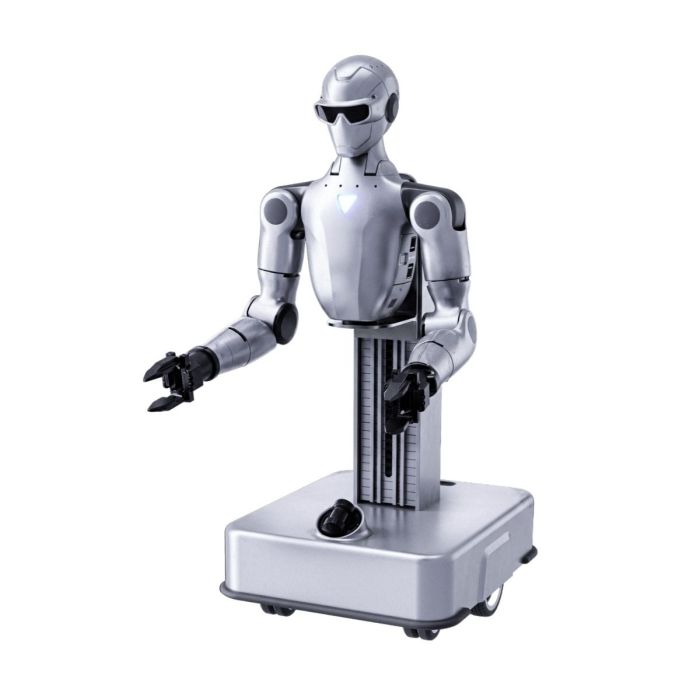
In stock
- BRAND:
- UNITREE ROBOTICS
- MODEL:
- R1-A5-D-Smart-E
- PART #:
- R1-A5-D-Smart-E
- ORIGIN:
- China
- Warranty:
- 12 MONTHS
- AVAILABILITY:
- SUBJECT TO AVAILABILITY
- SKU:
- Unitree-R1-A5-D-Smart-E
Unitree R1-A5-D Smart E Humanoid Robot
A humanoid robot that can only be watched teaches very little; one that its owners can open up, programme and rebuild teaches a great deal more. The Unitree R1-A5-D Smart E Humanoid Robot belongs firmly to the second kind. It is a configuration of Unitree's R1 family aimed at people who intend to write their own software for it, connect it to their own systems and treat it as a working platform rather than a showpiece. Its value lies less in any single headline figure than in what it allows a laboratory, a university department or an innovation team to build on top of it.
Robots Middle East supplies the Unitree R1-A5-D Smart E Humanoid Robot to universities, research institutes, technology centres and corporate innovation teams across the Middle East. Robots Middle East prepares each quotation, arranges delivery to the customer's site and provides after-sales support, so that a team can move from enquiry to a robot on the bench through a single, accountable point of contact.
Background
Unitree Robotics and its lineage
Unitree Robotics is a Chinese robotics manufacturer that first became widely known for its legged robots, particularly its quadrupeds, before extending its range into full humanoid platforms. The company has built a reputation for bringing advanced locomotion and embodied robotics within reach of research groups and educational institutions that previously could not justify the cost or complexity of bespoke hardware. The R1 family continues that approach, and it sits within the wider Unitree R1 range alongside the other configurations Unitree offers.
The R1 family and its configurations
The R1 comes in several versions: the R1 Air, the R1, the R1 Edu Standard, the R1 Edu Smart and four Edu Pro variants labelled A, B, C and D. The Edu versions are the ones intended for development work, and the Smart tier sits between the Edu Standard and the Edu Pro options. Within the Unitree R1-A5-D category, the Smart E is one of several lettered Smart configurations, and buyers comparing it with its siblings should do so configuration by configuration, since equipment and features are tied to each version rather than shared across the whole family.
Technical Specifications
| Specification | Value |
|---|---|
| Camera (R1 Edu Smart) | Humanoid binocular camera |
| Microphones | 4-mic array |
| Connectivity | WiFi 6, Bluetooth 5.2 |
| Included items (R1 Edu Smart) | Robot, battery, charger, joystick |
| Protection frame (R1 Edu Smart) | Included |
| Development (R1 EDU) | Secondary development supported; ROS 2 can be used |
Specifications are as published by the manufacturer and are confirmed against the datasheet at quotation.
Unitree has not published the running speed, the IP rating, the charging time or the battery capacity; these are confirmed at quotation.
What does the Edu Smart configuration add to the R1?
The most important difference between the Edu versions and the entry-level R1 is not a piece of hardware but a permission. The EDU version allows purchasers to carry out secondary development, and it can use ROS 2. For a research group, that changes the nature of the purchase: the robot becomes a platform on which the team's own perception, interaction and control software can run, rather than a closed product with fixed behaviour.
Specific equipment is also tied to the Edu Smart tier. The R1 Edu Smart carries a humanoid binocular camera, giving the robot a stereo view of its surroundings that suits work on depth perception, object recognition and visual navigation. Alongside it, the R1 has a 4-mic array for capturing speech and sound, and WiFi 6 with Bluetooth 5.2 for linking the robot to development machines, networks and peripherals.
The package is equally practical. The R1 Edu Smart comes with the robot, a battery, a charger and a joystick, and the Edu Standard, Edu Smart and Edu Pro configurations additionally include a protection frame. For anyone who has watched a prototype fall during its first weeks of testing, that frame is a meaningful inclusion: it allows teams to experiment with new code without treating every trial as a risk to the hardware.
Can the Unitree R1-A5-D Smart E Humanoid Robot be programmed with ROS 2?
The EDU version can use ROS 2, the Robot Operating System framework that has become a common language for robotics research and teaching. This matters because ROS 2 gives a team access to a large body of existing tools, libraries and community knowledge, and it allows software written for other robots in a laboratory to be adapted rather than rewritten from the beginning.
In practice, a ROS 2 route means that students can learn on the same framework they are likely to meet in industry, and that researchers can integrate the robot's camera and microphone data into established pipelines for mapping, speech processing and behaviour planning. Robots Middle East is glad to discuss software support and development documentation with a department before the robot arrives, so that its developers know what they will be working with.
Who is the Unitree R1-A5-D Smart E Humanoid Robot for?
The clearest audience is the university robotics laboratory. Departments of engineering and computer science need hardware that students can programme directly, and the combination of secondary development, ROS 2 and a protection frame makes this configuration a sensible fit for practical modules, final-year projects and postgraduate research.
Research institutes working on human-robot interaction form a second group. A robot with a binocular camera and a microphone array gives researchers the raw material for studies in speech, gesture, attention and social behaviour, and the wireless connectivity simplifies data collection during experiments.
Corporate innovation teams and technology centres are a third audience. Organisations exploring how humanoid robots might serve in reception areas, exhibitions or service roles often need a platform on which to build and test their own applications before committing to a larger programme. Schools and science centres with an advanced technology curriculum may also find the Edu approach suited to their teaching.
Buyers who are still choosing between configurations can compare the Smart E with siblings such as the Unitree R1-A5-D Smart A Humanoid Robot and the Unitree R1-A5-D Smart F Humanoid Robot. Robots Middle East will set out the differences in equipment for each option so that the configuration matches the work planned for it.
What is the Unitree R1-A5-D Smart E Humanoid Robot used for?
- Robotics teaching: giving students a real humanoid on which to practise programming, control and system integration.
- Computer vision research: using the binocular camera for studies in depth perception, recognition and visual tracking.
- Speech and audio interaction: capturing voice and sound through the microphone array for conversational and listening experiments.
- ROS 2 development: building and testing software within a widely used robotics framework before deploying it elsewhere.
- Human-robot interaction studies: observing how people respond to a humanoid in controlled research settings.
- Application prototyping: developing service, guidance or exhibition behaviours for evaluation by innovation teams.
Pricing and Availability
The Unitree R1-A5-D Smart E Humanoid Robot is supplied on quotation, which lets Robots Middle East match the configuration, the included items and the development access to what a project requires. Delivery, customs clearance and after-sales support are arranged together with the quotation. To begin, please send your requirements and intended application; the quotation request for the Unitree R1-A5-D Smart E Humanoid Robot is available on this page.
Frequently Asked Questions
Does the Unitree R1-A5-D Smart E Humanoid Robot support secondary development?
Yes. The EDU version of the R1 allows purchasers to carry out secondary development and can use ROS 2.
What camera does the Edu Smart configuration use?
The R1 Edu Smart has a humanoid binocular camera, which provides a stereo view suited to perception and vision research.
How does the robot capture sound?
The R1 uses a 4-mic array, which supports work on speech recognition and audio-based interaction.
What wireless connectivity does it offer?
The robot supports WiFi 6 and Bluetooth 5.2 for connection to networks, development computers and peripherals.
What is included in the box?
The R1 Edu Smart comes with the robot, a battery, a charger and a joystick, and the Edu configurations additionally include a protection frame.
Which other versions of the R1 are available?
The R1 family comprises the R1 Air, the R1, the R1 Edu Standard, the R1 Edu Smart and the Edu Pro A, B, C and D variants. Robots Middle East can help you choose between them.
Where can I buy the Unitree R1-A5-D Smart E Humanoid Robot and what does it cost?
You can buy it from Robots Middle East, which supplies it across the Middle East on quotation. The cost depends on the chosen configuration, delivery and support arrangements, and is set out in the quotation you request through this page.
Summary
The Unitree R1-A5-D Smart E Humanoid Robot is best understood as a robot meant to be worked on rather than merely watched. Its EDU status opens the door to secondary development and ROS 2; its binocular camera, microphone array and modern wireless connectivity supply the inputs that research and teaching depend on; and its protection frame lets teams experiment without undue worry for the hardware. For a laboratory, a university or an innovation team in the region that wants a humanoid it can genuinely make its own, with Robots Middle East handling quotation, delivery and support, this page is the starting point.