
Unitree R1-A7-D Smart C Humanoid Robot
In stock
- BRAND:
- UNITREE ROBOTICS
- MODEL:
- R1-A7-D-Smart-C
- PART #:
- R1-A7-D-Smart-C
- ORIGIN:
- China
- Warranty:
- 12 MONTHS
- AVAILABILITY:
- SUBJECT TO AVAILABILITY
- SKU:
- Unitree-R1-A7-D-Smart-C
Unitree R1-A7-D Smart C Humanoid Robot
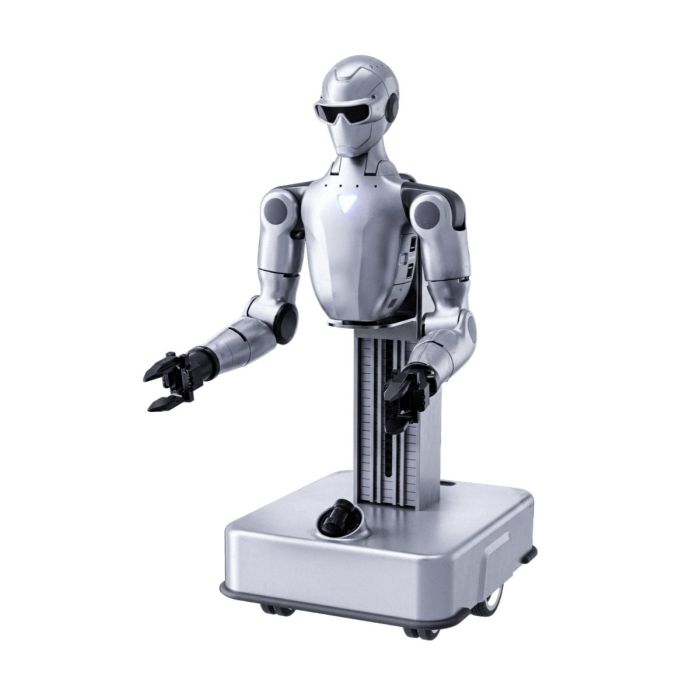
Every laboratory, stockroom and workshop is designed around human proportions. Benches sit at waist height, shelves climb above the shoulder, and the objects worth handling are small, varied and often fragile. A robot meant to work in those rooms has to meet them on their terms: travel to the task, rise to the right height and handle what it finds with something closer to a sense of touch. The Unitree R1-A7-D Smart C Humanoid Robot is built around that brief. It places a humanoid upper body with two 7-DoF arms on a wheeled base with a powered lifting column. A chassis LiDAR supports navigation, and each arm ends in a Dex3-1 three-finger hand with tactile fingertips.
Robots Middle East supplies the Unitree R1-A7-D Smart C Humanoid Robot to universities, research institutes, system integrators and corporate innovation teams across the Middle East. Our team prepares each quotation for the buyer's configuration and site and arranges delivery to the destination country. We remain your point of contact for commissioning questions and after-sales support once the robot is in service.
Background
Unitree Robotics and its lineage
Unitree Robotics became known for agile quadruped robots before extending its range into humanoid platforms. Its approach has consistently favoured compact mechanical design, in-house actuation and machines that developers can program directly. As a result, its robots are a familiar sight in university laboratories and corporate research centres. The R1 family continues that line with a different emphasis. Rather than pursuing locomotion, the R1-A7 series concentrates on what an upper body does with its arms, hands and sensors.
Where the Smart C sits in the R1-A7 series
Unitree names several versions: the R1-A5 and R1-A7, their mobile counterparts the R1-A5-D and R1-A7-D, and configured packages such as the R1-A7-D Smart C and the R1-A7-D Ultimate C. The R1-A7 is a desk-mount torso. The R1-A7-D mounts that torso on a wheeled mobile base with a powered lifting column and a chassis LiDAR, which turns a fixed manipulator into a mobile one.
Smart configurations add a 40 TOPS Orin Nano to the onboard compute. The C designation pairs the platform with Dex3-1 force-controlled three-finger hands fitted with tactile fingertips. Every configuration is open for secondary development. The Smart C is therefore intended as a foundation for the buyer's own software as much as a finished machine.
Technical Specifications
| Specification | Value |
|---|---|
| Configuration | R1-A7-D Smart C – Dex3-1 Tactile Hands |
| Platform | Humanoid torso on a wheeled mobile base with powered lifting column and chassis LiDAR |
| Dimensions (collapsed) | 683 x 520 x 440 mm (26.9 x 20.5 x 17.3 in) |
| Maximum height | 1,600 mm (63 in) |
| Weight | About 32 kg (71 lb) |
| Degrees of freedom | 20 (adds a 3-DoF wheeled chassis), or 22 counting the grippers |
| Arms | Two 7-DoF arms, rotating waist, 2-DoF sensor head |
| Arm reach | 555 mm (21.9 in) |
| Arm payload | 2 to 4 kg (4.4 to 8.8 lb) per arm |
| Maximum shoulder torque | 60 Nm (44 lb-ft) |
| End-clamp accuracy | ±0.1 mm (±0.004 in) |
| Waist and head range | Waist yaw ±35°, head yaw ±115°, head pitch ±36° |
| Head camera | RGB at 1280 x 720 at 30 Hz; depth at 544 x 448 at 10 Hz |
| Chassis sensing | Chassis LiDAR |
| Compute | 8-core CPU (body); 8-core CPU with 10 TOPS (head); 40 TOPS Orin Nano (Smart configurations) |
| Hands | Dex3-1 three-finger force-controlled hands with tactile fingertips |
| Power | Removable chassis battery (about 1.5 h) plus external supply |
| Joint design | Crossed-roller and deep-groove ball bearings, hollow internal wiring, dual encoders on the arm joints, local air cooling |
| Audio | 4-array microphone, dual 3 W speakers |
| Wireless | Wi-Fi 6, Bluetooth 5.2 |
| Development | Open for secondary development |
Specifications are as published by the manufacturer and are confirmed against the datasheet at quotation.
The manufacturer has not published the top speed, IP rating, operating temperature range, charging time, battery capacity or package contents; Robots Middle East confirms these at quotation.
What do tactile fingertips add to the R1-A7-D Smart C?
Cameras and joint encoders tell a robot where an object is and where its own hand has gone. They say little about what happens at the moment of contact. The Dex3-1 hands used in the B and C configurations are force-controlled three-finger hands designed for dexterous manipulation. The C version adds tactile fingertips, so the hand gains a direct channel of information from the surface it is touching.
In manipulation research, tactile signals of this kind are typically used to detect slip, regulate grip on delicate or deformable items, and record richer demonstration data for learning-based control. For a team working on those questions, the fingertips are the centre of the platform rather than an accessory. The rest of the Smart C supports that work in three ways. The two 7-DoF arms place the hands with an end-clamp accuracy of ±0.1 mm. The head camera supplies RGB and depth streams. The added Orin Nano gives room to run perception and control models on board.
How does the R1-A7-D differ from the desk-mount R1-A7?
The desk-mount R1-A7 is a stationary torso: a capable manipulator that works wherever it is fixed. The R1-A7-D keeps the same arms, waist, sensor head and head camera, and places them on a wheeled mobile base. That base is a 3-DoF chassis, bringing the total to 20 degrees of freedom, or 22 counting the grippers.
A powered lifting column takes the robot from a collapsed 683 x 520 x 440 mm to a height of 1,600 mm. The same machine can therefore work at a low bench and at a high shelf. A chassis LiDAR supports navigation between workstations. A removable chassis battery provides about 1.5 h of operation, and an external supply covers longer sessions at a fixed station. At about 32 kg, the platform remains manageable for a laboratory team to reposition and store.
Who is the Unitree R1-A7-D Smart C Humanoid Robot for?
The clearest fit is a research group studying contact-rich or dexterous manipulation, where tactile feedback from the fingertips is the variable under investigation. Embodied-AI and robot-learning teams form a second group. For them, the combination of mobility, height adjustment, onboard compute and open secondary development allows data collection and model deployment on a single machine. Universities can use the platform to teach mobile manipulation, perception and human–robot interaction, with the microphone array and speakers supporting spoken-interaction projects. System integrators and corporate innovation centres can prototype service, logistics or laboratory-automation tasks before committing to a production design.
Buyers who want the Dex3-1 force-controlled hands but do not need tactile sensing may find the Unitree R1-A7-D Smart B Humanoid Robot a closer match. The full set of packages can be compared in the R1-A7-D Smart range and the wider Unitree R1-A7-D category.
What is the Unitree R1-A7-D Smart C Humanoid Robot used for?
- Tactile manipulation research: studying grasp stability, slip and contact forces with fingertips that sense touch.
- Robot learning and data collection: recording vision, joint and tactile data for imitation and reinforcement learning.
- Mobile laboratory assistance: moving between benches and handling samples, tools or consumables at different working heights.
- Shelf and workstation tasks: using the lifting column to pick and place items from low surfaces to high storage.
- Teaching and student projects: giving courses in robotics, perception and control a programmable, open platform.
- Human–robot interaction studies: combining the sensor head, microphone array and speakers for spoken and gestural exchanges.
Pricing and Availability
The Unitree R1-A7-D Smart C Humanoid Robot is supplied by quotation, so that the configuration, software requirements and destination can be reviewed before an order is placed. Robots Middle East arranges delivery, customs clearance and support together with the quotation. To begin, send us your intended application and site details; the quotation request form is available on this page.
Frequently Asked Questions
Does the R1-A7-D Smart C walk on legs?
No. The humanoid upper body rides on a wheeled base with a 3-DoF chassis and a powered lifting column, and a chassis LiDAR supports navigation.
How high can the robot work?
The lifting column raises the robot from its collapsed form to 1,600 mm, and each arm has 555 mm of reach. Tasks can therefore range from low benches to high shelving.
What is the difference between the Smart B and the Smart C?
Both use Dex3-1 three-finger force-controlled hands. The C version adds tactile fingertips for work in which contact sensing matters.
How long does it run on its battery?
The removable chassis battery provides about 1.5 h of operation. An external supply can also be connected for longer sessions at a fixed station.
Can we develop our own software for it?
Yes. Every configuration is open for secondary development. The Smart C pairs the body and head processors with a 40 TOPS Orin Nano for onboard workloads.
Which sensors does it carry?
The head camera provides RGB at 1280 x 720 at 30 Hz and depth at 544 x 448 at 10 Hz, and the chassis carries a LiDAR. A 4-array microphone, dual encoders on the arm joints and the tactile fingertips complete the sensing.
Where can I buy the Unitree R1-A7-D Smart C Humanoid Robot and what does it cost?
You can buy it from Robots Middle East, which supplies it across the Middle East. The cost depends on configuration, delivery and support requirements, so it is set out in a quotation prepared for your project.
Summary
Rooms built for people ask a robot to move, to reach the right height and to handle objects with care. The Unitree R1-A7-D Smart C Humanoid Robot answers each of those demands in turn: a wheeled base and chassis LiDAR for travel, a powered lifting column for height, and two 7-DoF arms with Dex3-1 hands whose tactile fingertips report what they touch. With onboard compute that includes an Orin Nano and an architecture open for secondary development, it serves as a research instrument and a development base in one. For institutions and integrators across the Middle East planning work at the point of contact, this page is the starting point.