
Unitree R1-A7-D Smart E Humanoid Robot
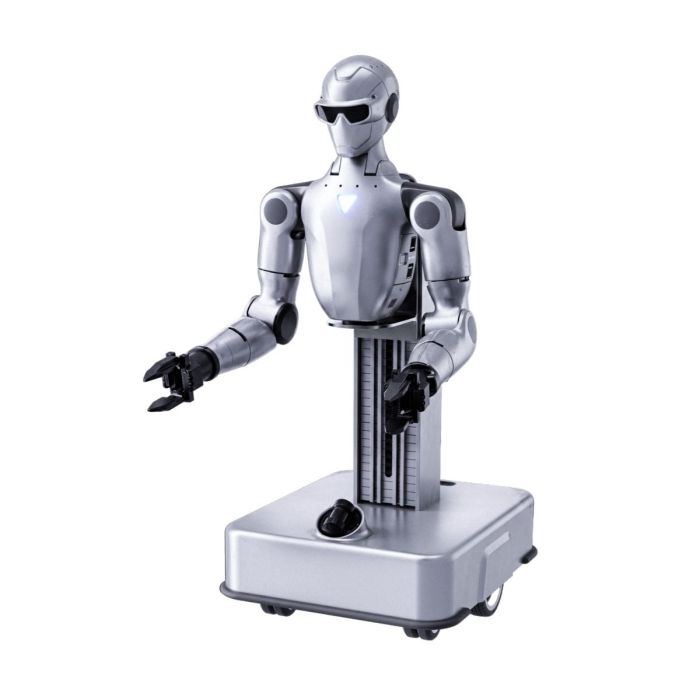
In stock
- BRAND:
- UNITREE ROBOTICS
- MODEL:
- R1-A7-D-Smart-E
- PART #:
- R1-A7-D-Smart-E
- ORIGIN:
- China
- Warranty:
- 12 MONTHS
- AVAILABILITY:
- SUBJECT TO AVAILABILITY
- SKU:
- Unitree-R1-A7-D-Smart-E
Unitree R1-A7-D Smart E Humanoid Robot
Picture a visitor crossing an exhibition floor while a robot turns its head to follow her, keeps her within a wide stereo view and replies through its own speakers. Moments of attention like this decide whether people accept a humanoid, and the Unitree R1-A7-D Smart E Humanoid Robot is built for them. Behind the expressive head is a platform that maps its surroundings with a chassis LiDAR, runs perception on a dedicated head module and opens its systems to developers. The attention it pays to people can therefore become behaviour that your own team designs, rather than a routine fixed at the factory.
Robots Middle East sells the Unitree R1-A7-D Smart E Humanoid Robot and supplies it to universities, research centres, system integrators and enterprises across the Middle East. Robots Middle East prepares each quotation, coordinates delivery to the customer's site and supports the robot after handover, so that a project team deals with one partner from first enquiry to day-to-day operation.
Background
Unitree Robotics and the R1 family
Unitree Robotics is a Chinese robotics manufacturer that made its name with agile quadruped robots before extending its range into humanoid platforms for research, education and commercial development. The R1 family continues in that direction. It is a humanoid intended for teams that want to programme, extend and adapt a robot, not simply operate it. The sources name four core variants: R1-A5, R1-A7, R1-A5-D and R1-A7-D. Resellers also offer the R1-A7-D in lettered Smart configurations, from Smart A to Smart H. This page covers the Smart E package of the R1-A7-D, and every figure given below belongs to the R1-A7-D or to the platform as a whole, not to a sibling variant.
A humanoid that changes its height
The R1-A7-D has no single fixed stature. It is specified with two sets of dimensions: a shrunk size of 683x520x440mm and a raised size of 1600x520x440mm. Only the height changes, and the footprint stays the same. In practice, the robot can be stowed in a compact form for transport between sites or storage overnight, then raised to a working height at which it meets people and work surfaces more naturally. The upper body adds further reach: the waist turns through Yaw±35° and the neck through Yaw ± 115° and Pitch ± 36°. This allows the robot to direct its gaze and its arms without repositioning its base for every small change of target.
Technical Specifications
| Specification | Value |
|---|---|
| Weight | Approx. 32kg |
| Shrunk size | 683x520x440mm |
| Raised size | 1600x520x440mm |
| Head module computing power | 10 TOPS |
| Body processor | 8-core high-performance CPU |
| High-computing module (optional) | Multiple brands and models available, such as Orin (40-100TOPS) |
| Binocular field of view | Horizontal 146°, Vertical 124° |
| Binocular eye spacing | 60mm |
| Waist | Yaw±35° |
| Cervical joint movement space | Yaw ± 115°, Pitch ± 36° |
| Sensors | Chassis LiDAR + Binocular Camera + Optional Wrist Camera |
| Speaker | Dual Speakers (3W×2) |
| Battery life (battery-powered) | Approx. 1.5h |
| Wireless | WiFi 6 & Bluetooth 5.2 |
| Open interfaces | Underlying system, robotic arm, audio, lighting, visual control, etc. |
| End effector options | Two-finger gripper / three-finger dexterous hand / five-finger dexterous hand |
| Charger | Included |
Specifications are as published by the manufacturer and are confirmed against the datasheet at quotation.
The manufacturer has not published the total degrees of freedom of the Smart E, the model of the chassis LiDAR, the maximum travel speed, the charging time, the IP rating, the hand weight and grip force of the Smart E, or the battery capacity; Robots Middle East confirms these at quotation.
How does the R1-A7-D Smart E divide its computing work?
The R1-A7-D separates its processing into distinct roles. A head module rated at 10 TOPS sits next to the binocular camera, where vision and AI workloads arise. An 8-core high-performance CPU in the body manages the machine itself. For a development team, this division matters. Perception experiments and new models can run close to the sensors without competing for resources with the processes that keep the robot stable and responsive.
Where a project needs more than the head module provides, the platform accepts a high-computing module from several brands and models, such as Orin (40-100TOPS). This offers a clear upgrade path for larger vision models, multimodal interaction or on-board planning. Connectivity comes through WiFi 6 and Bluetooth 5.2. The open interfaces cover the underlying system, the robotic arm, audio, lighting and visual control. Taken together, these let researchers use the R1-A7-D as a foundation for their own software rather than a closed appliance.
Which end effector suits the R1-A7-D Smart E?
Three end effectors are offered for the platform: a two-finger gripper, a three-finger dexterous hand and a five-finger dexterous hand. A two-finger gripper generally suits repeatable pick-and-place tasks, where robustness and simple control matter most. Multi-fingered hands suit research into grasp strategies, tool use and human-like manipulation. An optional wrist camera can complement the binocular head view, giving close-range visual feedback during grasping.
Robots Middle East discusses the intended tasks with each customer and specifies the hand and wrist camera for the Smart E together with the rest of the order. That way, the configuration you receive matches the manipulation work you have planned.
Who is the Unitree R1-A7-D Smart E Humanoid Robot for?
The first group is university departments and research laboratories working on human-robot interaction, perception and embodied AI. For them, the wide binocular view, the articulated neck and the open interfaces form a practical test bed. The second group is system integrators who build customer-facing or service applications and need a humanoid they can adapt to a client's workflow. A third group is innovation teams at enterprises, museums and exhibition venues, who want a robot that can engage visitors with gaze, voice and gesture and can be stowed compactly between events.
Buyers comparing packages can review the full R1-A7-D Smart range, including the Unitree R1-A7-D Smart A Humanoid Robot and the Unitree R1-A7-D Smart F Humanoid Robot, or the wider Unitree R1-A7-D category. Robots Middle East can then advise which package best fits a given programme.
What is the Unitree R1-A7-D Smart E Humanoid Robot used for?
- Human-robot interaction research: studying gaze, attention and conversation with a head that tracks people across a wide field of view.
- University teaching: giving students hands-on experience of perception, manipulation and robot software on an open platform.
- Visitor engagement: welcoming and informing guests at exhibitions, showrooms and cultural venues through voice and movement.
- Manipulation studies: comparing grippers and dexterous hands on grasping tasks at a practical working height.
- Perception and mapping development: combining chassis LiDAR with binocular vision to build and test navigation and scene-understanding software.
- Application prototyping: allowing integrators to trial service and assistance concepts before committing to a wider deployment.
Pricing and Availability
The cost of the Unitree R1-A7-D Smart E Humanoid Robot depends on the exact configuration, the end effector, any additional high-computing module and the support package you require. For this reason, Robots Middle East prepares an individual quotation for each enquiry. Delivery, customs clearance and after-sales support are arranged together with that quotation. To begin, the quotation request for the Unitree R1-A7-D Smart E Humanoid Robot is available on this page.
Frequently Asked Questions
How large is the R1-A7-D when raised and when stowed?
The raised size is 1600x520x440mm and the shrunk size is 683x520x440mm. The robot weighs approx. 32kg.
How long does the robot run on its battery?
Battery-powered operation lasts approx. 1.5h, and a charger is included in the delivery.
Which sensors does the R1-A7-D carry?
It uses a chassis LiDAR, a binocular camera and an optional wrist camera. The binocular field of view covers Horizontal 146° and Vertical 124°, with an eye spacing of 60mm.
Can the computing power be increased?
Yes. Beyond the 10 TOPS head module, the platform accepts a high-computing module from several brands and models, such as Orin (40-100TOPS).
Which hands can be fitted?
The options are a two-finger gripper, a three-finger dexterous hand and a five-finger dexterous hand. Robots Middle East advises on the hand best suited to your tasks.
Is the robot open to custom software?
Yes. It offers open interfaces for the underlying system, the robotic arm, audio, lighting, visual control and more, and it connects through WiFi 6 and Bluetooth 5.2.
Where can I buy the Unitree R1-A7-D Smart E Humanoid Robot and what does it cost?
You can buy it from Robots Middle East, which supplies it across the Middle East. The cost depends on the configuration and services you choose, so please request a quotation on this page.
Summary
A humanoid earns its place when it pays attention convincingly: it turns towards a person, sees them clearly and responds in a way that feels deliberate. The Unitree R1-A7-D Smart E Humanoid Robot builds that attention from a wide binocular view, an articulated neck and waist, a dedicated head module and a chassis LiDAR. It adds open interfaces and an upgrade path for more computing power, so the behaviour can be shaped by the team that owns it. Its ability to stow compactly and rise to working height makes it practical across laboratories, classrooms and public venues alike. For anyone ready to put that attention to work with configuration, delivery and support handled by Robots Middle East, this page is the starting point.