
Unitree R1 Air Humanoid Robot
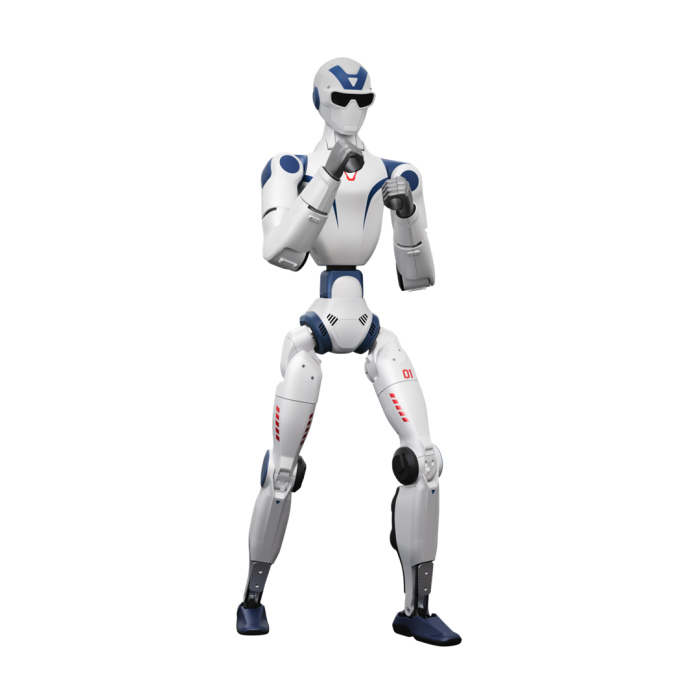
In stock
- BRAND:
- UNITREE ROBOTICS
- MODEL:
- R1-AIR
- PART #:
- R1-AIR
- ORIGIN:
- China
- Warranty:
- 12 MONTHS
- AVAILABILITY:
- SUBJECT TO AVAILABILITY
- SKU:
- Unitree-R1-AIR
Unitree R1 Air Humanoid Robot
Good engineering is often a matter of subtraction. Every joint added to a humanoid brings another motor, another cable run, another component to calibrate and another line in the budget. The most telling question about a robot is therefore not what it has, but what its designers chose to leave out. The Unitree R1 Air Humanoid Robot is a study in that discipline. It keeps the parts of a humanoid that people notice first: two legs that carry it, two arms that gesture, a camera that sees, microphones that hear and an onboard model that can talk about both. Everything else is trimmed to a total of 20 degrees of freedom. The result is a 1230 mm biped weighing about 27kg. It behaves like a humanoid in front of an audience without first asking its owner to build a robotics laboratory around it.
Robots Middle East supplies the R1 Air to universities, schools, innovation centres, exhibitors and private buyers across the Middle East. Each quotation is prepared individually for your project. We also arrange delivery and import formalities into your country, and we remain your point of contact for commissioning questions and after-sales support once the robot has arrived.
Background
Unitree Robotics and the R1 family
Unitree Robotics, based in Hangzhou, China, built its reputation on legged robots. It began with quadrupeds that found their way into laboratories, inspection teams and university programmes, and then moved into humanoids. That history matters for a buyer. A company that has shipped many legged machines has had to solve the unglamorous problems of balance, motor heat and field updates, rather than only the impressive ones. The R1 family applies this experience to a compact humanoid format. The family comprises three versions: the R1 Air, the R1 and the R1 EDU. They share a common body, so the standing dimensions of 1230x357x190mm are the same across the line, but they differ in sensing, articulation and openness to development.
Where the Air sits, and what drives it
The Air is the essentials-first member of the family. Its joints are driven by low-inertia, high-speed internal-rotor permanent magnet synchronous motors (PMSM). This motor type is chosen for quick response and good heat dissipation, both of which matter in a machine that must correct its balance continuously. The robot's perception and dialogue rest on a Large Multimodal Model for voice and images, fed by a monocular camera and a 4-mic array. Wi-Fi 6 and Bluetooth 5.2 provide connectivity, and continuous OTA software upgrades mean the robot's behaviour can be updated over the network rather than through a service visit.
Technical Specifications
| Specification | Value |
|---|---|
| Dimensions (standing, H x W x D) | 1230x357x190mm |
| Weight (with battery) | About 27kg |
| Degrees of freedom (total joints) | 20 |
| Single leg degrees of freedom | 6 |
| Single arm degrees of freedom | 4 |
| Maximum torque of arm joint | About 2kg |
| Joint motor | Low inertia high-speed internal rotor PMSM (permanent magnet synchronous motor) |
| Camera | Monocular camera |
| Microphone array | 4-mic array |
| Wireless connectivity | Wi-Fi 6 and Bluetooth 5.2 |
| Software updates | Continuous OTA software upgrade and update |
| AI model | Integrated Large Multimodal Model for voice and images |
Specifications are as published by the manufacturer and are confirmed against the datasheet at quotation.
The manufacturer has not published the maximum walking speed, the IP rating, the battery capacity, the charging time, the camera resolution or the operating system; Robots Middle East confirms these details at quotation.
What does the R1 Air leave out compared with the R1 and R1 EDU?
The specification table tells its own story once you add up the joints. Six in each leg and four in each arm account for all twenty degrees of freedom, so the Air's articulation is concentrated entirely in its limbs. The legs carry the same joint count across the family, which means the Air gives nothing away in the part of the body that keeps it upright and moving. The savings come from elsewhere.
First, the arms. The R1 and R1 EDU have additional arm articulation and a higher total joint count. For gestures, waving and expressive movement, the Air's arms are sufficient. For tasks where the angle of the wrist matters, the fuller versions are the more sensible choice.
Second, vision. The Air uses a monocular camera, whereas the R1 and R1 EDU carry a binocular camera. A single camera is well suited to recognising faces, objects and scenes for the multimodal model to describe. Binocular vision adds the stereo depth cues that matter more when a robot must judge distances precisely.
Third, mass. The Air is the lighter configuration, at about 27kg with its battery. A lighter robot is simpler to move between rooms and venues, which matters to anyone who plans to take it from a classroom to an exhibition stand.
None of these choices is an accident. Together they describe a humanoid tuned for presence and interaction rather than manipulation research.
Can the Unitree R1 Air hold a conversation?
This is where the Air's subtraction stops. The voice and vision capabilities are not reduced for the entry version. The same 4-mic array appears across the family, and the integrated Large Multimodal Model handles both speech and images. In practice, the robot can be addressed by voice and can relate what it hears to what its camera sees, so visitors are not limited to a fixed script. Continuous OTA updates mean that this layer of software can develop after purchase. Wi-Fi 6 gives the robot a fast link to the local network, and Bluetooth 5.2 allows short-range pairing. For organisations that want a humanoid to greet, explain and respond, the conversational side is arguably more important than an extra arm joint, and the Air keeps it intact.
Who is the Unitree R1 Air for?
The first group is education. Schools, colleges and university outreach programmes often need a humanoid that students can see walking, can speak to and can study as a system: motors, sensors, connectivity and AI working together. The Air serves that purpose without the complexity of a full development platform.
The second group comprises exhibitors, museums, retail spaces and corporate visitor centres. Here the robot's job is to attract attention and engage people, and the combination of a human-like form with voice and image understanding is precisely what matters.
The third group is private buyers and technology enthusiasts who want to live with a humanoid and follow its development through software updates.
Developers and research groups are better served elsewhere in the family. Teams that need open development access, more joints or richer hands should look at the R1 EDU line, such as the Unitree R1 Edu Pro A Humanoid Robot, or, where manipulation is the focus, the Unitree R1 Edu Pro C Humanoid Robot with BrainCo Revo 2 Basic Dexterous Hands. The complete line-up is available in the Unitree R1 category, and broader options are listed under Research Robots.
What is the Unitree R1 Air used for?
- Visitor reception: greeting guests in lobbies and showrooms and answering spoken questions.
- Classroom demonstrations: showing students how motors, sensors and AI combine in a single machine.
- Exhibitions and events: drawing people to a stand with a humanoid that walks and responds.
- STEM outreach: taking a working humanoid to schools and community programmes.
- Human-robot interaction studies: observing how people speak to and respond to a humanoid form.
- Personal exploration: following the development of a consumer humanoid through ongoing OTA updates.
Pricing and Availability
Robots Middle East supplies the R1 Air by quotation, so that the configuration, documentation and support suit your organisation and country. Delivery, customs and after-sales support are arranged together with your quotation. If you are comparing the Air with the R1 or an R1 EDU version, we can quote them side by side so that the differences are clear before you decide. To begin, a quotation request for the Unitree R1 Air Humanoid Robot is available on this page.
Frequently Asked Questions
How tall is the Unitree R1 Air?
Standing, it measures 1230x357x190mm (height, width and depth). Its weight with the battery is about 27kg.
How many degrees of freedom does the R1 Air have?
It has 20 degrees of freedom in total: six in each leg and four in each arm.
What camera does the R1 Air use?
The R1 Air uses a monocular camera, whereas the R1 and R1 EDU versions carry a binocular camera.
Can I talk to the robot?
Yes. A 4-mic array captures speech, and an integrated Large Multimodal Model processes both voice and images.
Does the R1 Air receive software updates?
Yes. The robot receives continuous OTA software upgrades and updates, delivered over its wireless connection.
What wireless connectivity does the R1 Air offer?
The R1 Air supports Wi-Fi 6 and Bluetooth 5.2, giving it a fast link to the local network and short-range pairing.
Where can I buy the Unitree R1 Air Humanoid Robot and what does it cost?
You can buy it from Robots Middle East, which supplies it across the Middle East. The cost depends on your configuration and destination, so please request a quotation and we will prepare one for you.
Summary
The R1 Air shows what remains when a humanoid is reduced to what an audience notices. Twenty joints are spread across two legs and two arms, and PMSM motors are chosen for responsiveness. A monocular camera and a 4-mic array feed a multimodal model that listens, looks and replies, while OTA updates allow that intelligence to develop over time. What has been left out — extra arm articulation and stereo vision — belongs to the R1 and R1 EDU versions, whose buyers need them. For those who want a humanoid to greet, teach and engage people, Robots Middle East supplies the Air with delivery, customs and support arranged in one quotation, and this page is the starting point.