Xynova PR20-102-130-HS Rotary Actuator
In stock
- BRAND:
- XYNOVA
- MODEL:
- PR20-102-130-HS
- ORIGIN:
- China
- Warranty:
- 12 MONTHS
- AVAILABILITY:
- SUBJECT TO AVAILABILITY
- SKU:
- Xynova-PR20-102-130-HS
Xynova PR20-102-130-HS Rotary Actuator
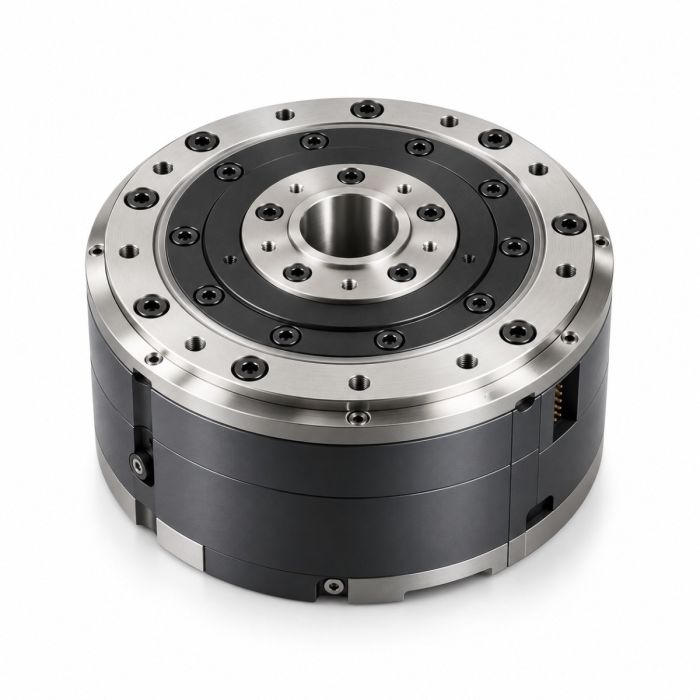
Most of the decisive moments in a humanoid robot's working day are over in an instant: a foot planted to recover balance, an arm swung to catch a falling part, a torso straightened under a sudden load. Those bursts are where a joint earns its place, and they are the movements the Xynova PR20-102-130-HS Rotary Actuator is designed around. Its in-house planetary gearbox is optimised for high-burst movements, and the module pairs 130Nm of peak torque with a no-load speed of 150r/min on a 48V supply, inside a housing of Φ102×59mm. For an engineer laying out a robot limb by limb, that is a joint which responds quickly without demanding a larger frame around it.
Robots Middle East supplies the Xynova PR20-102-130-HS Rotary Actuator to universities, research laboratories, system integrators and industrial development teams across the Middle East. Robots Middle East prepares each quotation, arranges delivery to your site and remains your point of contact for technical questions once the actuators are installed, so that a project team can move from specification to integration with a single, accountable partner in the region.
Background
Xynova Technology Co., Ltd. and its focus on humanoid robots
Xynova Technology Co., Ltd. is a core component supplier in the field of humanoid robots. Rather than offering a single motor for every purpose, the company describes its work as customised, complete electric drive solutions for humanoid robots, built from a family of rotary actuators whose torque range of 6.7-500Nm is intended to meet the needs of every joint in the body. The PR20-102-130-HS is one member of that family. Other versions named by the manufacturer include the PR64-110-500, the PR43-120-600-HB, the PRH19-57-25-HS and the PR21-100-140-HS, so a design team can draw several joints of one robot from the same supplier and the same software environment.
That approach matters to anyone who has assembled a humanoid platform from mixed components. When every joint comes from a different source, the integration work multiplies: separate control software, separate tuning practices, separate support channels. A family designed around one class of machine reduces that burden and lets engineers concentrate on locomotion, manipulation and behaviour rather than on reconciling incompatible parts.
Planetary gearing and coordinated control
Two pieces of in-house engineering define this module. The first is the planetary gearbox, developed by Xynova and optimised for high-burst movements, the short, forceful actions that dominate legged and upper-body motion. The second is the upper-level software, also developed in-house, which offers a rich set of API interfaces and allows multiple actuators to be coordinated and controlled together. For a humanoid robot, where a single gesture may involve shoulder, elbow and wrist acting at once, that coordination layer is as important as the hardware it commands.
Across its actuator design, Xynova states that at the same peak torque, module size is reduced by more than 45% and weight by more than 35%. In practical terms, that is the space and mass a designer recovers for batteries, sensors, structure or payload elsewhere in the robot.
Technical Specifications
| Specification | Value |
|---|---|
| Input voltage | 48V |
| No-load speed | 150r/min |
| Peak torque | 130Nm |
| Torque density | 113Nm/kg |
| Weight | 1.2kg |
| Size | Φ102×59mm |
| Gear ratio | 20 |
| Encoder resolution | 17bit |
| Repeatability | ≤0.1° |
Specifications are as published by the manufacturer and are confirmed against the datasheet at quotation.
Xynova has not published the rated torque, continuous torque, peak current, rated current, peak speed, motor type, backlash, communication interface, IP rating, operating temperature, mounting dimensions or the contents of the box for this module; Robots Middle East confirms these details with the manufacturer at quotation.
Why does a gear ratio of 20 suit high-burst movements?
Every geared joint balances two demands. A high reduction multiplies torque but slows the output and tends to make the joint stiff and less responsive to external forces; a low reduction keeps the joint lively but asks more of the motor. The PR20-102-130-HS sits deliberately towards the responsive side, with a gear ratio of 20 feeding a planetary gearbox that Xynova has optimised for high-burst movements. The result is a joint that reaches 150r/min with no load and still delivers 130Nm at its peak.
For legged robots and dynamic upper bodies, that combination is what allows a limb to move decisively when balance or timing is at stake. The 17bit encoder and a repeatability of ≤0.1° then give the controller fine positional feedback, so that speed does not come at the expense of precise placement. A designer evaluating joints for walking, jumping or fast reaching tasks will find the essential trade-off already resolved in favour of responsiveness, with enough torque density, 113Nm/kg, to keep the limb light.
How does the PR20-102-130-HS fit into Xynova's actuator family?
Xynova presents its rotary actuators as a set rather than as isolated products, spanning a torque range of 6.7-500Nm across the family. Within that set, the PR20-102-130-HS offers a compact Φ102×59mm housing, a weight of 1.2kg and 130Nm of peak torque, a profile that suits joints where both strength and agility are needed without the bulk of the largest modules. Because the same upper-level software and API interfaces coordinate several actuators together, the module can share a control architecture with its siblings elsewhere in the robot.
This is a practical advantage during development. A team can prototype a limb with one version, specify a different version for a joint with heavier or lighter duty, and keep the control approach consistent. Robots Middle East can quote mixed sets of Xynova actuators for a complete build.
Who is the Xynova PR20-102-130-HS Rotary Actuator for?
The first group is humanoid robot developers, whether in university laboratories, government research programmes or commercial start-ups, who need joints that combine dynamic response with a modest footprint. The second is research teams working on legged locomotion and balance control, for whom fast, repeatable joints are the raw material of every experiment. The third is system integrators building custom manipulators, exoskeleton prototypes or mechatronic test rigs, who value a module with a documented software layer for multi-actuator control.
Not every joint in a robot carries the same duty. Where a design calls for a different torque class or form factor, Xynova's other rotary versions may be the better fit: the Xynova PR21-100-140-HS Rotary Actuator, the Xynova PR43-120-600-HB Rotary Actuator, the Xynova PR64-110-500 Rotary Actuator and the Xynova PRH19-57-25-HS Rotary Actuator. The full range of drive components is gathered in our Robot Actuators category.
What is the Xynova PR20-102-130-HS Rotary Actuator used for?
- Humanoid leg joints — hips and knees that must react quickly to keep a walking robot upright.
- Shoulder and elbow joints — upper-limb axes where a light module reduces the load on every joint further up the chain.
- Legged locomotion research — test platforms for gait, balance recovery and dynamic manoeuvres.
- Robotic manipulation — custom arms where repeatable positioning and responsive motion both matter.
- Exoskeleton and assistive prototypes — wearable mechanisms in which compactness and low mass are essential.
- Teaching and laboratory rigs — multi-axis demonstrators controlled through the in-house software and its API interfaces.
Pricing and Availability
The Xynova PR20-102-130-HS Rotary Actuator is supplied on quotation, which allows Robots Middle East to reflect the quantity and the mix of versions your project requires. Delivery, customs clearance and after-sales support are arranged together with the quotation, so that the terms are settled before you commit. To begin, please share the number of joints you are planning and the application, and a member of our team will respond with a tailored offer. The request form for a quotation is available on this page.
Frequently Asked Questions
What is the peak torque of the Xynova PR20-102-130-HS Rotary Actuator?
The module delivers a peak torque of 130Nm, the figure around which the most demanding movements of a limb can be planned.
What voltage does the actuator require?
The PR20-102-130-HS operates on a 48V input voltage.
How precise is the actuator's positioning?
It has a 17bit encoder and a repeatability of ≤0.1°, giving the controller fine positional feedback.
What type of gearbox does it use?
It uses a planetary gearbox developed in-house by Xynova and optimised for high-burst movements, with a gear ratio of 20.
Can several actuators be controlled together?
Yes. Xynova's in-house upper-level software provides a rich set of API interfaces that enable the coordination and control of multiple actuators.
How large and heavy is the module?
The actuator measures Φ102×59mm and weighs 1.2kg, giving a torque density of 113Nm/kg.
Where can I buy the Xynova PR20-102-130-HS Rotary Actuator and what does it cost?
You can buy it from Robots Middle East, which supplies Xynova actuators across the Middle East. The cost depends on quantity and project requirements, so please request a quotation and we will prepare an offer including delivery, customs and support.
Summary
A humanoid robot is judged by its decisive instants, the step that saves a fall or the reach that arrives on time, and the Xynova PR20-102-130-HS Rotary Actuator is engineered for exactly those moments. A planetary gearbox optimised for high-burst movements, a gear ratio of 20, 130Nm of peak torque and 150r/min of no-load speed on 48V give it a responsive character, while a 17bit encoder and ≤0.1° repeatability keep that response precise. At 1.2kg and Φ102×59mm, it leaves room in the limb for everything else the robot needs, and Xynova's software lets it work in concert with the rest of the family. For teams across the Middle East planning their next humanoid or dynamic manipulator, a quotation from Robots Middle East on this page is the starting point.