
Zerith Z1 Humanoid Robot
In stock
- BRAND:
- ZERITH
- PART #:
- Z1
- ORIGIN:
- China
- AVAILABILITY:
- SUBJECT TO AVAILABILITY
- SKU:
- Zerith-Z1
Zerith Z1 Humanoid Robot
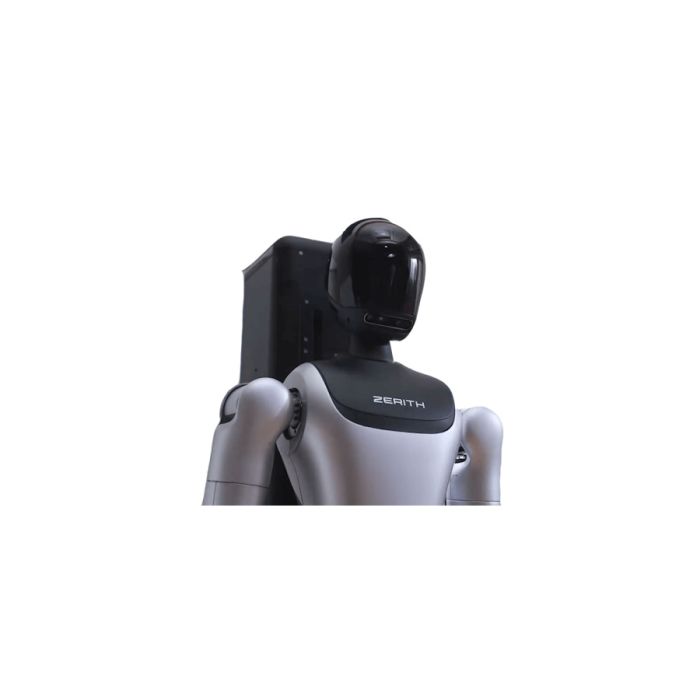
Every humanoid designer works against the same bargain: a stronger joint tends to mean a heavier limb, and a heavier limb makes the whole machine harder to keep upright. The Zerith Z1 Humanoid Robot is Zerith Technology's attempt to strike that bargain on better terms. Its joint motors reach a peak torque of 150Nm across 27 degrees of freedom, it carries a load of up to 20 kg, and its structure was shaped by AI-driven optimisation to lower energy consumption while keeping its movement dynamic. The outcome is a bipedal platform that stands upright, holds its balance on uneven ground and is intended to walk and interact in the spaces people already occupy.
Robots Middle East supplies the Zerith Z1 to universities, research laboratories, innovation centres and corporate development teams across the Middle East. Robots Middle East prepares each quotation, coordinates delivery to the customer's site and remains the point of contact for support once the robot has arrived, so that your team can concentrate on its work rather than on the logistics of importing specialist equipment.
Background
Zerith Technology and its first biped
Zerith Technology launched the Z1, its first bipedal humanoid robot, on 24 October 2024. The company concentrates mainly on humanoid robots, and its range comprises the ZERITH Z1 and the dual-arm robot F1. Within that range the Z1 is the walking platform: where the F1 is organised around a pair of arms, the Z1 carries a full two-legged body that has to manage its own balance at every step. Bipedal humanoids as a class are chosen when the environment cannot be adapted to the machine, which is why they appear so often in laboratories studying locomotion, whole-body control and the interaction between robots and human surroundings.
A structure shaped by optimisation
What distinguishes the Z1 most clearly is how its body was designed. Zerith applied AI-driven design optimisation to the robot's structural parameters, an approach unique among its peers. The purpose is twofold: to reduce energy consumption, expressed as COT (cost of transport, the energy a walking machine spends to move a given distance), and to enhance dynamic motion performance. Alongside this structural work, the robot integrates an EtherCAT communication module developed in-house by Zerith Technology, offering low-latency, high-bandwidth communication between its control system and its joints. Together these choices point to a platform engineered as a whole rather than assembled from unrelated parts.
Technical Specifications
| Specification | Value |
|---|---|
| Manufacturer | Zerith Technology |
| Product type | Bipedal humanoid robot |
| Launch date | 24 October 2024 |
| Peak joint torque | 150Nm |
| Degrees of freedom | 27 |
| Load-bearing limit | Up to 20 kg |
| Load-to-weight ratio | Exceeding 70% |
| Communication module | In-house EtherCAT module, low-latency and high-bandwidth |
| Structural design | AI-driven optimisation of structural parameters to reduce COT and enhance dynamic motion |
| Terrain capability | Stable navigation of irregular surfaces and complex terrain for extended periods |
Specifications are as published by the manufacturer and are confirmed against the datasheet at quotation.
Zerith has not published the robot's weight, height, maximum walking speed, battery capacity, charging time, IP rating, onboard computer, operating system, hand and finger configuration or the contents of the box; Robots Middle East confirms each of these at quotation.
How does the Zerith Z1 balance strength against weight?
For a walking robot, strength on its own says little. A joint that delivers high torque but adds mass to the leg can leave the machine slower to recover from a stumble and more costly to move. The meaningful figure is how much the robot can carry in proportion to what it weighs, and here the Z1 achieves a load-to-weight ratio exceeding 70%, with a load-bearing limit of up to 20 kg. That relationship is the practical result of pairing joint motors that reach 150Nm at peak with a structure whose parameters were optimised by AI rather than settled by convention.
The 27 degrees of freedom matter to the same argument. Each additional joint gives the controller another way to redistribute weight, absorb a disturbance or adjust a stride, which is precisely what a biped needs on ground that is not flat. The Z1 has exceptional anti-interference capability, allowing it to navigate irregular surfaces and complex terrain stably for extended periods. For a research team, this combination means experiments can move beyond the polished laboratory floor without the robot becoming the limiting factor.
Why does the Z1 use an EtherCAT communication module?
EtherCAT is an industrial Ethernet protocol widely used in motion control, valued because it lets a controller exchange data with many drives in tight, predictable cycles. In a humanoid, where dozens of joints must react together within fractions of a second, that predictability is the difference between a controlled recovery and a fall. Zerith chose to develop its own EtherCAT communication module for the Z1, giving the robot low-latency, high-bandwidth links between its control layer and its actuators. For developers, an architecture built on a recognised fieldbus is generally easier to reason about when writing balance controllers, logging joint data or testing new whole-body behaviours.
Who is the Zerith Z1 Humanoid Robot for?
The Z1 is aimed first at developers and researchers. Developers use it to study humanoid balance, imitation learning and embodied AI within real-world settings, and those three fields describe its natural buyers: university departments in robotics, mechanical engineering and computer science; national and corporate research laboratories developing locomotion and manipulation policies; and AI teams that need a physical body on which to test models trained in simulation.
Innovation centres and technology parks across the region may also find the Z1 suitable as a demonstrator of bipedal locomotion, provided the programme behind it is a technical one. Organisations comparing several platforms can browse the wider Bipedal Humanoids category, or the broader Humanoids range, to see the Z1 alongside alternatives. Where the work takes place on level indoor floors and walking itself is not the object of study, a wheeled platform such as the Zerith H1 Wheeled Humanoid Robot may be worth comparing; Robots Middle East can advise on which approach fits the intended application.
What is the Zerith Z1 Humanoid Robot used for?
- Balance research: studying how a biped stays upright and recovers from disturbances on uneven surfaces.
- Imitation learning: developing methods through which a humanoid acquires behaviours from demonstration.
- Embodied AI: testing intelligent models on a physical body acting within real-world settings.
- Terrain locomotion: evaluating walking on irregular surfaces and complex terrain over extended sessions.
- Load-carrying studies: examining how gait and posture adapt while the robot bears loads of up to 20 kg.
- Control architecture development: building and benchmarking whole-body controllers over a low-latency EtherCAT link.
Pricing and Availability
The Zerith Z1 is supplied on quotation, which allows Robots Middle East to confirm the current configuration, the outstanding specifications and the requirements of your project before any commitment is made. Delivery, customs clearance and after-sales support are arranged together with the quotation. To begin, please share a brief outline of your intended application; the request for a quotation is available on this page.
Frequently Asked Questions
Who manufactures the Zerith Z1, and when was it launched?
The Z1 is made by Zerith Technology, which launched it as its first bipedal humanoid robot on 24 October 2024.
How many degrees of freedom does the Z1 have?
The Z1 has 27 degrees of freedom, driven by joint motors that reach a peak torque of 150Nm.
How much weight can the Z1 carry?
Its load-bearing limit is up to 20 kg, and it achieves a load-to-weight ratio exceeding 70%.
Can the Z1 walk on uneven ground?
Yes. The Z1 is designed to stand upright and keep its balance on uneven surfaces, and it can navigate irregular surfaces and complex terrain stably for extended periods.
What are the Z1's weight, height and battery capacity?
Robots Middle East confirms these figures, together with the other outstanding specifications listed beneath the table, at quotation.
Which research fields is the Z1 suited to?
Developers use the Z1 to study humanoid balance, imitation learning and embodied AI within real-world settings.
Where can I buy the Zerith Z1 Humanoid Robot and what does it cost?
Robots Middle East supplies the Z1 across the Middle East on quotation. The price depends on configuration and project requirements, so please request a quotation and our team will respond with full details.
Summary
The Zerith Z1 answers the old trade-off between strength and mass with a coherent design rather than a single headline figure: joints reaching 150Nm, 27 degrees of freedom, a load-bearing limit of up to 20 kg and a structure optimised by AI to reduce the cost of transport. An in-house EtherCAT module ties these elements together, and the result is a biped that holds its balance where the ground is irregular. For teams researching balance, imitation learning and embodied AI, and for organisations that want Robots Middle East to handle quotation, delivery and support, this page is the starting point.