
Geek+ S20C Sorting Robot
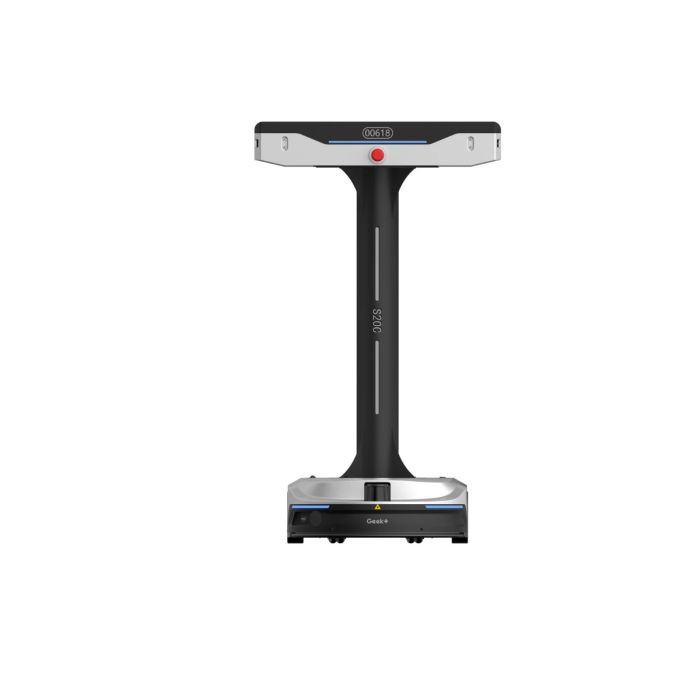
In stock
- BRAND:
- GEEK+
- MODEL:
- S20C
- PART #:
- S20C
- ORIGIN:
- China
- Warranty:
- 12 MONTHS
- AVAILABILITY:
- SUBJECT TO AVAILABILITY
- SKU:
- GeekPlus-S20C
Geek+ S20C Sorting Robot
A traditional sorting line is something a warehouse is built around: steel, chutes and conveyors fixed to the floor, sized for the volumes forecast on the day it was commissioned and difficult to move afterwards. The Geek+ S20C Sorting Robot reverses that logic. Rather than bringing every parcel to one fixed machine, it sends a fleet of compact autonomous robots across open floor space, each carrying an item on its own conveyor and handing it off at the correct destination. When volumes rise, the answer is additional robots rather than a longer line, and when the layout changes, the routes change with it.
Robots Middle East supplies the Geek+ S20C Sorting Robot to parcel, fulfilment and distribution operators across the Middle East. Because the S20C is offered as part of a sortation system rather than as a standalone unit, Robots Middle East quotes it as a project, covering the robot fleet, the Geek+ software layer and the arrangements for delivery and ongoing support at your site.
Background
Geek+ and its sorting robot range
Geek+ is a warehouse robotics specialist whose portfolio spans goods-to-person picking, intralogistics robots that move shelves and pallets, and dedicated sorting robots. Within the sorting range, Geek+ offers four versions: the S20C, the S20C-A, the S20T and the S100C. This page concerns the S20C, the conveyor-top model. Its closest relative, the S20C-A, adds a lifting module; the S20T and S100C are not covered on this page. Geek+ sorting robots achieve nearly 10 times the efficiency of traditional sorting systems and up to 10× their processing speed, and the sorting solution delivers up to 99.99% accuracy, with multi-fold higher efficiency than manual sorting.
The software that runs the fleet
A sorting robot is only as capable as the system that directs it. Geek+ sortation is managed through four software components: RMS handles robot scheduling, WES holds the task logic that decides where each item goes, IOP raises alerts to the operations team, and G-plan provides simulation. In practice this means a sortation project can be modelled before robots arrive on site, then run as a coordinated fleet rather than as individual machines. For operators, the software layer is where the flexibility of a mobile sorting system is actually realised: destinations, routes and priorities are changed in configuration rather than in steelwork.
Technical Specifications
| Specification | S20C | S20C-A |
|---|---|---|
| Robot type | Autonomous Mobile Robot (AMR) | Sorting robot |
| Top module | Conveyor | Conveyor belt and lifting module |
| Payload | 20kg | — |
| Maximum speed | Up to 2.5m/s | — |
| Dimensions (LxWxH) | 560x600x1027mm | 560x600x1150mm |
| Weight | 75kg | 100kg |
| Loads transported | Loose items and small specialised loads, totes, boxes and small containers | — |
| Ingress protection | — | IP54 |
| Low-temperature operation | — | Down to -20°C |
| Supply form | Part of a sortation system | — |
Specifications are as published by the manufacturer and are confirmed against the datasheet at quotation.
The manufacturer has not published the battery capacity, runtime per charge, charging time, connectivity, navigation method, obstacle detection, IP rating, operating temperature or the contents of the box for the S20C, nor the payload and speed of the S20C-A; these are confirmed at quotation.
What makes the S20C different from a fixed sorting line?
A fixed sorter concentrates its capacity in one place. Every item must be inducted onto the same machine, and the number of destinations is set by the number of chutes built into it. The S20C distributes that capacity across a fleet. Each robot is an Autonomous Mobile Robot carrying up to 20kg on a conveyor on its top surface, travelling at up to 2.5m/s between induction points and destinations, and discharging its load sideways at the correct drop-off.
This changes several things at once. Capacity becomes incremental: an operator can begin with a fleet sized for current volumes and add robots as demand grows, instead of committing to the throughput of a single large machine. Layout becomes adaptable, because the routes exist in software rather than in conveyors bolted to the floor. And the range of goods is broad for a sorter of this kind, as the conveyor carries loose items and small specialised loads as well as totes, boxes and small containers.
The footprint of each robot, 560x600x1027mm at 75kg, is compact enough to move through the aisles and sorting grids typical of parcel and fulfilment operations. Combined with the efficiency and accuracy that Geek+ sorting robots deliver against traditional systems, the S20C suits operations where volumes are growing, seasonal or simply uncertain.
Should you choose the S20C or the S20C-A?
The two versions share the same length and width, and both carry a conveyor on top, but they answer different site conditions. The S20C is the lower and lighter of the pair, rated for 20kg at up to 2.5m/s, which makes it the natural choice where all handover points sit at a single working height and the environment is a conventional ambient warehouse.
The S20C-A adds a lifting module, so the robot can link up with equipment at different heights, such as conveyors, shelving or workstations that do not share a common level. It stands at 1150mm and weighs 100kg. It is rated IP54, meaning it withstands water sprayed from any direction, and it handles freezing temperatures down to -20°C. Those figures belong to the S20C-A alone and should not be read across to the S20C. A cold-store or chilled-goods project, or a site where items must be handed to equipment at varying heights, should therefore be discussed with the S20C-A in mind.
Who is the Geek+ S20C Sorting Robot for?
The S20C is designed for organisations whose sorting volumes justify automation but whose operations need to remain adaptable. Parcel and courier hubs are an obvious fit, as their volumes swing sharply between ordinary weeks and peak periods. E-commerce fulfilment centres benefit from sorting orders to destinations without dedicating floor space permanently to a fixed machine. Third-party logistics providers, who frequently change clients and layouts, gain a sorting capability that can be reconfigured rather than rebuilt. Retail distribution centres sorting replenishment for stores are a further segment.
System integrators planning a broader automation programme will also find the S20C a useful building block, particularly where it sits alongside other Warehouse Robots in the same facility. Buyers comparing mobile platforms more widely can browse our range of AMRs. Where the project involves freezing environments or handovers at several heights, the S20C-A is the better-suited version, and Robots Middle East can advise on which configuration matches the site.
What is the Geek+ S20C Sorting Robot used for?
- Parcel sorting: routing parcels from induction to outbound destinations in courier and postal hubs.
- E-commerce order sorting: consolidating picked items into customer orders before packing.
- Tote and box distribution: moving totes, boxes and small containers between process areas.
- Returns processing: sorting returned goods to inspection, restock or disposal destinations.
- Store replenishment: sorting retail stock to destinations representing individual branches.
- Peak-season capacity: scaling sorting throughput by adding robots rather than building new lines.
Pricing and Availability
The Geek+ S20C Sorting Robot is supplied by quotation, since every sortation system is sized to the volumes, destinations and layout of the site it serves. Robots Middle East prepares each quotation around your operation, specifying the fleet and the software configuration required. Delivery, customs clearance and ongoing support are arranged together with the quotation. To begin the process, use the quotation request available on this page.
Frequently Asked Questions
How much can the S20C carry?
The S20C carries up to 20kg on its top conveyor. It handles loose items and small specialised loads as well as totes, boxes and small containers.
How fast does the S20C travel?
The S20C drives at up to 2.5m/s. Actual throughput depends on the layout and the size of the fleet, which are defined during project planning.
Can the S20C be bought as a single robot?
The S20C is available as part of a sortation system. Robots Middle East therefore quotes it as a project that includes the robots and the Geek+ software.
What software runs a Geek+ sorting system?
Geek+ uses RMS for robot scheduling, WES for task logic, IOP for alerts and G-plan for simulation. Together they coordinate the fleet and allow the project to be modelled in advance.
Is the S20C suitable for cold storage?
The cold-environment version of this range is the S20C-A, which handles freezing temperatures down to -20°C. For chilled or frozen sites, Robots Middle East recommends discussing the S20C-A.
How accurate is a Geek+ sorting solution?
The Geek+ sorting solution delivers up to 99.99% accuracy. It also offers multi-fold higher efficiency than manual sorting.
Where can I buy the Geek+ S20C Sorting Robot and what does it cost?
Robots Middle East supplies the Geek+ S20C Sorting Robot across the Middle East. The cost depends on the size and configuration of the sortation system, so it is set out in a project quotation requested through this page.
Summary
The Geek+ S20C Sorting Robot replaces the fixed sorting line with something that moves: a fleet of conveyor-topped AMRs that carry up to 20kg at up to 2.5m/s, coordinated by Geek+ scheduling, task and simulation software. Capacity grows by adding robots, layouts change through configuration, and the range of loads extends from loose items to small containers. For sites with freezing conditions or handovers at several heights, the S20C-A offers its lifting module, IP54 rating and operation down to -20°C. For operators in the region ready to size a sorting system to their own floor, this page is the starting point.