
OrionStar CarryBot
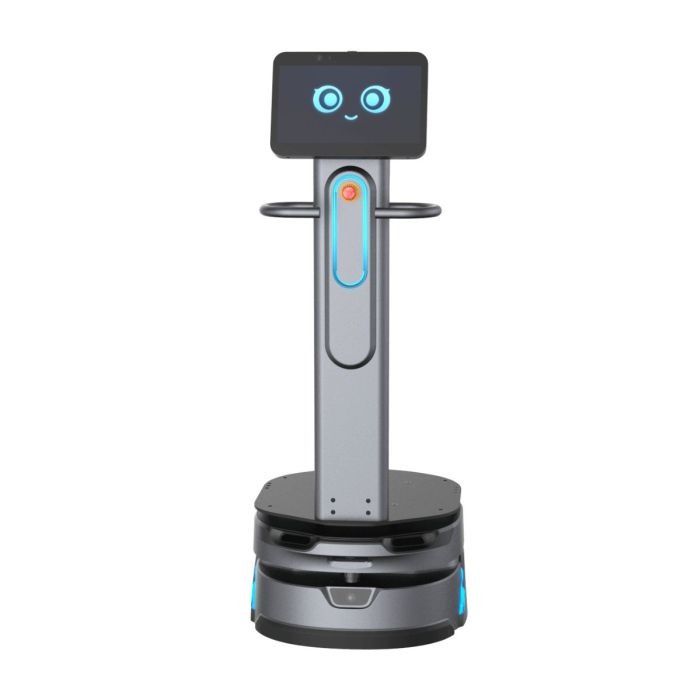
In stock
- BRAND:
- ORIONSTAR
- MODEL:
- CARRYBOT
- ORIGIN:
- Canada
- AVAILABILITY:
- SUBJECT TO AVAILABILITY
- SKU:
- OrionStar-CarryBot
OrionStar CarryBot
On many factory floors, the hardest part of a delivery is not the distance but the final few metres between crowded workbenches, racks and the people working at them. That is the gap the OrionStar CarryBot is built to close. It is an autonomous mobile robot that carries materials and goods through tight passages and shared walkways, where a forklift is unsuitable and a fixed conveyor would be too rigid. Instead of following a track laid into the floor, it reads its surroundings, plans its own route and gives way to its fellow robots at junctions. Operators are freed from the steady stream of short carrying trips that fills a shift.
Robots Middle East supplies the OrionStar CarryBot to manufacturers, warehouse operators and logistics businesses across the Middle East. Our team prepares each quotation for the specific site, confirms the version and carrying attachments that suit the workflow, and arranges delivery, commissioning and after-sales support in the customer's country. For organisations comparing several OrionStar robots, the full range is available in our OrionStar category.
Background
Beijing OrionStar and its service-robot portfolio
The CarryBot is manufactured by Beijing OrionStar technology co., Ltd., a company whose range spans delivery, reception and cleaning robots for commercial and industrial settings. The CarryBot is its answer to internal logistics. OrionStar positions it for discrete manufacturing enterprises in consumer electronics, warehousing, logistics and related sectors. These are businesses where parts, sub-assemblies and finished goods move in many small batches between stations rather than in a single continuous flow.
Perception instead of fixed infrastructure
The key technology is the robot's perception system. The CarryBot combines LiDAR, three depth cameras and V-SLAM 2.0, OrionStar's visual simultaneous localisation and mapping technology. The LiDAR maps the geometry of the space, the depth cameras detect obstacles at different heights, and the visual mapping system keeps the robot localised as the environment changes. Because the robot does not depend on magnetic strips or reflectors, OrionStar states that deployment time falls from several weeks with traditional AGVs to less than one day. The robot runs on a deeply customised RobotOS based on Android 9.0, and OrionStar offers more than 500 free APIs for integration work.
Technical Specifications
| Specification | CarryBot D150 | CarryBot D100 |
|---|---|---|
| Navigation sensors | LiDAR, three depth cameras, V-SLAM 2.0 | Not specified separately |
| Positioning accuracy | Up to 1 cm under optimal conditions | Not specified separately |
| Minimum clearance | 65 cm (depending on dynamic traffic) | Not specified separately |
| Obstacle crossing | 10 mm thresholds and 30 mm grooves | Not specified separately |
| Moving speed | 0.5 ~ 1.0 m/s | Not specified separately |
| Load capacity | CarryBot 3: max load 150 kg (including shelf) | 100kg payload |
| Working time | Up to 12 hours on a single charge (100 kg loads) | 9-hour runtime |
| Charging time | Full charge within 4.5 hours | Not specified separately |
| Charging mode | Automatic charging dock, cable | Not specified separately |
| Battery capacity and voltage | 34Ah, 25.2V | Not specified separately |
| Screen | 14-inch, 1080 FHD | Not specified separately |
| Overall size | CarryBot 1: 600 mm x 525 mm x 1377 mm | Not specified separately |
| Net weight | CarryBot 3: 60 kg (robot 48kg + shelf 12 kg) | Not specified separately |
| Operating system | Customised RobotOS based on Android 9.0 | Customised RobotOS based on Android 9.0 |
| Connectivity | 4G and dual-band Wi-Fi | 4G and dual-band Wi-Fi |
| Open APIs | 500+ free APIs | Not specified separately |
| Deployment time | Less than one day | Not specified separately |
Specifications are as published by the manufacturer and are confirmed against the datasheet at quotation.
The manufacturer has not published the IP rating, certifications, operating temperature range, noise level, maximum slope, lithium battery chemistry or package contents; these are confirmed at quotation.
What is the difference between the CarryBot D150 and the CarryBot D100?
The two versions share the same software foundation, a customised RobotOS based on Android 9.0 with 4G and dual-band Wi-Fi, so the choice between them is mainly about load and endurance. OrionStar describes the CarryBot D100 as the classic model for standard delivery needs, with a 100kg payload and a 9-hour runtime. The CarryBot D150 is the heavier-duty option. In its CarryBot 3 configuration it carries a maximum load of 150 kg including the shelf, and it works for up to 12 hours on a single charge with 100 kg loads.
The D150 is also the version for which OrionStar publishes the fuller set of operating figures. These include a moving speed of 0.5 ~ 1.0 m/s, a full charge within 4.5 hours from an automatic charging dock or by cable, a 34Ah, 25.2V battery and a 14-inch, 1080 FHD screen. Within the D150 family, OrionStar names CarryBot 1, CarryBot 2 and CarryBot 3 configurations. CarryBot 1 measures 600 mm x 525 mm x 1377 mm, and CarryBot 3 weighs 60 kg in total, made up of a 48kg robot and a 12 kg shelf. Robots Middle East confirms which configuration matches the loads on your floor before quoting.
How does CarryBot cope with narrow and busy floors?
Three published characteristics make the CarryBot suited to congested sites. It operates in passages with a minimum physical clearance of 65 cm, depending on dynamic traffic, which suits the cramped layouts of micro-fulfilment centres and assembly halls. It crosses 10 mm thresholds and 30 mm grooves, so door sills and floor joints do not break its route. When several CarryBots work in the same area and meet at a fork, they avoid each other autonomously by following the priority of their robot numbers, without any human intervention.
Positioning accuracy of up to 1 cm under optimal conditions means the robot can stop reliably at a workstation or shelf location. This matters when people expect a load to arrive in the same place every time.
Who is OrionStar CarryBot for?
The CarryBot is aimed first at discrete manufacturers, particularly in consumer electronics, where components and sub-assemblies move between lines in frequent, modest loads. Warehouse and third-party logistics operators running micro-fulfilment or picking areas form a second group, especially where aisles are narrow and the layout changes with the seasons. Facilities that have hesitated over AGVs because of the installation work involved may find the less-than-one-day deployment the deciding factor.
Buyers whose loads stay comfortably within 100kg and whose shifts fit a 9-hour runtime are well served by the CarryBot D100. Operations moving heavier shelves, or running longer shifts, should look at the CarryBot D150 and its CarryBot 3 configuration. Systems integrators and in-house automation teams will value the 500+ free APIs for connecting the robot to existing software. Carrying attachments are sold separately, so the right attachment is agreed as part of the quotation.
What is OrionStar CarryBot used for?
- Line-side replenishment – bringing components from stores to assembly stations without taking operators away from their benches.
- Work-in-progress transfer – moving sub-assemblies between production steps in electronics and other discrete manufacturing.
- Micro-fulfilment picking support – shuttling totes and shelves through the tight aisles of compact fulfilment centres.
- Warehouse goods movement – carrying stock between receiving, storage and dispatch zones on repeated routes.
- Finished-goods collection – taking completed products from the end of a line to packing or quality inspection.
- Multi-robot fleets – running several CarryBots in one area, with right of way at junctions resolved by robot-number priority.
Pricing and Availability
Robots Middle East prepares a quotation for each project, taking into account the version, the configuration, the carrying attachments and the site where the robot will work. Delivery, customs clearance and support are arranged together with the quotation. To begin, share your loads, route lengths and shift pattern with our team using the quotation request available on this page.
Frequently Asked Questions
What navigation technology does the CarryBot use?
It combines LiDAR, three depth cameras and V-SLAM 2.0 visual mapping technology. This lets it plan routes without magnetic strips or other fixed floor infrastructure.
How much can the CarryBot carry?
The CarryBot D150 in its CarryBot 3 configuration carries a maximum load of 150 kg including the shelf. The CarryBot D100 is rated for a 100kg payload.
How long does it run on one charge?
The CarryBot D150 works for up to 12 hours on a single charge with 100 kg loads and reaches a full charge within 4.5 hours. The CarryBot D100 has a 9-hour runtime.
Can several CarryBots work in the same area?
Yes. When they meet at a fork, they give way to each other autonomously according to the priority of their robot numbers, with no human intervention.
How long does deployment take?
OrionStar states that deployment takes less than one day, compared with several weeks for traditional AGVs.
Are carrying attachments included?
Attachments are sold separately. Robots Middle East confirms the right attachment for your loads when preparing the quotation.
Where can I buy the OrionStar CarryBot and what does it cost?
Robots Middle East supplies the OrionStar CarryBot across the Middle East. The cost depends on the version, configuration and attachments, so it is set out in a quotation prepared for your site.
Summary
The OrionStar CarryBot is designed for the last crowded metres of internal logistics: the narrow passage, the door sill and the busy junction where people and loads cross. Its LiDAR, depth cameras and V-SLAM 2.0 allow it to work there without fixed infrastructure, and it can be deployed in less than one day. The CarryBot D100 covers standard delivery work, while the CarryBot D150 adds heavier loads and longer shifts. Robots Middle East quotes, delivers and supports both across the region. For a floor where the last few metres cost the most effort, this page is the starting point.