
OrionStar LuckiBot
In stock
- BRAND:
- ORIONSTAR
- ORIGIN:
- China
- AVAILABILITY:
- SUBJECT TO AVAILABILITY
- SKU:
- OrionStar-LuckiBot
OrionStar LuckiBot
Watch a busy dining room at the height of an evening service and you will see the same journey made again and again: a server leaves the kitchen with plates balanced along one arm, threads between chairs and returning guests, and walks back empty-handed to start over. Every one of those trips is time a host could have spent at the table. The OrionStar LuckiBot is built to take over the carrying, so the walk from kitchen to table becomes the robot's job and the conversation with the guest remains the team's. It moves through the room on its own, carries dishes on stacked trays, and can switch from delivering food to welcoming and guiding guests, giving restaurant operators a dependable extra pair of hands across a long service.
Robots Middle East supplies the OrionStar LuckiBot to restaurants, hotels, cafés and hospitality groups across the Middle East. Our team prepares the quotation, arranges delivery to your venue and provides support once the robot is working on your floor, so that a single point of contact handles the project from the first enquiry to everyday operation.
Background
The manufacturer
The LuckiBot is made by Beijing OrionStar technology co., Ltd., the company behind a family of commercial service robots that also includes delivery, reception and floor-cleaning machines. The wider range is presented on our OrionStar category page. OrionStar designs its robots for public, people-facing spaces, and the LuckiBot is its answer to one of the most repetitive tasks in hospitality: moving food and drink from the pass to the guest.
Positioning and key technology
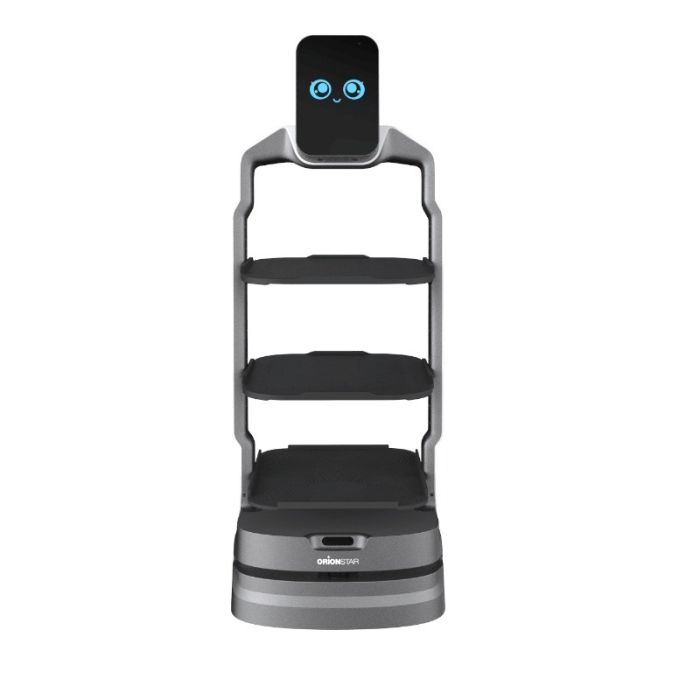
The LuckiBot sits in the class of restaurant delivery robots: autonomous trolleys with trays, a touch screen and voice interaction, intended to work alongside waiting staff rather than replace them. What sets it within that class is the combination of a Dual SLAM navigation solution that recognises location markers, a chassis with a radar sensing system and inertial navigation, and a 6-microphone ring array for voice pickup. It runs OrionStar's customised Robot OS, which is based on Android 9.0, and offers delivery, greeting, guidance and cruise modes. A colour-changing indicator tape shows the robot's status at a glance, for example green while it is charging.
Technical Specifications
| Specification | Value (LuckiBot) |
|---|---|
| Overall size | 530 mm × 500 mm × 1320 mm |
| Net weight | 39 Kg |
| Colour | Pearl white + Elegant black |
| Screen | 10.1-inch; Touch Screen, 1200×1920 pixel resolution |
| Tray tiers | 3 or 4 adjustable tiers, 0.18㎡ per tier |
| Single tray load | Max 10 Kg |
| Total load | Max 40 Kg |
| Cruising speed | 0.5 ~ 1.2 m/s (adjustable) |
| Cruising time | 10 H (typical cruising scene) |
| Charging time | 4.5 H (charge when turned off) |
| Operating system | OrionStar's customised Robot OS, based on Android 9.0 |
| Microphone array | 6-microphone ring array, 360° coverage, 5m effective |
| Navigation | Dual SLAM solution recognising location markers |
| Chassis sensing | Radar sensing system and inertial navigation |
| Modes | Delivery, greeting, guidance and cruise |
| Status indication | Colour-changing indicator tape |
Specifications are as published by the manufacturer and are confirmed against the datasheet at quotation. The manufacturer has not published the battery capacity, IP rating, operating temperature, processor and memory, package contents or camera details; these are confirmed with your quotation.
How does the OrionStar LuckiBot find its way around a busy dining room?
A restaurant is a demanding place for a robot: furniture moves between services, guests stand up without warning, and lighting changes as the evening goes on. The LuckiBot addresses this with a Dual SLAM navigation solution that lets it recognise location markers, so it does not get lost at night when the room is dimmed. Beneath the trays, a radar sensing system and inertial navigation give the chassis balanced movement and a steady sense of where it is heading, which matters when it is carrying soup or drinks.
Larger venues often need more than one robot, and here the LuckiBot is designed to share the floor. When several Lucki robots working in the same restaurant meet at a fork in the route, they avoid each other autonomously, without staff stepping in, by following the priority of their robot numbers. For an operator, this means a second or third unit can be added without turning the aisles into a negotiation. Cruising speed is adjustable between 0.5 and 1.2 m/s, so the robot can be set to a gentle pace in a crowded lounge or a brisker one along a quiet corridor.
How much can the LuckiBot carry on each trip?
The trays are where the robot earns its place. The LuckiBot offers 3 or 4 adjustable tiers of tray, each with 0.18㎡ of surface. Each tray takes a maximum of 10 Kg and the total load is a maximum of 40 Kg, enough to serve several dishes for a table in one run rather than in a series of trips. Because the tiers are adjustable, a venue can configure taller spacing for bowls and teapots or tighter spacing for plates.
OrionStar also lists accessories that extend what the trays can handle: the Lucki-Button, a Sealed Food Protector, a Silicone Tray Mat, an Aluminum Alloy Tray, cup holders and a head cover. The accessories for your order are agreed with Robots Middle East. With a cruising time of 10 H in a typical cruising scene and a charging time of 4.5 H when the robot is switched off, the LuckiBot can cover a full trading day and recharge overnight.
Who is the OrionStar LuckiBot for?
The clearest fit is the full-service restaurant with a long floor between kitchen and tables, where staff spend much of each shift walking rather than serving. Family restaurants and buffet-style venues gain from the tray capacity during peak hours, while hotel restaurants and banqueting areas can use the robot to carry dishes over longer distances. Cafés and shopping-centre food outlets may value the greeting and guidance modes as much as delivery, using the robot to welcome guests and lead them to free tables.
Hospitality groups planning to run several robots in one venue should note the multi-robot cooperation, which allows units to share routes without supervision. OrionStar also offers a LuckiBot Pro and a LuckiBot Pro Autodoor version; if your project calls for one of these, Robots Middle East will set out what each version includes when we prepare your offer, so that every figure you rely on belongs to the version you order.
What is the OrionStar LuckiBot used for?
- Food delivery — carrying dishes from the kitchen pass to the right table on stacked trays.
- Drinks service — taking beverages to tables with cup holders among the listed accessories.
- Guest greeting — welcoming visitors at the entrance in greeting mode with voice and screen.
- Table guidance — leading guests to their seats in guidance mode.
- Cruise service — circulating through a venue in cruise mode to offer items or promotions.
- Multi-robot operation — running several units in one restaurant that give way to each other at junctions.
Pricing and Availability
The cost of a LuckiBot project depends on the version, the tray configuration, the accessories and the number of robots your venue needs, so we prepare each offer individually. Request a quotation from Robots Middle East and our team will prepare an offer tailored to your venue. Delivery, customs clearance and after-sales support are arranged together with your quotation. To begin, use the quotation request available on this page.
Frequently Asked Questions
How long does the LuckiBot run on a single charge?
The cruising time is 10 H in a typical cruising scene. Charging takes 4.5 H when the robot is turned off.
Can several LuckiBot robots work in the same restaurant?
Yes. When multiple Lucki robots meet at a fork in the route, they avoid each other autonomously by following the priority of their robot numbers, without staff intervention.
Will the robot lose its way when the lights are dimmed?
Its Dual SLAM navigation solution recognises location markers so that it does not get lost at night. The chassis also uses a radar sensing system and inertial navigation.
How much weight can each tray hold?
Each tray takes a maximum of 10 Kg, and the total load is a maximum of 40 Kg across 3 or 4 adjustable tiers.
Can guests speak to the robot?
The LuckiBot has a 6-microphone ring array with 360° coverage and a 5m effective range, alongside a 10.1-inch touch screen for interaction.
Which operating system does the LuckiBot use?
It runs OrionStar's customised Robot OS, which is based on Android 9.0.
Where can I buy the OrionStar LuckiBot and what does it cost?
You can buy the OrionStar LuckiBot from Robots Middle East, which supplies it across the Middle East. The cost depends on version, configuration and quantity, so please request a quotation on this page.
Summary
The repeated walk from kitchen to table is where a restaurant quietly loses time, and the OrionStar LuckiBot is designed to absorb it. Adjustable tray tiers with a maximum total load of 40 Kg, Dual SLAM navigation that holds its course in a dimmed room, cooperation between several robots on one floor and a cruising time of 10 H make it a practical partner for a full service, while its greeting, guidance and cruise modes extend its role beyond carrying plates. Robots Middle East supplies, delivers and supports the LuckiBot across the region and prepares every offer individually. If you are ready to give your team more time with your guests, this page is the starting point.