
Unitree H2-D Standard Fixed Base Dual-Arm Humanoid Robot
In stock
- BRAND:
- UNITREE ROBOTICS
- MODEL:
- H2-D STANDARD
- PART #:
- H2-D Standard
- ORIGIN:
- China
- Warranty:
- 12 MONTHS
- AVAILABILITY:
- SUBJECT TO AVAILABILITY
- SKU:
- Unitree-H2-D-Standard
Unitree H2-D Standard Fixed Base Dual-Arm Humanoid Robot
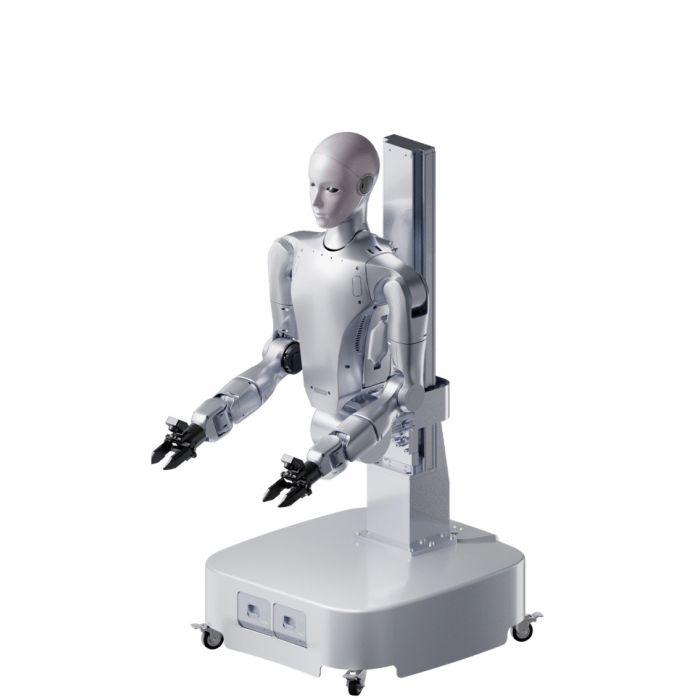
Most humanoid robot demonstrations are measured in minutes, because they end when the battery runs down. A production cell, a teaching laboratory or an embodied AI data rig runs on a different clock, one counted in shifts, weeks and months. The Unitree H2-D Standard Fixed Base Dual-Arm Humanoid Robot is built for that longer clock. It is a dual-arm humanoid upper body mounted on a column that lifts and turns, with a waist that pitches forward towards the work. It runs from a direct power supply around the clock, or from a quick-release battery in its base when it must be moved away from the wall socket. It gives up locomotion in exchange for endurance and reach, and that exchange decides where it belongs.
Robots Middle East supplies the H2-D Standard to universities, research institutes, system integrators and industrial operators across the Middle East. Each quotation from Robots Middle East is prepared for the configuration your project requires, including the choice of end-effector. Robots Middle East also remains your point of contact for delivery, commissioning questions and technical support once the robot is in service.
Background
Unitree Robotics and the H2 family
Unitree Robotics made its name with agile quadruped robots before extending its work to full-size humanoids, and it develops its own motors and motion control in-house. The H2 generation continues that approach and the manufacturer's sources name several versions: the H2-A Standard with a fixed base, the H2-D Standard described on this page, and the H2-D Flagship with a mobile chassis. The versions share a design language but are not interchangeable. The figures on this page belong to the H2-D Standard alone, and the specifications of the other versions should be checked on their own pages or requested with your quotation.
A column in place of legs
Instead of walking to a task, the H2-D Standard changes its own geometry around it. The column provides two degrees of freedom, vertical lift and yaw, so the torso can be raised, lowered and rotated to face a work surface. The waist adds pitch from 0° to 115°, allowing the upper body to lean over a bench, a conveyor or a tray. The joints are driven by low-inertia, high-speed inner-rotor permanent magnet synchronous motors with air cooling, and the structure combines aerospace-grade aluminium, titanium alloy and high-strength engineering plastics. For a stationary platform, this arrangement keeps the working envelope adjustable without the balance and safety questions that legged motion raises in a shared workspace.
Technical Specifications
| Specification | Value |
|---|---|
| Column degrees of freedom | Vertical Lift, Yaw |
| Waist joint range of motion | Pitch: 0°-115° |
| Overall dimensions, minimum column height | 1200x560x605mm |
| Overall dimensions, maximum column height | 1700x560x605mm |
| Lift speed | Up to 200 mm/s |
| Total weight (with battery) | Approx. 148Kg |
| Battery | Quick-Release Base Battery: 48V/18Ah (864Wh) |
| Operation on direct power supply | 7*24H |
| Joint motor | Low-Inertia High-Speed Inner-Rotor Permanent Magnet Synchronous Motor |
| Cooling system | Air Cooling |
| Materials | Aerospace-grade aluminium, titanium alloy and high-strength engineering plastics |
| End-effector options | Optional 2-Finger Gripper / 3-Finger Dexterous Hand / 5-Finger Dexterous Hand |
| Voice interaction | Microphone array and high-power speaker |
| Connectivity | WiFi 6 & Bluetooth 5.2 |
| Software and development | Comprehensive SDKs and APIs, with a mature navigation software stack |
| Handheld controller | Yes |
Specifications are as published by the manufacturer and are confirmed against the datasheet at quotation.
The manufacturer has not published the IP rating, the operating temperature range, the noise level, the power consumption or the certifications for this model; Robots Middle East confirms these at quotation.
Why choose a fixed-base humanoid instead of a mobile one?
A mobile humanoid has to solve two problems at once: getting to the task and performing it. Every metre it travels brings navigation, floor conditions, battery planning and safety zoning into the project. A fixed-base platform removes the first problem entirely, so engineering effort goes into the part that usually matters most, which is what the hands do once they arrive.
The H2-D Standard compensates for its lack of travel by reshaping its reach. The column moves between its minimum and maximum heights at up to 200 mm/s, turns on its yaw axis, and the waist pitches over a wide arc. In practice, one installation can address a low tray, a standard bench and a raised shelf without the workstation being rebuilt around it. Weighing approximately 148 kg with its battery, the robot is also a substantial, stable installation rather than a lightweight unit that needs bolting down before it can be trusted.
Where a project genuinely needs the robot to move between stations across a site, the sources name the H2-D Flagship with a mobile chassis, and that is the version to discuss. Where the work comes to the robot, the fixed base is the simpler and more predictable choice.
How does the H2-D Standard stay in service around the clock?
Continuity is where this platform differs most from many humanoids. Connected to a direct power supply, it is specified for 7*24H operation, which suits long data-collection sessions, endurance testing and permanent demonstration stations. The quick-release base battery, rated at 48V/18Ah (864Wh), covers the moments when the robot must be repositioned or operated away from mains power, and its quick-release design means the battery is handled as a serviceable component rather than buried inside the structure.
Air cooling of the joint motors supports this sustained duty without a liquid circuit to maintain. WiFi 6 and Bluetooth 5.2 keep the robot connected to development workstations and peripherals, while the handheld controller gives operators direct manual control for setup, teaching and recovery. The microphone array and high-power speaker add natural voice interaction, useful wherever the robot works alongside people or greets visitors.
Who is the Unitree H2-D Standard Fixed Base Dual-Arm Humanoid Robot for?
The first group is embodied AI and machine learning teams. Their work depends on long, repeatable sessions of manipulation data, and a robot that stays in one calibrated position on continuous power is well suited to that task. The comprehensive SDKs and APIs give these teams the access they need to build their own pipelines.
The second group is universities and research institutes studying dual-arm manipulation, grasping and human-robot interaction. The choice between a 2-finger gripper, a 3-finger dexterous hand and a 5-finger dexterous hand allows a laboratory to match the end-effector to its research question, from robust pick-and-place to fine dexterity.
The third group is system integrators and industrial operators running pilot cells. These teams want to evaluate humanoid manipulation at a fixed station before committing to wider automation. Education providers and innovation centres also benefit, because voice interaction and a handheld controller make the robot approachable for students and visitors.
Teams whose tasks are spread across a building should consider the H2-D Flagship with its mobile chassis instead. The configurations available within this range are listed under H2-D Standard, and the wider family can be browsed under Unitree H2-D.
What is the Unitree H2-D Standard Fixed Base Dual-Arm Humanoid Robot used for?
- Embodied AI data collection: long, uninterrupted manipulation sessions on mains power for training and evaluating learning models.
- Dual-arm manipulation research: studying coordinated grasping, handover and bimanual tasks at a fixed workstation.
- Pilot automation cells: trialling humanoid handling of parts and trays before scaling an industrial process.
- Dexterity studies: comparing gripper and dexterous hand options on the same platform and task.
- Education and training: teaching robotics programming through the SDKs, APIs and handheld controller.
- Interactive demonstrations: permanent exhibits and reception points that use voice interaction with visitors.
Pricing and Availability
The H2-D Standard is configured to each project, so Robots Middle East provides a written quotation rather than a fixed listing. Your quotation reflects the end-effector you choose and the technical details your team needs confirmed. Delivery, customs clearance and after-sales support are arranged together with the quotation. To begin, please send your requirements using the quotation request available on this page.
Frequently Asked Questions
Can the H2-D Standard walk or drive?
No. It is a fixed-base platform that reaches its work through vertical lift and yaw on its column and pitch at the waist. For movement around a site, the sources name the H2-D Flagship with a mobile chassis.
Can it operate continuously?
Yes. On a direct power supply it is specified for 7*24H operation, and a quick-release base battery of 48V/18Ah (864Wh) is provided for untethered use.
What height range does the column cover?
The overall dimensions are 1200x560x605mm at minimum column height and 1700x560x605mm at maximum column height, with a lift speed of up to 200 mm/s.
Which end-effectors are available?
You may choose an optional 2-Finger Gripper, 3-Finger Dexterous Hand or 5-Finger Dexterous Hand. Robots Middle East confirms the selected option in your quotation.
How is the robot programmed?
Unitree provides comprehensive SDKs and APIs together with a mature navigation software stack. A handheld controller is included for direct manual operation.
What is the IP rating and operating temperature range?
The manufacturer has not published these figures, nor the noise level, power consumption or certifications. Robots Middle East confirms them when preparing your quotation.
Where can I buy the Unitree H2-D Standard Fixed Base Dual-Arm Humanoid Robot and what does it cost?
You can buy it from Robots Middle East, which supplies it across the Middle East. The cost depends on your configuration and is set out in a written quotation that you can request on this page.
Summary
The H2-D Standard is built for the robot that is still working when the demonstration crowd has gone home. It replaces legs with a lifting, rotating column and a pitching waist, and pairs continuous mains operation with a quick-release battery. It offers a choice of grippers and dexterous hands, and gives developers open SDKs and APIs. For laboratories, data-collection teams and pilot cells that value hours of reliable manipulation over distance travelled, it is a practical and focused platform. To configure one with Robots Middle East, this page is the starting point.