
Agilex SCOUT 2.0
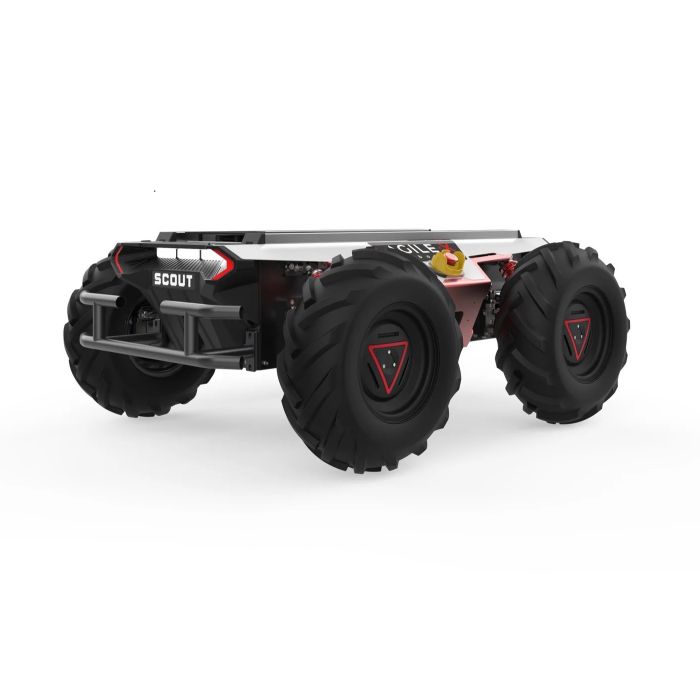
In stock
- BRAND:
- AGILEX
- PART #:
- SCOUT 2.0
- ORIGIN:
- China
- AVAILABILITY:
- SUBJECT TO AVAILABILITY
- SKU:
- AgileX-SCOUT-2.0
Agilex SCOUT 2.0
Every robotics laboratory has a bench where the real work happens: sensor calibration, parameter tuning, the code that almost works. The difficulty is taking that bench outdoors. The Agilex SCOUT 2.0 is, in effect, that bench on four wheels. It is an unmanned ground vehicle designed for robotics research and development, with a suspension built to keep instruments steady over broken ground and an open software interface that lets your own algorithms take control. It carries CE certification, and its purpose is clear: to let a team stop building chassis and start testing ideas in the environments where those ideas will eventually have to work.
Robots Middle East supplies the Agilex SCOUT 2.0 to universities, research institutes, government laboratories and engineering companies across the Middle East. Our team prepares each quotation around your configuration, whether the standard battery or the larger option, and the level of protection your site requires. Robots Middle East then arranges delivery to your facility and continues to support you once the vehicle is in service.
Background
AgileX and its family of mobile platforms
AgileX builds mobile robot chassis intended as foundations for other people's work rather than as finished, single-purpose machines. The idea behind such platforms is well established in robotics: a research group gains far more from a dependable, well-documented base than from a closed product that solves one problem and resists every modification. The SCOUT 2.0 sits within a wider range that also includes platforms such as the Agilex BUNKER MINI 2.0 and the Agilex BUNKER PRO 2.0, together with development kits for manipulation and autonomy. The full line-up is available in the AgileX range.
Suspension, cooling and an open interface
Three design choices define the SCOUT 2.0. The first is its double-wishbone suspension with shock absorbers, which keeps the body stable on rough terrain and allows the vehicle to climb obstacles up to 10cm tall. The second is a circulating cooling system that combines internal and external circulation, intended for all-weather operation and for high-intensity, high-temperature environments. The third is openness: the master control provides a serial port and a standard CAN bus as its communication interface, and AgileX supplies an open-source SDK and a ROS_PACKAGE. Aluminium T-slot rails along the body give a secure mounting surface for external sensors and kits, so a LiDAR, a camera mast or a computing enclosure can be fitted without drilling into the chassis.
Technical Specifications
| Specification | Value |
|---|---|
| Product type | Unmanned ground vehicle (UGV) for robotics research and development |
| Certification | CE |
| Drive | Four-wheeled, differential drive |
| Motors | 400W brushless servo motors |
| Rated payload | Up to 50kg (110lb) |
| Speed (manufacturer page headline) | 1.67 m/s |
| Maximum speed (Trossen documentation) | 1.5m/s (3.3mph) |
| Obstacle height | Up to 10cm |
| Wheelbase | 498mm |
| Minimum ground clearance | 135mm |
| Suspension | Double-wishbone with shock absorbers |
| Battery (standard) | 24V / 30Ah |
| Battery (optional) | 60Ah |
| Ingress protection | IP22 as standard; customisable to IP44 / IP64 |
| Operating temperature | 0°C to 40°C |
| Cooling | Circulating system combining internal and external circulation |
| Communication interface | Serial port / standard CAN bus |
| Software | Open-source SDK, ROS_PACKAGE |
| Mounting | Aluminium T-slot rails for external sensors or kits |
| In the box | 1x Scout 2.0 Robot Body; 1x Battery Charger (AC 220V); 1x Aviation Plug (male, 4-pin); 1x Remote Control Transmitter (optional); 1x USB to CAN communication module |
Specifications are as published by the manufacturer and are confirmed against the datasheet at quotation.
The manufacturer has not published the onboard sensors, the remote control range, the total power consumption, a service life independent of the warranty, or which ingress rating applies to each optional upgrade; these points are confirmed at quotation.
What do the 60Ah battery and the IP44 / IP64 options change?
The SCOUT 2.0 is offered in three configurations: the standard vehicle with its 24V / 30Ah battery, a version fitted with the optional 60Ah battery, and a version customised for IP44 or IP64 protection. None of these changes the vehicle's character. The suspension, the interfaces and the mounting rails remain the same; what changes is how long the vehicle can work between charges and how much exposure it can tolerate.
The larger battery matters to teams whose experiments are long rather than fast. Mapping a campus, repeating a navigation trial dozens of times or running an endurance test of a perception stack all reward the extra capacity. The higher protection levels matter where the environment is less forgiving than a car park or a corridor: dust, spray and outdoor exposure are exactly the conditions in which the IP22 standard rating may be insufficient. Because the manufacturer does not specify which rating applies to each upgrade, Robots Middle East confirms the exact protection level of your configuration in writing with the quotation.
How does SCOUT 2.0 handle rough ground and heat?
A research vehicle that bounces its sensors around produces noisy data, and noisy data produces misleading results. The double-wishbone suspension with shock absorbers addresses this directly, keeping the body level enough for cameras and LiDAR to deliver usable readings while the wheels deal with kerbs, gravel and uneven paving. With 135mm of minimum ground clearance and the ability to climb obstacles up to 10cm tall, the vehicle can leave the laboratory floor without leaving its payload behind.
Heat is the other practical question in this region. The circulating cooling system is designed for high-intensity and high-temperature work, and the published operating temperature range is 0°C to 40°C. Teams planning summer field trials should therefore schedule outdoor sessions within that range, and our engineers are glad to discuss test planning when preparing your quotation.
On speed, the manufacturer's page gives 1.67 m/s as its headline figure, while the Trossen documentation rates the maximum speed at 1.5m/s (3.3mph) with a payload of up to 50kg. Either figure is ample for research work, where repeatable, controlled motion counts for more than outright pace.
Who is Agilex SCOUT 2.0 for?
The SCOUT 2.0 is built first and foremost for university research groups working on autonomy, perception and mobile manipulation. It gives postgraduate students and faculty a shared platform on which successive projects can build, rather than a new chassis for every thesis. Its open-source SDK and ROS_PACKAGE mean that existing ROS skills transfer directly.
It also suits corporate and government research and development teams that need to prototype an outdoor application, such as inspection, security patrol or site logistics, before committing to a production design. Systems integrators benefit from the CAN bus and serial interfaces, which allow the vehicle to be integrated into larger architectures, and from the T-slot rails, which make it straightforward to change the sensor arrangement between customers.
Within the SCOUT 2.0 itself, teams running long data-collection sessions are better served by the optional 60Ah battery, while those working in dusty or wet conditions should specify the IP44 / IP64 customisation. Buyers whose application calls for a different type of mobility can compare the other platforms in the AgileX range.
What is Agilex SCOUT 2.0 used for?
- Autonomous navigation research: testing path planning and obstacle avoidance on real terrain rather than in simulation alone.
- SLAM and sensor fusion: carrying LiDAR, cameras and inertial sensors on the T-slot rails to build and compare mapping pipelines.
- Teaching robotics and ROS: giving students hands-on experience with a vehicle that speaks the same software language as their coursework.
- Inspection prototyping: developing patrol and monitoring routines for industrial sites, facilities and infrastructure.
- Logistics trials: evaluating last-metre delivery and material transport concepts with a realistic payload on board.
- Outdoor field experiments: collecting datasets in agricultural, campus or urban settings where a stable sensor platform is essential.
Pricing and Availability
The Agilex SCOUT 2.0 is supplied on quotation, because the right offer depends on your configuration: the battery option, the protection level, the optional remote control transmitter and any integration work your project requires. Robots Middle East reviews your application and prepares a written quotation that sets out exactly what is supplied. Delivery, customs clearance and after-sales support are arranged together with your quotation. To begin, please send your requirements through the quotation request available on this page.
Frequently Asked Questions
Is the Agilex SCOUT 2.0 compatible with ROS?
Yes. AgileX provides an open-source SDK and a ROS_PACKAGE, and the master control communicates over a serial port or a standard CAN bus.
How much can the SCOUT 2.0 carry?
The Trossen documentation rates the SCOUT 2.0 to carry up to 50kg (110lb), driven by its 400W brushless servo motors.
Which battery options are available?
The vehicle is supplied with a 24V / 30Ah battery as standard, and an optional 60Ah battery is available for longer operating sessions.
Can the SCOUT 2.0 work outdoors in dusty conditions?
The standard ingress rating is IP22, and the vehicle can be customised up to IP44 and IP64. The exact rating of each upgraded configuration is confirmed in your quotation.
How do I mount my own sensors?
The body carries aluminium T-slot rails designed for the secure mounting of external sensors or kits, so equipment can be fitted and repositioned without modifying the chassis.
What is included in the box?
The package contains the Scout 2.0 robot body, a battery charger (AC 220V), a male 4-pin aviation plug and a USB to CAN communication module, with a remote control transmitter available as an option.
Where can I buy the Agilex SCOUT 2.0 and what does it cost?
You can obtain the SCOUT 2.0 from Robots Middle East, which supplies it across the Middle East. The cost depends on the configuration you choose, so we provide a tailored quotation on request.
Summary
The value of a research platform lies in how faithfully it carries the laboratory's work into the real world. The Agilex SCOUT 2.0 does this through stable double-wishbone suspension, a cooling system designed for demanding conditions, open CAN bus and serial interfaces with ROS support, and mounting rails that accept whatever your project requires. With a choice of battery capacity and protection level, it can be matched to a campus pilot or to a harsher field trial. For teams ready to move their bench outdoors, with Robots Middle East handling supply, delivery and support, this page is the starting point.