
Astribot S1 Wheeled Humanoid Robot
In stock
- BRAND:
- ASTRIBOT
- PART #:
- S1
- ORIGIN:
- China
- AVAILABILITY:
- SUBJECT TO AVAILABILITY
- SKU:
- Astribot-S1
Astribot S1 Wheeled Humanoid Robot
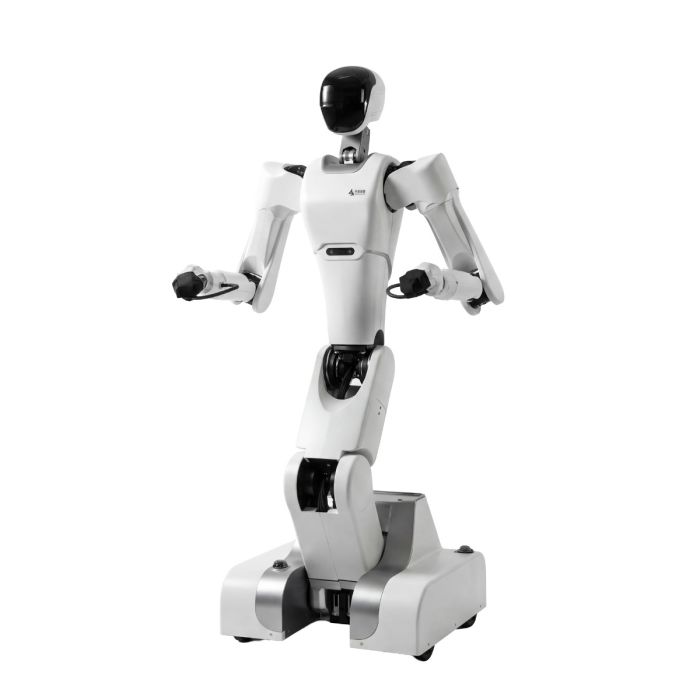
In robot learning, the algorithm is seldom the hardest part. The hardest part is the body that gathers the demonstrations and must then reproduce them, because a model trained on clumsy, partial or poorly sensed examples will itself be clumsy. The Astribot S1 Wheeled Humanoid Robot tackles that problem from the hardware side. It is a wheeled humanoid for AI research and service automation: a dual-arm upper body with a torso and a head, carried on an omnidirectional mobile chassis, with VR-based whole-body motion data collection built into the platform. The machine that records a task is the same machine that is asked to repeat it, at human scale and across a room rather than at a fixed bench.
Robots Middle East supplies the Astribot S1 to universities, research centres, technology integrators and corporate innovation teams across the Middle East. Our team prepares each quotation, coordinates delivery to your site and remains your point of contact for support after installation. Your laboratory can therefore concentrate on its research programme and leave the logistics to us.
Background
ASTRIBOT and the S1 platform
ASTRIBOT presents the S1 as a general platform, not a single-purpose machine. Its design brief covers research, AI development, service robotics, human-robot interaction and advanced automation scenarios that need two-arm manipulation together with autonomous mobility. That breadth is deliberate. Embodied AI work tends to move between the laboratory and real premises, and a platform that serves both settings reduces the number of systems a team must learn, integrate and maintain. In the wider humanoid field, many machines are built to show one capability well. The S1 is built so that a research group can keep using it as its questions change: first manipulation, then mobility, then the combination of the two.
Whole-body motion data and teleoperation
The feature that defines the S1 is its support for VR-based whole-body motion data collection, used both for training and for teleoperation. In practice, an operator in virtual reality guides the robot through a task, and the robot's whole-body motion is captured as training data. The same channel allows a remote operator to take direct control when a task is new, unusual or sensitive. For teams building imitation-learning or policy-learning pipelines, this places data gathering and deployment on one platform. The demonstrations are recorded on the same kinematics that will later execute the learned behaviour, which removes a whole class of transfer problems between a human demonstrator and a robot body.
Technical Specifications
| Specification | Value |
|---|---|
| Product type | Wheeled humanoid robot for AI research and service automation |
| Total degrees of freedom | 23 |
| Arms | Dual-arm architecture, 7 DOF per arm |
| Torso | 4 DOF |
| Head | 2 DOF |
| Mobile base | Chassis with omnidirectional movement |
| Continuous payload | 5 kg per arm |
| End-effector speed | Exceeding 10 m/s |
| End-effector acceleration | Above 100 m/s² |
| Sensors | RGB-D cameras, stereo vision cameras, dual LiDAR systems |
| Data collection | VR-based whole-body motion data collection for training and teleoperation |
| Height | 170 cm |
| Weight | 80 kg |
| Runtime | 4–6 hours |
Specifications are as published by the manufacturer and are confirmed against the datasheet at quotation.
The manufacturer has not published the battery capacity, the charging time, the connectivity, the IP rating, the onboard compute or the contents of the box; Robots Middle East confirms these at quotation.
What makes the Astribot S1 different from a fixed dual-arm workstation?
A pair of arms bolted to a bench is an excellent tool for studying grasping, but the world it can reach ends at the edge of the table. The S1 takes the same bimanual capability, two arms of 7 DOF each, and adds a 4 DOF torso, a 2 DOF head and a chassis with omnidirectional movement. The result is a body of 23 degrees of freedom that can reposition itself to suit the task, rather than requiring the task to be brought to it.
Scale matters as well. At 170 cm tall, the S1 is sized for spaces designed around people: counters, shelves, desks and doorways. Research carried out on it therefore transfers more directly to the offices, laboratories and service environments where such robots are ultimately expected to work. The torso adds reach and posture, so the robot can lean, turn and bring its hands to working height instead of relying on the arms alone.
The dynamic figures point to a further difference. The S1 reaches end-effector speeds exceeding 10 m/s and accelerations above 100 m/s², with a continuous payload of 5 kg per arm. Many research arms are deliberately slow. A platform with this dynamic range lets researchers explore fast, fluid motions as well as careful ones, which widens the set of tasks a learned policy can attempt.
How do the S1's sensors and data tools support robot learning?
Perception on the S1 comes from an integrated sensor suite of RGB-D cameras, stereo vision cameras and dual LiDAR systems, which together provide environmental perception and object interaction. In general terms, RGB-D cameras pair colour images with depth, stereo cameras give a second route to three-dimensional vision, and LiDAR maps the surroundings, which is valuable for a robot that moves through a room. Combining these sensor types gives a learning system several views of the same scene.
Coupled with VR-based whole-body motion data collection, the sensors turn every demonstration into a rich record: what the robot saw, and how its whole body moved in response. For a team assembling datasets for embodied AI, that pairing of perception and motion is the raw material of the work. Teleoperation through the same VR channel also lets a team intervene, correct and re-record, so that a dataset improves steadily rather than being collected once and frozen.
Who is the Astribot S1 for?
The first audience is academic: university laboratories and national research centres working on embodied AI, robot learning and mobile manipulation, for whom a human-scale platform with built-in data collection shortens the path from idea to experiment. The second is corporate research and development, where AI teams need a physical body on which to test models that will later inform products. Developers of service robotics form a third group, using the S1 to prototype tasks in offices, hospitality settings or public buildings before committing to a dedicated design. Researchers in human-robot interaction will value a body with an articulated head and torso, and system integrators can use it to run advanced automation pilots for clients.
Not every project needs the mobile chassis. Where the work is centred on bimanual manipulation at a fixed station, the Astribot S1-U Upper Body Humanoid Robot (S1-U) may suit the brief, and the Astribot T1 Wheeled Humanoid Robot is a further option to compare; our team can set out the differences against your requirements. The wider range is presented in our Wheeled Humanoids and Humanoids categories.
What is the Astribot S1 used for?
- Embodied AI research – testing how learned models perceive, plan and act in a full human-scale body.
- Demonstration datasets – recording VR-guided whole-body motion as training data for imitation and policy learning.
- Teleoperation – controlling the robot remotely through VR for tasks that are new, delicate or not yet automated.
- Service robotics prototyping – trialling fetching, handling and tidying tasks in offices, laboratories and public premises.
- Human-robot interaction studies – examining how people respond to a mobile humanoid with an articulated head and torso.
- Advanced automation pilots – evaluating two-arm manipulation combined with autonomous mobility before a wider deployment.
Pricing and Availability
Robots Middle East supplies the Astribot S1 on quotation, prepared for the configuration and the destination of your project. Delivery, customs clearance and after-sales support are arranged together with the quotation. We would be grateful for a short outline of your intended application, so that we can advise on the right setup, and the request for a quotation is available on this page.
Frequently Asked Questions
How many degrees of freedom does the Astribot S1 have?
The S1 has 23 total degrees of freedom, including 7 DOF per arm, a 4 DOF torso and a 2 DOF head, mounted on a mobile chassis with omnidirectional movement.
How much can each arm carry?
Each arm supports a continuous payload of 5 kg.
How long does the Astribot S1 run?
The S1 runs for 4–6 hours. Battery capacity and charging time are among the open items listed beneath the specification table.
Which sensors does the S1 use?
It carries RGB-D cameras, stereo vision cameras and dual LiDAR systems, which together provide environmental perception and support object interaction.
Can the Astribot S1 be operated remotely?
Yes. The platform supports VR-based whole-body motion data collection for training and teleoperation, so an operator can guide the robot remotely and record the motion as training data.
Is the S1 suitable for harsh or outdoor environments?
The S1 is designed for research, AI development, service robotics, human-robot interaction and advanced automation, and the IP rating is among the open items listed beneath the specification table. If your site involves dust, moisture or outdoor operation, please discuss it with our team before ordering.
Where can I buy the Astribot S1 and what does it cost?
The Astribot S1 is available from Robots Middle East across the Middle East. Pricing is provided on request, with delivery, customs and support arranged as part of the same offer.
Summary
Good robot learning begins with good demonstrations, and good demonstrations need a capable body. The Astribot S1 Wheeled Humanoid Robot supplies that body: 23 degrees of freedom across two 7 DOF arms, a torso and a head, an omnidirectional chassis, a sensor suite of RGB-D, stereo and dual LiDAR, and VR-based whole-body data collection that links recording to execution. For research groups, corporate AI teams and service robotics developers in the region who want one platform on which to gather data, train and test, supplied and supported by Robots Middle East, this page is the starting point.